
Granby businesses can use equipment financing to spread the cost of essential commercial assets while protecting working capital. Financing may be available for manufacturing and production machinery, commercial vehicles, construction equipment, material-handling assets, food-processing equipment, agricultural equipment, and other business-use purchases.
Granby is an equipment-intensive business market shaped by manufacturers, specialized suppliers and service providers. Financing can help a company spread a machinery purchase over its productive life while keeping operating cash available for materials, labour, repairs and growth. The credit decision still hinges on whether the company can afford the payments and whether the asset is suitable security for the requested terms.
The local industrial mix is specific. Granby Industriel identifies aeronautics and specialty vehicles as industrial strengths, alongside food processing and hydroelectric engineering. Its industry directory also shows metal products, plastics, machinery and transport suppliers. That context suggests several distinct financing situations: a precision shop acquiring a CNC mill, a specialty-vehicle builder adding fabrication equipment, a food processor upgrading packaging or a subcontractor buying a forklift. These are market illustrations, not claims about Mehmi transactions in Granby.
When buying or refinancing business assets in Granby, compare the structure and total ownership cost—not just the monthly payment. Availability and terms depend on equipment, business credit, cash flow and individual lenders.
| Equipment funding need | Option to compare | What to verify |
|---|---|---|
| Purchasing eligible manufacturing machinery | Equipment loan or conditional sale | Equipment value, term, interest calculation, down payment, collateral, title and early-payout terms. |
| Using equipment while managing initial cash outlay | Equipment lease | Payment schedule, deposits, insurance, end-of-term purchase options, return conditions and total cost. |
| Purchasing from a used-equipment dealer or private seller | Used-equipment financing | Asset age, hours or mileage, inspection, seller verification, lien search and any lender limits. |
| Unlocking equity in owned machinery or vehicles | Equipment refinancing or sale-leaseback | Appraised value, current liens, payout amounts, advance against value, fees and continuing use of the asset. |
| Buying multiple assets or upgrading in stages | Equipment financing facility or separate leases | Each asset's eligibility, draw timing, security, documentation, amortization and combined payment burden. |
Next step: Compare equipment loans, leases and refinancing before requesting indicative terms. Examples above are educational, not offers or approvals.
Aeronautics and precision machining. Machine shops supplying demanding parts may use five-axis CNC equipment, milling machines, coordinate-measuring machines, tooling, surface finishing systems and quality-control equipment. For custom-built machinery, the lender may need supplier credentials, commissioning dates, installation costs and a clear explanation of the limited or broad resale market. A specialized machine can be highly productive but less liquid than an ordinary commercial truck.
Specialty vehicles and fabrication. Businesses making components for specialty vehicles may need metal-cutting equipment, robotic welding cells, presses, lifts, shop compressors and material handling systems. For equipment related to road transport itself, use a separate truck and trailer financing comparison because age, kilometres, registration and maintenance can change how a lender evaluates the collateral.
Food processing and distribution. Granby Industriel identifies dairy and confectionery among regional food-processing activities. Refrigeration, packaging lines, mixers, conveyors, cold-storage systems and forklifts are possible equipment projects. Food operators should separate fixed production machinery from consumable inventory and plan for maintenance, temperature controls and any necessary installation. For volatile purchase cycles, lenders may review revenue across several months rather than a single period.
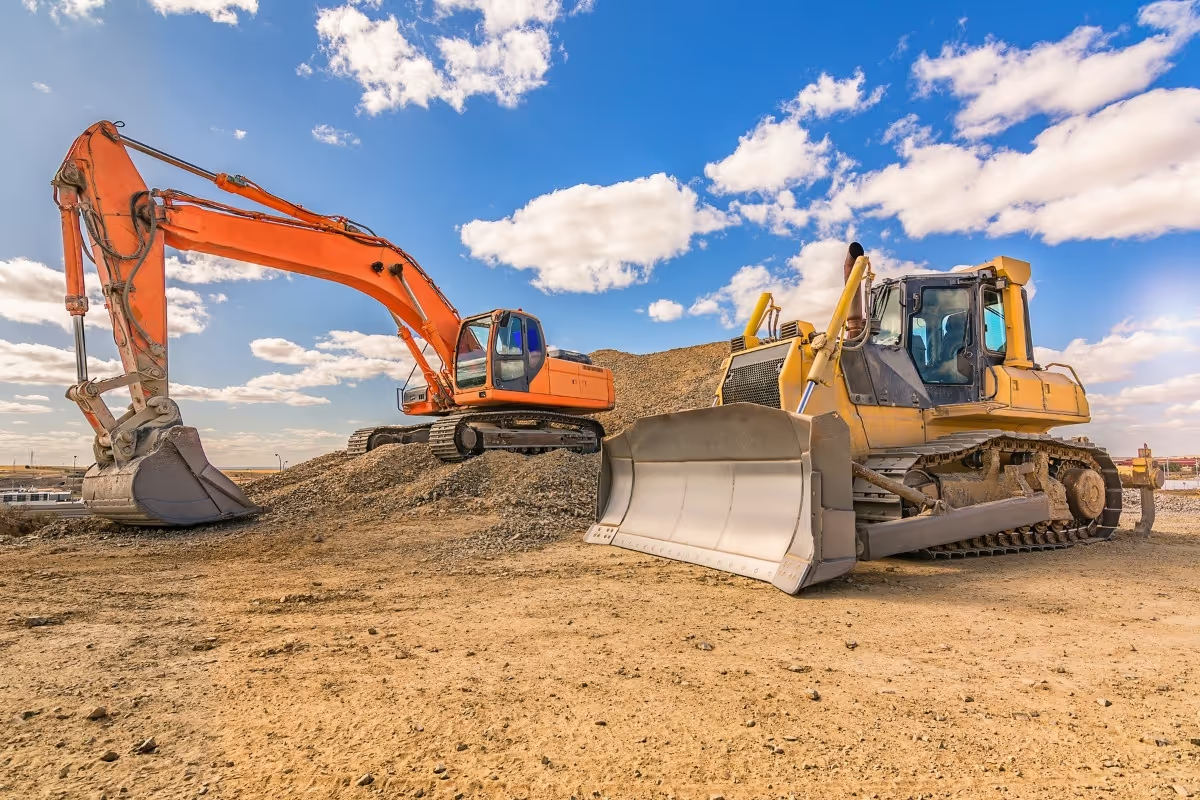
Hydroelectric engineering, metal products and construction. Design or fabrication companies may finance cutting, lifting and measuring assets, while contractors may need excavators, skid steers, trailers or service bodies. The heavy equipment financing guide explains why hours, model, attachments and practical resale value matter for used yellow iron.
Geography also affects a Granby transaction. Granby Industriel places the industrial park near Route 139 and Autoroute 10; shipping a production machine from outside Québec adds freight, crating, rigging, vendor verification and commissioning considerations. A borrower should document where equipment will physically be stored and used, particularly for assets that can move between provinces.
An equipment loan may fit an owner focused on buying an asset and repaying principal on a clear schedule. An equipment lease can match payments with machine use and may contain an end-of-term buyout or other residual arrangement. Some leases involve a different ownership or tax treatment. Ask the lender to explain exactly what happens at maturity, which fees apply and whether early payout is permitted.
If an operating business already owns eligible unencumbered assets, refinancing and sale-leaseback may be worth comparing. The lender first needs proof of ownership and an acceptable value. Financing against existing equipment is not a guarantee of unrestricted working capital: other lienholders, fees and payout obligations can materially reduce net proceeds.
Term length, down payment and pricing vary by borrower and asset. An established business financing widely traded equipment may qualify for a different structure than a young firm buying highly customized production machinery. A longer payment schedule often lowers the periodic obligation while increasing the total cost or leaving an end-of-term balance. Consider realistic machine useful life before stretching amortization to lower a headline payment.
Character and ownership. Underwriters may review the owners' credit histories, payment record, business registration and ownership structure. In a bilingual operating environment, use consistent legal business names in English or French documents. If a translated quote differs from the registered invoice, clarify the discrepancy before it becomes a funding condition.
Capacity and seasonality. Lenders evaluate whether the company can carry the payment after payroll, rent, materials, taxes and existing debt. For a Granby shop supporting aerospace or specialty vehicle production, purchase orders and recurring customer relationships can help contextualize the forecast. Forecasts are supporting evidence, not a substitute for actual deposits and financial statements.
Capital and security. A cash contribution, existing machinery equity or appropriate guarantee can influence risk. A lender may register security against identifiable equipment and require satisfactory insurance. Used machines usually call for year, make, model, serial number, hours, condition, seller verification and possibly an appraisal or inspection.
Transaction integrity. For a private sale or cross-border acquisition, verify the vendor, invoicing entity, title, foreign currency exposure, freight, taxes and payment instructions. Lenders may ask for a lien search, proof of payout of existing security and delivery confirmation. A machine can be technically financeable yet fail because title cannot be confirmed.
A $100,000 machine purchase is rarely only the invoice. A precision CNC cell may need measuring tools, software, electrical work, toolholders, safety guarding and staff training. An industrial refrigeration unit may require site preparation, installation and building modifications. Present a line-item cost breakdown and ask which items are eligible financing costs. Money reserved for installation and operating ramp-up is often as important as money reserved for the deposit.
Hypothetical illustration (not a funded deal): a specialty-vehicle supplier in Granby budgets $180,000 for two fabrication machines and another $25,000 for setup and training. The actual project is $205,000 before applicable taxes; the lender may consider only eligible hard equipment or a subset of installation costs. The borrower would need to fund any difference and show that incremental output can support payments. This is not an approval example, indicative rate or customer testimonial.
Granby businesses should compare the cash impact of GST and Québec Sales Tax, especially under leases. Revenu Québec explains that longer-term leases of tangible personal property are treated as a series of transactions and that the property's usual location can affect where tax applies. This matters if a mobile machine moves between Québec and Ontario during a lease.
Input tax credits and input tax refunds may be available to eligible registrants for commercial business costs, subject to the detailed rules. Your accountant should review deductions and tax treatment under the proposed financing structure. Do not assume an entire tax amount is recoverable or that a leased asset and purchased asset receive identical treatment.
Eligible smaller businesses may also explore Canada's Small Business Financing Program through participating lenders. This separate program has qualifying limits, definitions and lender discretion and should not be confused with a commercial leasing offer.
Scenario 1 — precision aerospace subcontractor. A machining shop buys a higher-tolerance CNC unit to serve its existing contracts. Before applying, it should show the technical specification, project cost, tooling requirements, current sales, customer commitments and projected output. The lender still needs evidence the company can make payments if the ramp-up takes longer than anticipated.
Scenario 2 — dairy and confectionery production. A food producer replaces packaging machinery to reduce downtime. Maintenance history, production bottlenecks, the vendor service agreement and realistic waste-reduction assumptions can help explain the investment. The finance term should not outlast the equipment's expected economically useful period without a reason.
Scenario 3 — specialty vehicle fabricator. A fabricator adds welding and lifting machinery to satisfy orders. The borrower should distinguish a signed order backlog from possible future business and include safety, insurance and installation costs. A lender may want to know whether the machine has value outside this one specialty use.
All three scenarios are educational and invented for comparison. They do not depict actual funded Mehmi files or local clients.
Start with the equipment specification and project budget, then compare total financing cost and ownership terms. Test payments using the equipment financing calculator as a hypothetical tool, and contact Mehmi Financial Group to discuss your profile. Any funding decision remains subject to lender review and conditions.
For nearby markets, review Saint-Hyacinthe, Sherbrooke and Longueuil equipment financing pages. Return to the 94-city financing directory for other Canadian markets. Read Mehmi's editorial standards and commercial finance specialist background.
Content updated October 17, 2026. Informational only; no stated payment, rate or lender approval is guaranteed and no local branch is implied.
Potentially. Lenders consider repayment capacity, machine details, credit profile, age, supplier documentation and collateral value.
Some lenders finance suitable used assets. Equipment condition, hours, title, lien status, valuation and seller identity can change eligibility.
Some do, while others use residual or return provisions. Confirm in the proposed contract before signing.
Location and timing of lease periods can affect tax application. Revenu Québec provides the rules. Seek tax advice specific to your business.
Yes. Confirm whether the invoice and financing are in CAD or another currency, and budget exchange, delivery, brokerage and duties where applicable.
Some files may qualify with additional equity, supporting contracts, reliable owner credit or stronger security. No approval is assured.
Requirements vary by lender, business strength, loan or lease type and the machine's resale value. There is no universal zero-down guarantee.
Sometimes; it depends on the lender and cost category. Show hard equipment and ancillary costs separately.
Seller identity, ownership evidence, serial numbers, photos, lien checks, bill of sale and acceptable valuation may be required.

.svg)