
This page covers equipment financing in Saint John, New Brunswick — who qualifies, what structures are available, how approvals work, and what local businesses need to know before applying. Saint John is New Brunswick's largest city and economic engine, home to the Irving Oil refinery (the largest refinery in Canada east of Alberta), the Port of Saint John container and bulk terminal, a significant forestry and industrial manufacturing base, and construction and service sectors serving both the urban population and the industrial complex. Its position on the Bay of Fundy at the mouth of the Saint John River and along the Trans-Canada Highway makes it both a major Atlantic port and a critical freight corridor. Approval and funding timelines vary by lender, application completeness, and required conditions.
Saint John is a city built around industry. The Irving Oil refinery on Bayshore Drive processes over 320,000 barrels per day — making it the largest refinery in Canada east of Alberta — and the network of Irving-linked industrial and commercial businesses that cluster around it represents the dominant private employer base in New Brunswick. The Port of Saint John handles container, bulk, and break-bulk cargo year-round, supported by the port's deep-water access that the Bay of Fundy's 7.5-metre tidal range uniquely enables. And the city's position on Highway 1 — the Trans-Canada east from Fredericton and the gateway to the Fundy coast — anchors transportation and logistics operations that connect New Brunswick to Nova Scotia, the ferry links to Newfoundland, and the US border at St. Stephen.
Approval and funding timelines vary by lender, application completeness, and required conditions. Whether you're an industrial maintenance contractor serving the Irving Oil refinery or J.D. Irving's operations, a construction company building in the Millidgeville, East Saint John, or Rothesay corridor, a forestry operator in the New Brunswick Crown licence areas north of the city, a carrier running Highway 1 freight east to Amherst and west toward Fredericton, or a healthcare business serving Saint John's regional catchment, Mehmi structures financing around how Atlantic Canada's industrial economy actually operates.
Equipment can be sourced from Saint John and New Brunswick dealers, from the broader Atlantic Canada market, private sellers, or auctions. High-hour and older units qualify regularly when they continue generating stable revenue and are properly documented.
Use the equipment payment calculator to model monthly payments before you apply.
When buying or refinancing business assets in Saint John, compare the structure and total ownership cost—not just the monthly payment. Availability and terms depend on equipment, business credit, cash flow and individual lenders.
| Equipment funding need | Option to compare | What to verify |
|---|---|---|
| Purchasing eligible construction machinery | Equipment loan or conditional sale | Equipment value, term, interest calculation, down payment, collateral, title and early-payout terms. |
| Using equipment while managing initial cash outlay | Equipment lease | Payment schedule, deposits, insurance, end-of-term purchase options, return conditions and total cost. |
| Purchasing from a used-equipment dealer or private seller | Used-equipment financing | Asset age, hours or mileage, inspection, seller verification, lien search and any lender limits. |
| Unlocking equity in owned machinery or vehicles | Equipment refinancing or sale-leaseback | Appraised value, current liens, payout amounts, advance against value, fees and continuing use of the asset. |
| Buying multiple assets or upgrading in stages | Equipment financing facility or separate leases | Each asset's eligibility, draw timing, security, documentation, amortization and combined payment burden. |
Next step: Compare equipment loans, leases and refinancing before requesting indicative terms. Examples above are educational, not offers or approvals.
Saint John's economy creates financing patterns shaped directly by the Irving industrial ecosystem and the Port's operational demands.
Industrial maintenance and service contractors working for Irving Oil, J.D. Irving Limited, and the broader Irving-linked industrial complex — maintenance firms, pipefitters, welders, hydrovac operators, scaffold companies, and industrial cleaning services — have revenue tied to planned turnaround schedules at the refinery and contracted maintenance windows at the East Point Energy Centre and other industrial facilities. Like Sarnia's Chemical Valley, Saint John's refinery complex generates large lump-sum contract invoices around planned outages rather than steady daily deposits. Contract documentation from named Irving entities is powerful capacity evidence that transforms how bank statements are read by underwriters unfamiliar with the sector.
Construction contractors active on Saint John's residential and commercial development — the Millidgeville and East Saint John growth corridors, the Uptown Saint John revitalization zone, and commercial development along Rothesay Avenue and the McAllister Drive commercial strip — work through a construction season that Atlantic weather and ground conditions compress meaningfully compared to Ontario or Alberta.
Forestry contractors operating under New Brunswick Crown licence allocations — harvesting softwood and hardwood timber across the province for J.D. Irving's woodlands division, AV Group, and other New Brunswick forestry operators — run harvesters, forwarders, feller bunchers, and skidders under supply agreements that define the revenue picture for these files.
Carriers running Highway 1 — the Trans-Canada east through Sussex and Moncton toward Amherst and Nova Scotia, and west through Fredericton toward Quebec — handle agricultural, manufacturing, and industrial freight that keeps Atlantic Canada's supply chains moving. Truck and trailer financing that works on freight contract timelines is essential here.
For operators who want full ownership from day one, equipment loans provide a clear path — fixed payments, equity build, and refinancing options when working capital is needed.
Lenders assess five core factors — character, capacity, capital, collateral, and conditions — and the strength of your file across all five determines what gets approved, on what terms, and at what rate.
Character is your business track record. Years in operation, commercial bureau history, and whether bank statements reflect consistent, well-managed cash flow. Documentation requirements vary by lender, transaction size, business history, and credit profile. Saint John's industrial contractor community is heavily owner-operated — a personal guarantee and a clear personal net worth statement are standard on most deals.
Capacity is whether your revenue supports the proposed payment. For Irving refinery maintenance contractors, a contract, scope letter, or purchase order from an Irving entity — Irving Oil, J.D. Irving, or a recognized Irving subsidiary — provides capacity context that changes how irregular deposit patterns are read. Include it with every initial submission. For forestry operators, a Crown licence allocation and mill purchase order from a named operator performs the same function.
Capital is your equity position. Down payments vary by risk profile and asset type. The required contribution varies by lender, asset, business profile, and transaction.
Collateral is the asset itself. Construction iron has an active Atlantic Canada secondary market. Forestry equipment has a strong New Brunswick and Maritime secondary market. Industrial service vehicles — hydrovac trucks, vacuum tankers, welding rigs — are well-established assets in Atlantic Canada's industrial service economy.
Conditions cover the deal structure — term length, payment structure, advance amount, and documentation requirements. Files over $250,000 may require financial statements. Files over $500,000 typically need three years of accountant-prepared statements plus interim financials.
Thresholds above reflect typical patterns across Mehmi's financing programs. Requirements vary by program and file.
Equipment loans — Full ownership from day one. Fixed payments, equity build, and the asset on your balance sheet. Best for long-lived industrial service and construction assets Saint John businesses plan to keep.
Equipment leasing — Lower upfront cost with end-of-term flexibility — return, renew, or purchase. New Brunswick applies 15% HST on lease payments and purchases — confirm ITC recovery timing with your accountant.
Conditional sales contracts — Fixed payments with a nominal buyout at the end. A common ownership path for commercial vehicles, forestry equipment, and construction iron across Atlantic Canada.
Truck and trailer financing — For Saint John carriers running Highway 1 east toward Moncton and Amherst, west toward Fredericton and Quebec, and local distribution serving the Port of Saint John and Irving industrial complex.
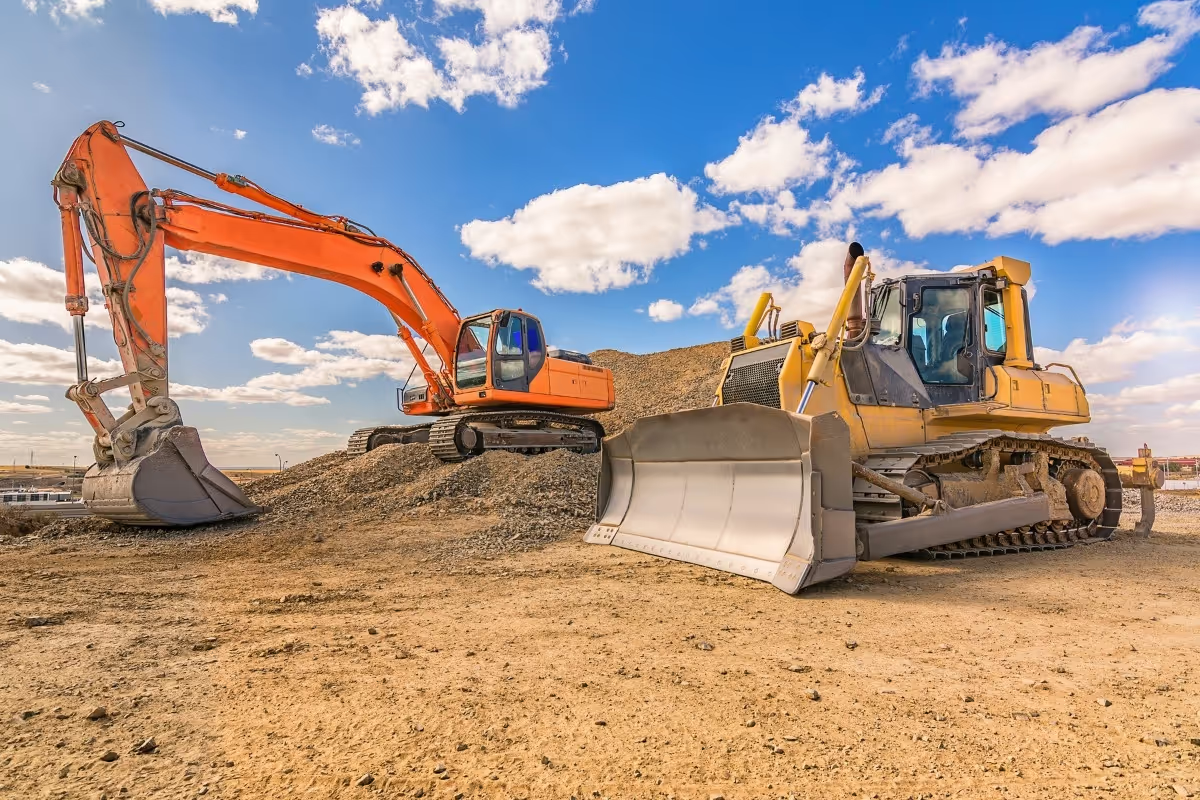
Heavy equipment financing — Excavators, cranes, compactors, motor graders, and large construction and industrial assets for projects across Saint John and the greater Saint John-Rothesay corridor.
Refinancing and sale-leaseback — Converts equity in owned equipment into working capital without requiring a sale. Supported on qualifying hard assets up to a reasonable percentage of current market value. Useful for Saint John industrial contractors who have built equity across multiple refinery maintenance cycles.
Asset-based lending — For larger capital requirements backed by a portfolio of equipment or receivables. Common for mid-size industrial service and construction operations with significant asset bases and recurring contract revenue.
Equipment line of credit — A revolving draw facility for businesses financing equipment on a recurring basis — useful for contractors expanding their capabilities across multiple Irving maintenance cycles or forestry operators cycling assets across harvest blocks.
Invoice and freight factoring — Converts outstanding invoices into immediate working capital. Factoring approval is based primarily on your customers' creditworthiness — not yours — so Credit-review practices vary by factoring provider. Particularly valuable for Saint John industrial contractors managing 30–60 day payment cycles from Irving entities.
Working capital loans — Short-term capital to bridge between contract milestone payments, cover mobilization costs before a refinery turnaround, or manage cash flow during the gap between equipment delivery and first invoice payment.
Review the eligible equipment guide to confirm what asset types qualify before applying.
New Brunswick uses the Harmonized Sales Tax at 15% — the same combined federal-provincial rate as Nova Scotia and Prince Edward Island, and significantly higher than Ontario's 13% HST or Alberta's 5% GST. For most New Brunswick businesses registered for HST, the full amount is recoverable as an input tax credit — but the timing and cash flow implications are real.
On a $300,000 hydrovac truck purchase in New Brunswick, the HST is $45,000 — all recoverable for a registered business, but representing a cash outflow of $45,000 at acquisition that is recovered over the following one to four quarterly filing periods depending on the business's HST filing frequency. An Alberta operator purchasing the same truck pays $15,000 in GST with the same recovery mechanism — a $30,000 difference in cash flow timing.
For Saint John industrial contractors managing tight cash flows between Irving contract milestones and quarterly HST filing periods, this timing difference matters. A business that regularly purchases equipment over $200,000 and files HST quarterly is routinely managing $30,000 to $60,000 in "float" between acquisition and ITC recovery. Understanding whether a lease or loan structure better aligns with your HST filing cycle — and confirming with your accountant — is a real operational decision, not a formality.
The practical advice: on any equipment purchase over $100,000 in New Brunswick, understand your HST recovery timeline before you commit to a structure. The total tax is the same either way, but the cash flow timing can be meaningfully different between a loan (large upfront HST, large upfront ITC recovery) and a lease (HST spread across monthly payments, ITCs recovered incrementally).
The most consistent equipment financing mistake we see with Saint John's industrial maintenance sector mirrors what we see in Sarnia: contractors applying without including their Irving contract documentation, then watching approvals slow down as underwriters try to make sense of bank statements that show large periodic deposits with long quiet stretches between them.
Irving Oil's refinery turnarounds, J.D. Irving's scheduled facility maintenance windows, and the broader Irving industrial complex's planned maintenance cycles are documented events. A contractor with a turnaround scope letter, a Master Service Agreement with Irving Oil, or a purchase order from any J.D. Irving entity holds contracted revenue from one of the largest and most creditworthy private companies in Atlantic Canada — the Irving group is one of Canada's largest privately held conglomerates, and their creditworthiness as a counterparty is as strong as any industrial client in the country.
That contract documentation changes the credit conversation from "explain these irregular deposits" to "how do we structure this to match your contract cash flow" — a much more productive and much faster conversation.
Include Irving contract documentation — in any form, including a one-page scope letter showing client name, project, value, and timing — with every initial submission. Don't wait for the underwriter to ask.
The application-only equipment financing guide up to $500K is a useful reference for understanding what document preparation looks like at different exposure levels.
Illustrative example only; not a statement of a specific funded client transaction.
A Saint John-based industrial hydrovac and vacuum truck contractor had been serving Irving Oil's Bayshore Drive refinery for seven years, operating three trucks. An expanded turnaround scope required five trucks on-site for a six-week maintenance window, with a four-week mobilization deadline.
Two additional hydrovac trucks — one from a Saint John dealer and one from a private seller in Moncton — were identified at a combined cost of $780,000.
The challenge: The dealer unit was straightforward. The private-sale unit added verification steps, and the combined file size exceeded application-only thresholds. Irving Oil's 45-day payment cycle meant the contractor needed financing funded well before the first invoice landed.
How Mehmi structured it: Both files were submitted simultaneously. The dealer unit was structured as an application-only file within the applicable threshold. The private-sale unit included lien search, seller documentation, serial number confirmation, and condition photos from the Moncton seller. Both files were supported by three months of bank statements showing consistent refinery contract deposits and the Irving Oil turnaround scope letter confirming the five-truck requirement, start date, and estimated contract value.
What made it work: The Irving scope letter eliminated any ambiguity about the deposit pattern in the bank statements. The private-sale documentation was complete at submission, removing the most common private-sale delay trigger.
Approval and funding timelines vary by lender, application completeness, and required conditions. Both trucks mobilized before the turnaround start date. The contractor fulfilled the six-week scope on schedule, invoiced Irving Oil for the full program, and was retained for two subsequent turnaround scopes. The invoice and freight factoring facility was noted as a complementary tool for managing Irving's 45-day payment cycle between contract completion and invoice payment.
Saint John's refinery maintenance, port operations, construction, forestry, transportation, and health services economy generates a distinctive equipment financing profile. These are the asset types we see most frequently, each linked to its specific financing page:
Industrial & Refinery Service
Construction & Civil
Forestry
Transportation
Medical & Dental
Natural resources and energy — Industrial maintenance contractors, pipeline operators, and energy sector service businesses serving Irving Oil's Bayshore Drive refinery and the broader J.D. Irving industrial complex. The dominant equipment financing sector in Saint John by transaction value.
Construction and contractors — Residential development in Millidgeville, East Saint John, and Rothesay; commercial and institutional construction across the city; and civil infrastructure projects throughout the Greater Saint John area. See the comprehensive guide to construction equipment financing.
Natural resources and energy (forestry) — Forestry contractors operating under New Brunswick Crown licences, supplying J.D. Irving's woodlands division, AV Group, and other New Brunswick forestry operators.
Transportation and trucking — Highway 1 freight carriers, port supply transport, Irving industrial logistics, and regional distribution businesses connecting New Brunswick to Nova Scotia and Quebec markets.
Manufacturing and wholesale — Industrial fabrication, equipment supply, and manufacturing businesses serving the Irving complex and Greater Saint John's commercial and industrial base.
Medical, dental and wellness — Saint John Regional Hospital anchors the regional health services sector. Clinics, dental practices, and wellness operators across the city access diagnostic and treatment equipment financing.
Hospitality and food service — Restaurants and food service operators across Saint John's Uptown core and commercial corridors access kitchen, refrigeration, and service equipment financing.
Technology and business services — Professional services and technology businesses supporting Irving operations and Saint John's commercial sector, connected to the University of New Brunswick Saint John campus.
Most equipment financing applications require:
For Irving refinery and industrial service files: Irving Oil scope letters, J.D. Irving purchase orders, or MSA documentation should be included with every initial submission. This is the single most important documentation step for Saint John industrial contractors.
Dealer purchases process fastest — application-only files under $250,000 with two to three or more years in business and a clean bureau are reviewed according to lender requirements.
Private-sale purchases require lien search, seller verification, serial number confirmation, and condition photos — fully supported and may require additional lender review even when documentation is ready.
For forestry files: Crown licence allocation and mill purchase order from a named New Brunswick operator are standard supporting documents.
Larger files over $250,000 may require financial statements depending on your profile. Files over $500,000 typically need three years of accountant-prepared statements plus interim financials.
Questions before applying Review the FAQ or explore all financing services to understand every option available.
Ready to get your equipment funded in Saint John? Call us directly at 1-833-863-4644 or apply online to request financing options, subject to lender review.
Related resource: Browse our equipment financing by city directory for more local financing guides.
Q. How fast are equipment financing approvals in Saint John?A. Approval and funding timelines vary by lender, application completeness, and required conditions. Application-only files under $250,000 with two to three or more years in business and a clean bureau are reviewed according to lender requirements — including for industrial service operators when Irving contract documentation is prepared in advance.
Q. Does having a contract with Irving Oil or J.D. Irving help my applicationA. Significantly. Irving entities are among the most creditworthy industrial clients in Atlantic Canada. An Irving Oil turnaround scope letter, a J.D. Irving purchase order, or an MSA from any Irving subsidiary provides capacity evidence that transforms how bank statements with irregular deposit patterns are read by underwriters. Always include it with your initial submission.
Q. My revenue is irregular because it concentrates around Irving turnaround windows. Will lenders flag thisA. Not if you include the right documentation. Turnaround-concentrated revenue is normal for Irving refinery contractors — but bank statements alone don't explain the pattern. The Irving contract documentation does. Without it, what is actually scheduled contract income looks like instability. Include it always.
Q. How does New Brunswick's 15% HST affect my equipment financing decisionA. On a $300,000 purchase, you pay $45,000 in HST — all recoverable as an ITC for registered businesses, but affecting cash flow timing. If you file HST quarterly and have tight cash flows between Irving invoice cycles, the upfront HST on a large purchase may favour a lease structure where HST is spread over monthly payments. Confirm with your accountant which structure better aligns with your filing cycle on transactions over $100,000.
Q. Can I finance equipment sourced from outside New BrunswickA. Yes. Equipment can be sourced from Atlantic Canada dealers, the broader Maritime market, private sellers, or out-of-province. Private-sale purchases require lien search, seller verification, condition photos, and serial number confirmation. Confirm financing eligibility before committing to a purchase.
Q. Can I finance forestry equipment under a New Brunswick Crown licenceA. Yes. Forestry equipment financed against active Crown licence allocations and mill purchase orders follows the same framework as Ontario and Quebec forestry files. Include your licence allocation and mill supply agreement with the application.
Q. Can I refinance equipment I already own in Saint JohnA. Yes. A refinancing or sale-leaseback converts equity in owned equipment into working capital without requiring a sale. Supported on qualifying hard assets up to a reasonable percentage of current market value.
Q. What documents do I need to applyA. For most files: bank statements, government ID, business registration, and an equipment quote or bill of sale. For Irving industrial service files, add scope letter, purchase order, or MSA. For forestry files, add Crown licence allocation and mill purchase order. Files over $250,000 may require financial statements depending on the program and your credit profile.

.svg)