
This page covers equipment financing in Maple Ridge, British Columbia — who qualifies, what structures are available, how approvals work, and what local businesses need to know before applying. Maple Ridge is Metro Vancouver's easternmost major municipality (population 87,000), located 50 kilometres east of Vancouver. It serves as the primary residential and commercial hub for the eastern Metro Vancouver region and the gateway to the Fraser Valley. The city anchors a significant industrial and manufacturing corridor, a thriving residential construction economy serving Metro Vancouver's eastern suburbs, major retail and commercial services corridors, and a growing technology and professional services sector. Approval and funding timelines vary by lender, application completeness, and required conditions. British Columbia applies 7% PST (non-recoverable on equipment purchases); GST (5%) also applies and is recoverable for GST-registered businesses.
Maple Ridge occupies a singular position in Metro Vancouver's geographic and economic landscape. Located 50 kilometres east of downtown Vancouver, it is Metro Vancouver's easternmost major municipality and the primary residential and commercial hub for the entire eastern suburbs region. The city's population of 87,000 has grown substantially over the past two decades, and it continues to serve as the gateway to the Fraser Valley and the eastern expansion corridor for the Lower Mainland.
Maple Ridge's economy is defined by three primary characteristics: residential growth, industrial and manufacturing capacity, and regional services and commerce. The city's position as the eastern edge of Metro Vancouver makes it the location where suburban residential development meets industrial operations serving both the Metro Vancouver region and the Fraser Valley.
The industrial zone in Maple Ridge hosts manufacturing, warehousing, and logistics operations serving the Lower Mainland and Fraser Valley supply chains. The Albion area and the Highway 1 corridor host industrial businesses, manufacturing operations, and trade service companies. Many businesses locate in Maple Ridge specifically because of Lower Mainland access combined with lower real estate costs than central Vancouver or the core GTA.
Maple Ridge's residential growth — particularly in developments along 224th Street, Dewdney Trunk Road, and the Maple Meadows and Silver Valley communities — creates sustained demand for construction equipment, trades services, and residential development contractor capacity.
The city's commercial corridors along Dewdney Trunk Road and 124th Street serve a local population and a regional catchment extending through Pitt Meadows, Haney, Mission, and the Fraser Valley communities.
Approval and funding timelines vary by lender, application completeness, and required conditions. Whether you're a construction contractor managing Maple Ridge's residential development pipeline, a manufacturer or logistics operator in the industrial corridor, a trades business expanding to serve the eastern Metro Vancouver market, a retail or commercial services operator on the major commercial corridors, or a commercial services business serving the region's gateway hub, Mehmi structures financing around how Maple Ridge's economy actually operates.
Equipment can be sourced from Maple Ridge-area, Metro Vancouver, and Canada-wide dealers, private sellers, or auctions. High-hour and older units qualify regularly when they continue generating stable revenue and are properly documented.
Use the equipment payment calculator to model monthly payments before you apply.
When buying or refinancing business assets in Maple Ridge, compare the structure and total ownership cost—not just the monthly payment. Availability and terms depend on equipment, business credit, cash flow and individual lenders.
| Equipment funding need | Option to compare | What to verify |
|---|---|---|
| Purchasing eligible manufacturing machinery | Equipment loan or conditional sale | Equipment value, term, interest calculation, down payment, collateral, title and early-payout terms. |
| Using equipment while managing initial cash outlay | Equipment lease | Payment schedule, deposits, insurance, end-of-term purchase options, return conditions and total cost. |
| Purchasing from a used-equipment dealer or private seller | Used-equipment financing | Asset age, hours or mileage, inspection, seller verification, lien search and any lender limits. |
| Unlocking equity in owned machinery or vehicles | Equipment refinancing or sale-leaseback | Appraised value, current liens, payout amounts, advance against value, fees and continuing use of the asset. |
| Buying multiple assets or upgrading in stages | Equipment financing facility or separate leases | Each asset's eligibility, draw timing, security, documentation, amortization and combined payment burden. |
Next step: Compare equipment loans, leases and refinancing before requesting indicative terms. Examples above are educational, not offers or approvals.
Maple Ridge's economy creates equipment financing demand across four distinct sectors with different financing patterns and regional market dynamics.
Construction and residential development serving Maple Ridge's sustained growth — with major new residential communities, infill development in established areas, and utility and infrastructure expansion — require equipment financing tied to development permits, municipal project awards, and residential construction timelines. Maple Ridge's eastern Metro Vancouver position creates sustained residential development demand.
Manufacturing, warehousing, and logistics operations in Maple Ridge's industrial corridor — serving both Metro Vancouver and Fraser Valley supply chains — finance production equipment, material handling systems, and warehousing infrastructure tied to supply contracts and utilization. Lower real estate costs relative to central Vancouver make Maple Ridge competitive for industrial operations.
Trades, skilled trades services, and equipment supply businesses expanding to serve Maple Ridge's growing population and the eastern Metro Vancouver region — from plumbing and HVAC to electrical and general contracting services — require vehicles, equipment, and tools tied to local service demand.
Retail, commercial services, and professional services serving Maple Ridge's population and the regional eastern Metro Vancouver catchment — including retail, restaurants, professional services, and business services — finance equipment tied to location operations and expansion.
For operators who want full ownership from day one, equipment loans provide a clear path — fixed payments, equity build, and refinancing options when working capital is needed.
Lenders assess five core factors — character, capacity, capital, collateral, and conditions — and the strength of your file across all five determines what gets approved, on what terms, and at what rate.
Character is your business track record. Years in operation, commercial bureau history, and whether bank statements reflect consistent, well-managed cash flow. Documentation requirements vary by lender, transaction size, business history, and credit profile. Construction contractors with documented Maple Ridge and regional project histories qualify frequently. Manufacturing and logistics operators with supply contracts strengthen applications.
Capacity is whether your revenue supports the proposed payment. For construction contractors, municipal development permits and regional project pipelines confirm workload. For manufacturers and logistics, supply contracts and utilization rates. For trades businesses, Maple Ridge population growth and local service demand. For retail and commercial services, sales volumes and location occupancy.
Capital is your equity position. Maple Ridge's industrial, commercial, and residential real estate have appreciated substantially. Owner-occupied manufacturing, warehouse, or facility space is a strong capital indicator. Equipment owned free and clear strengthens applications. Residential property ownership in Maple Ridge's residential communities provides capital evidence.
Collateral is the asset itself. Construction equipment has active regional and national secondary markets. Manufacturing and logistics equipment has strong BC and national secondary markets. Trades equipment and commercial vehicles have accessible regional secondary markets. Retail and commercial equipment has active secondary markets.
Conditions cover the deal structure — term length, payment structure, advance amount, and documentation requirements. Files over $250,000 may require financial statements. Files over $500,000 typically need three years of accountant-prepared statements plus interim financials.
Thresholds above reflect typical patterns across Mehmi's financing programs. Requirements vary by program and file.
Equipment loans — Full ownership from day one. Fixed payments, equity build, and the asset on your balance sheet. Best for long-lived construction, manufacturing, and facility assets Maple Ridge businesses plan to keep.
Equipment leasing — Lower upfront cost with end-of-term flexibility — return, renew, or purchase. BC's 7% PST applies to equipment value (non-recoverable); GST (5%) is recoverable for GST-registered businesses. Commonly used by construction contractors with shorter equipment cycles and trades businesses managing vehicle replacement schedules.
Conditional sales contracts — Fixed payments with a nominal buyout at the end. A common ownership path for construction assets, commercial vehicles, and equipment throughout BC.
Truck and trailer financing — For Maple Ridge carriers, construction contractors, trades operators, and logistics companies serving Metro Vancouver and the Fraser Valley. Highway 1 operations frequently finance heavy-duty trucks and specialized transport vehicles.
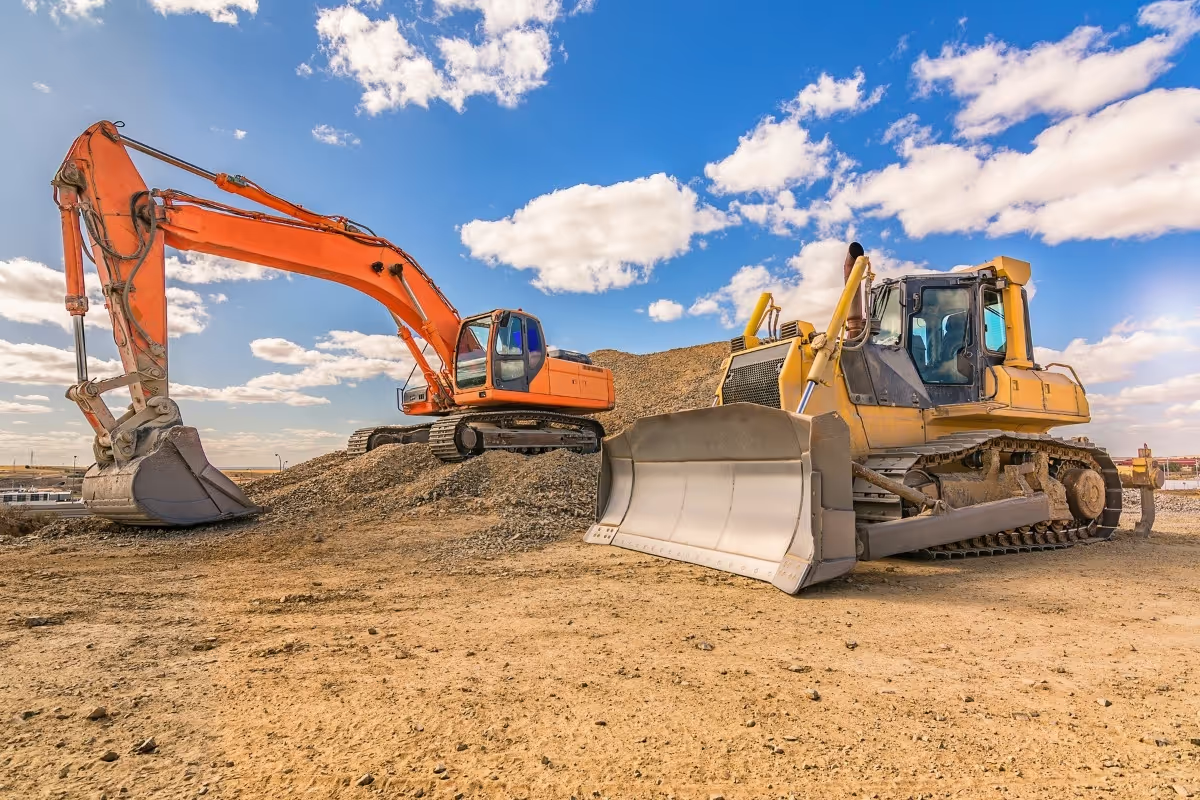
Heavy equipment financing — Excavators, concrete pumps, compactors, and construction assets for Maple Ridge's residential development pipeline and industrial projects.
Refinancing and sale-leaseback — Converts equity in owned equipment into working capital without requiring a sale. Supported on qualifying hard assets up to a reasonable percentage of current market value. Useful for established construction contractors, manufacturers, and logistics operators with substantial equipment portfolios.
Asset-based lending — For larger capital requirements backed by a portfolio of equipment or receivables. Relevant for established construction contractors, industrial operators, and larger logistics businesses with recurring equipment financing needs.
Equipment line of credit — A revolving draw facility for businesses financing equipment on a recurring basis — useful for construction contractors adding capacity as Maple Ridge's development pipeline expands, or trades businesses acquiring vehicles across multiple locations.
Invoice and freight factoring — Converts outstanding invoices into immediate working capital. Factoring approval is based primarily on your customers' creditworthiness — not yours. Useful for Maple Ridge contractors managing 30–45 day receivables from general contractors and developers.
Working capital loans — Short-term capital to bridge between project payments, cover equipment costs ahead of a busy construction season, or manage timing between equipment acquisition and revenue ramp-up.
Review the eligible equipment guide to confirm what asset types qualify before applying.
This is a market reality specific to Maple Ridge's geographic position that creates a financing pattern distinct from more central Metro Vancouver locations.
Maple Ridge's value proposition for industrial and construction operations is primarily geographic: it offers lower real estate costs than central Vancouver while maintaining Highway 1 access to the entire Lower Mainland and Fraser Valley. But this positioning creates operational dynamics that affect equipment financing.
Many construction contractors and industrial operators in Maple Ridge serve a broad geographic market — they're not solely dependent on Maple Ridge-local demand. A contractor may have significant workload in Maple Ridge, Pitt Meadows, and Haney, plus project pipelines extending into Mission and the Fraser Valley. Equipment utilization depends on this broader geographic service area.
The financing challenge: a contractor's equipment utilization and cash flow are dependent on sustained work across a broad geographic region, not just Maple Ridge. If Fraser Valley construction demand softens while Maple Ridge demand remains strong (or vice versa), equipment utilization and contractor cash flow fluctuate. Equipment financing needs to account for these regional demand variations.
Additionally, Maple Ridge's residential construction follows seasonal patterns. Spring and fall are peak construction seasons; winter construction slows. Equipment financed in anticipation of spring construction must be serviceable and available when peak season begins, but utilization may drop significantly during winter slowdowns.
The practical advice: Construction contractors and industrial operators seeking equipment financing in Maple Ridge should document their geographic service area — the actual region they serve (Maple Ridge plus adjacent communities and the broader Lower Mainland/Fraser Valley). Include documentation of project pipelines and customer relationships across this geographic area. For seasonal businesses, include documentation of seasonal demand patterns and how equipment deployment aligns with peak seasons. The conversation with underwriters should be explicit: "We're Maple Ridge-based but serve [geographic area]. Here's our project pipeline across the region, and here's how equipment deployment aligns with seasonal demand."
Maple Ridge's residential growth trajectory is documented and predictable. The city is adding 2,000+ residents annually, and approved residential inventory in developments like Maple Meadows and Silver Valley will sustain growth for the next several years. That growth will accelerate residential construction demand.
For Maple Ridge construction contractors and equipment suppliers, this creates a predictable forward dynamic: contractors who establish financing relationships and equipment capacity now — during the current market cycle — will be better positioned to scale and capture increasing market share as Maple Ridge's growth accelerates, than those who try to establish capacity after demand peaks.
Maple Ridge's growth is creating contractor capacity demand, particularly in concrete work, grading, and utility installation. Contractors who pre-position equipment capacity now will capture more work as the growth accelerates. Contractors who wait until after growth peaks will face stronger competition from established operators.
Pre-qualifying now, understanding your equipment financing range, and having a clear conversation with Mehmi about what fleet additions would position you for Maple Ridge's next 24–36 months of growth is the exercise. Maple Ridge's approved residential pipeline and municipal development data are publicly available. Your equipment financing capacity should align with that forward visibility.
Use the amortization calculator to model different equipment scenarios before Maple Ridge's growth demand accelerates further.
Illustrative example only; not a statement of a specific funded client transaction.
A construction contractor based in Maple Ridge — established in 2013, specializing in residential site development, grading, and utility installation — had built a steady business serving Maple Ridge and adjacent communities (Pitt Meadows, Haney, Mission). The contractor's client base included local home builders and residential developers with active projects across the eastern Metro Vancouver and Fraser Valley region.
An opportunity arrived: three major residential developers — with significant approved development pipelines across Maple Ridge, Pitt Meadows, and the Fraser Valley — approached the contractor about becoming their preferred site development vendor across the region. The developers committed to utilizing the contractor for site services across multiple communities and a 24-month development pipeline. Equipment capacity would need to expand to serve the consolidated developer demand.
The equipment investment: one additional excavator, one grader, one concrete pump truck, and specialized site utility equipment — total quoted at $540,000 from a Vancouver equipment supplier.
The challenge: The contractor's existing bank statements showed strong, steady growth but limited history (10 years in operation). The developer commitments were definitive but informal — based on relationship and intent, not formal multi-year contracts. The financial statement requirements for a $540,000 file would normally require three years of accountant-prepared statements.
How Mehmi structured it: The file was submitted with the $540,000 equipment package supported by three years of accountant-prepared financial statements, signed letters from each of the three developers confirming their multi-community development pipeline, documentation of prior projects with each developer, documentation of the contractor's geographic service area (Maple Ridge, Pitt Meadows, Haney, Mission, and surrounding communities), a detailed regional project timeline showing equipment deployment aligned with residential development phases, and a capacity letter from the contractor confirming current utilization and the developer pipeline visibility across the region.
What made it work: The combination of an established Maple Ridge contractor (10 years, documented developer relationships, consistent financials), formal commitments from three major developers with approved regional development pipelines, clear geographic service area documentation, and detailed equipment deployment timeline aligned with residential development phases created a straightforward capacity case. The developer letters and prior project history provided capacity evidence. The contractor's position as a preferred vendor for the developers' regional projects reduced credit risk. The geographic service area documentation showed that equipment would be utilized across a broad region, reducing seasonal and location-specific demand risk.
Approval and funding timelines vary by lender, application completeness, and required conditions. Equipment delivery coordinated with first phase residential development launches. Excavator and grader operational within one week of delivery. The contractor's utilization immediately increased from 70 percent to 95 percent across the region. Over the following 24 months, the contractor captured all three developers' site development work across Maple Ridge, Pitt Meadows, and the Fraser Valley. Annual revenue increased by 125 percent across the expanded regional service area, and the contractor expanded from 16 to 28 employees. The equipment line of credit was implemented to provide rolling capacity for ongoing regional development pipeline expansion.
Maple Ridge's construction, residential development, manufacturing and logistics, trades services, and retail and commercial services economy generates a distinctive equipment financing profile. These are the asset types we see most frequently, each linked to its specific financing page:
Construction & Residential Development
Manufacturing & Logistics
Trades & Service Vehicles
Retail & Commercial Services
Construction and contractors — Residential site development, grading, utility installation, and commercial construction serving Maple Ridge's sustained growth pipeline and the broader eastern Metro Vancouver and Fraser Valley region. One of Metro Vancouver's fastest-growing municipalities creates sustained construction equipment demand. See the comprehensive guide to construction equipment financing.
Manufacturing, warehousing, and logistics — Industrial operations in Maple Ridge's industrial corridor serving Metro Vancouver and Fraser Valley supply chains. Equipment finances on supply contracts and utilization tied to Lower Mainland and regional demand. See the comprehensive guide to manufacturing equipment financing.
Skilled trades and service contractors — HVAC, plumbing, electrical, roofing, and general contracting services expanding to serve Maple Ridge's growing population and the regional eastern Metro Vancouver market. Service vehicles and specialized equipment finance on local and regional service demand.
Transportation and logistics — Carriers and logistics operators serving the Metro Vancouver and Fraser Valley supply chains, utilizing Maple Ridge's Highway 1 access and lower real estate costs. Equipment finances on carrier utilization and regional freight movement. See the comprehensive guide to transportation and logistics equipment financing.
Retail and commercial services — Restaurants, retail operations, and professional services on Maple Ridge's commercial corridors serving the local and regional population. Equipment finances on location operations and expansion.
Most equipment financing applications require:
For construction contractors: include municipal development permits for specific Maple Ridge and regional projects, developer letters confirming project timelines and geographic service area, documentation of prior regional project experience, geographic service area documentation, and realistic project launch timelines alongside bank statements. Municipal documentation and developer commitments strengthen approvals.
For manufacturing and logistics operators: include supply contracts, equipment requirements tied to production schedules and utilization, Maple Ridge industrial corridor positioning documentation, and bank statements.
For skilled trades businesses: include Maple Ridge and regional service area documentation, local service demand projections, regional market growth data, and equipment requirements alongside bank statements.
For transportation and logistics operators: include carrier contracts or freight agreements, regional route documentation showing Metro Vancouver and Fraser Valley operations, equipment requirements, and bank statements.
For retail and commercial services: include location operations data, sales or utilization documentation, expansion timelines, and equipment requirements alongside bank statements.
Dealer purchases process fastest — application-only files under $250,000 with a clean bureau are reviewed according to lender requirements.
Larger files over $250,000 may require financial statements. Files over $500,000 typically need three years of accountant-prepared statements plus interim financials.
Questions before applying Review the FAQ or explore all financing services to understand every option available.
Ready to get your equipment funded in Maple Ridge? Call us directly at 1-833-863-4644 or apply online to request financing options, subject to lender review.
Related resource: Browse our equipment financing by city directory for more local financing guides.
Q. How fast are equipment financing approvals in Maple Ridge?A. Approval and funding timelines vary by lender, application completeness, and required conditions. Application-only files under $250,000 with a clean bureau are reviewed according to lender requirements. Approval and funding timelines vary by lender, application completeness, and required conditions.
Q. I'm a construction contractor with projects across Maple Ridge and the Fraser Valley. What documents do I need for equipment financingA. Include your business bank statements (6 months), municipal development permits for specific projects across your service area, signed letters from developers confirming project timelines and your involvement, documentation of prior projects with the developers, geographic service area documentation showing where you operate, and the equipment supplier quote. Municipal permits and developer confirmations are as important as financial statements for regional contractor files.
Q. How do my geographic service area and seasonal construction patterns affect my equipment financingA. Maple Ridge equipment financing should account for seasonal demand variations and your actual geographic service territory. Include documentation showing the region you serve (Maple Ridge plus adjacent communities), project pipelines across that region, and how equipment deployment aligns with peak construction seasons. This helps underwriters understand that your equipment utilization is based on broad regional demand, not just Maple Ridge-local activity.
Q. What if my company is relatively new but has strong developer relationships across the regionA. Include signed letters from developers confirming your involvement in their regional projects, documentation of prior successful project relationships, project status showing timelines, geographic service area documentation, and your equipment quote. Strong developer relationships and regional project documentation can support approval even if your company history is limited.
Q. I operate a manufacturing or logistics business in Maple Ridge's industrial corridor. What documents support my applicationA. Include your business bank statements (6 months), supply contracts or customer agreements confirming volume, Maple Ridge industrial property documentation showing your corridor positioning, equipment specifications, utilization projections, and the equipment quote. Supply contracts and industrial corridor positioning create clear capacity evidence.
Q. What is PST/GST treatment for leased equipment in BCA. BC applies 7% PST to equipment value (non-recoverable) and 5% GST (recoverable for GST-registered businesses). Consult with your accountant about how your lease structure affects PST and GST liability for your specific equipment type.
Q. Can I finance equipment if I'm expanding my trades business to Maple Ridge from elsewhere in Metro VancouverA. Yes. Include documentation of your existing Metro Vancouver trades operations, your Maple Ridge service area expansion plan, Maple Ridge residential market growth data, regional service demand projections, and equipment requirements. Your existing Metro Vancouver track record plus Maple Ridge market documentation support approval.
Q. Can I refinance equipment I already ownA. Yes. A refinancing or sale-leaseback converts equity in owned equipment into working capital without requiring a sale. Supported on qualifying hard assets up to a reasonable percentage of current market value.
Q. What equipment types qualify in Maple RidgeA. Construction and heavy equipment, manufacturing and logistics systems, trades service vehicles, and commercial and retail infrastructure all qualify. See the eligible equipment guide for the complete list.

.svg)