
This page covers equipment financing in Moncton, New Brunswick — who qualifies, what structures are available, how approvals work, and what local businesses need to know before applying. Moncton is the largest city in Atlantic Canada by population (85,000 in the city proper, 160,000 in the metropolitan area), the regional hub for the Maritimes, home to the Port of Moncton (a tidewater port serving the Bay of Fundy), a major Canadian National Railway intermodal hub, a growing contact centre and professional services corridor, and a sustained construction and trades economy serving Atlantic Canada's residential and commercial markets. Approval and funding timelines vary by lender, application completeness, and required conditions. Atlantic provinces (NB, NS, NL) apply 15% HST; fully recoverable as ITCs for HST-registered businesses.
Moncton holds a singular position in Atlantic Canada's economic geography. It is the largest city in the region by population (160,000 metropolitan), the primary business and transportation hub for the Maritime provinces, and one of Canada's most strategically positioned logistics and distribution centres. The Bay of Fundy defines its geography; the Port of Moncton on the downtown waterfront is one of North America's few year-round tidewater ports, offering natural deep-water access without channel dredging and serving as a gateway for containerized freight, bulk commodities, and project cargo destined for Atlantic Canada and beyond.
The Canadian National Railway operates a major intermodal hub in Moncton, making it one of CN's critical nodal points in eastern Canada. The city serves as the distribution hub for Atlantic Canada — goods moving into the region from central Canada or internationally through the Port funnel through Moncton's logistics and warehousing infrastructure. Contact centre operations have established substantial presence in Moncton, with multiple Fortune 500 companies maintaining customer service and technical support operations employing thousands of workers. Professional services, healthcare, and government sectors anchor Moncton's downtown and provide stable employment.
The construction and trades economy is sustained by residential and commercial development throughout Atlantic Canada, with Moncton serving as the trades and equipment supply hub for the broader region. The city's geographic position — equidistant from Halifax and Saint John, serving as the gateway to PEI and Newfoundland — creates transportation and logistics demand that sustains equipment financing across Port, rail, trucking, and distribution operations.
Approval and funding timelines vary by lender, application completeness, and required conditions. Whether you're a Port of Moncton cargo handler or intermodal operator, a CN Rail-connected transportation or logistics business, a contact centre or professional services operation, a construction contractor serving Atlantic Canada's residential and commercial markets, a trades business supplying equipment or services across the Maritimes, or a commercial services business serving the region's hub, Mehmi structures financing around how Moncton's economy actually operates.
Equipment can be sourced from Moncton-area, Atlantic Canada, and Canada-wide dealers, private sellers, or auctions. High-hour and older units qualify regularly when they continue generating stable revenue and are properly documented.
Use the equipment payment calculator to model monthly payments before you apply.
When buying or refinancing business assets in Moncton, compare the structure and total ownership cost—not just the monthly payment. Availability and terms depend on equipment, business credit, cash flow and individual lenders.
| Equipment funding need | Option to compare | What to verify |
|---|---|---|
| Purchasing eligible transport equipment | Equipment loan or conditional sale | Equipment value, term, interest calculation, down payment, collateral, title and early-payout terms. |
| Using equipment while managing initial cash outlay | Equipment lease | Payment schedule, deposits, insurance, end-of-term purchase options, return conditions and total cost. |
| Purchasing from a used-equipment dealer or private seller | Used-equipment financing | Asset age, hours or mileage, inspection, seller verification, lien search and any lender limits. |
| Unlocking equity in owned machinery or vehicles | Equipment refinancing or sale-leaseback | Appraised value, current liens, payout amounts, advance against value, fees and continuing use of the asset. |
| Buying multiple assets or upgrading in stages | Equipment financing facility or separate leases | Each asset's eligibility, draw timing, security, documentation, amortization and combined payment burden. |
Next step: Compare equipment loans, leases and refinancing before requesting indicative terms. Examples above are educational, not offers or approvals.
Moncton's economy creates equipment financing demand across four distinct sectors with different financing patterns and regional supply chain dynamics.
Port of Moncton and intermodal logistics require containers, forklifts, cargo handling equipment, and dock infrastructure tied to ship schedules, tidewater port cycles, and intermodal freight movement. The Bay of Fundy's extreme tidal range (the highest in the world) creates unique operational windows — ships can only berth and depart during high tide. Equipment financing aligns with Port activity cycles, tidal schedules, and the timing of containerized and bulk cargo movement.
Canadian National Railway and rail intermodal operations finance railcar handling equipment, intermodal terminal infrastructure, locomotive support systems, and specialized yard equipment tied to CN's transcontinental freight flows and intermodal terminal utilization.
Construction, trades, and residential development serving Atlantic Canada's scattered, regionally-dependent construction market — requiring contractors to travel between Moncton, Saint John, Halifax, and PEI — require equipment financing tied to regional project pipelines and development permits.
Contact centre, professional services, and technology-enabled operations finance computer and telecommunications equipment, office furniture, and facility infrastructure tied to customer service expansion, staffing cycles, and technology refresh schedules.
For operators who want full ownership from day one, equipment loans provide a clear path — fixed payments, equity build, and refinancing options when working capital is needed.
Lenders assess five core factors — character, capacity, capital, collateral, and conditions — and the strength of your file across all five determines what gets approved, on what terms, and at what rate.
Character is your business track record. Years in operation, commercial bureau history, and whether bank statements reflect consistent, well-managed cash flow. Documentation requirements vary by lender, transaction size, business history, and credit profile. Port operators with documented cargo handling contracts and CN intermodal connections qualify frequently. Construction contractors with documented project histories strengthen applications.
Capacity is whether your revenue supports the proposed payment. For Port operations, cargo manifests and shipping schedules confirm volume. For CN intermodal operations, rail terminal contracts and freight volume projections. For construction, municipal development permits and regional contractor workload. For contact centres, customer service contracts and staffing projections.
Capital is your equity position. Moncton's Port-adjacent industrial real estate, railway corridor property, and commercial space have appreciated substantially. Owner-occupied warehouse, terminal, or facility space is a strong capital indicator. Equipment owned free and clear strengthens applications. Residential property ownership in Moncton's established neighbourhoods provides capital evidence.
Collateral is the asset itself. Port and cargo handling equipment has active regional and national secondary markets. Rail intermodal equipment has CN-affiliated secondary markets and national refurbishment networks. Construction equipment has strong regional markets. Computer and office equipment has active secondary markets.
Conditions cover the deal structure — term length, payment structure, advance amount, and documentation requirements. Files over $250,000 may require financial statements. Files over $500,000 typically need three years of accountant-prepared statements plus interim financials.
Thresholds above reflect typical patterns across Mehmi's financing programs. Requirements vary by program and file.
Equipment loans — Full ownership from day one. Fixed payments, equity build, and the asset on your balance sheet. Best for long-lived Port, rail, construction, and facility assets Moncton businesses plan to keep.
Equipment leasing — Lower upfront cost with end-of-term flexibility — return, renew, or purchase. Atlantic Canada applies 15% HST; fully recoverable as ITCs for HST-registered businesses. Commonly used by construction contractors with shorter equipment cycles and contact centres managing technology refresh timelines.
Conditional sales contracts — Fixed payments with a nominal buyout at the end. A common ownership path for Port cargo equipment, rail intermodal systems, construction assets, and commercial vehicles throughout Atlantic Canada.
Truck and trailer financing — For Moncton carriers, construction contractors, and logistics operators serving Atlantic Canada and the CN Rail network. Port-adjacent and intermodal terminal operations frequently finance heavy-duty trucks and specialized transport vehicles.
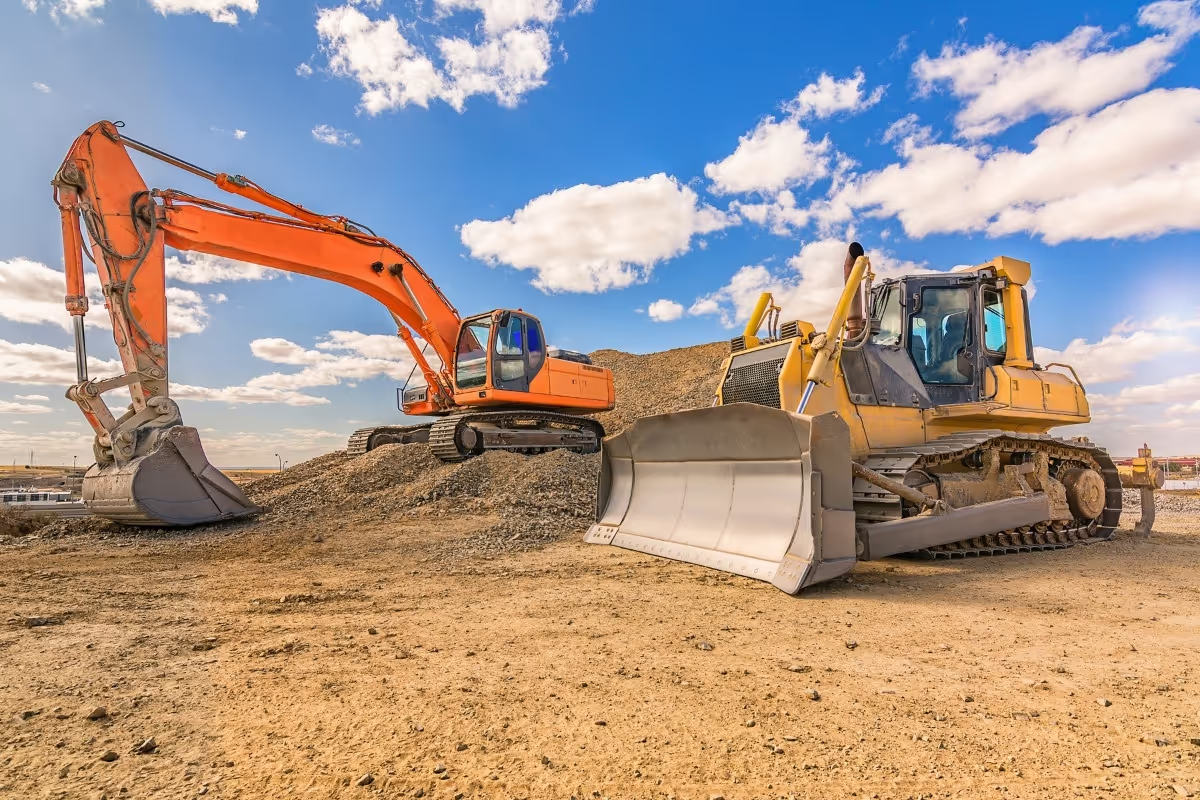
Heavy equipment financing — Excavators, concrete pumps, compactors, and construction assets for Moncton's residential and commercial development pipeline and regional Atlantic Canada projects.
Refinancing and sale-leaseback — Converts equity in owned equipment into working capital without requiring a sale. Supported on qualifying hard assets up to a reasonable percentage of current market value. Useful for established Port operators, rail intermodal businesses, and construction contractors with substantial equipment portfolios.
Asset-based lending — For larger capital requirements backed by a portfolio of equipment or receivables. Relevant for established Port cargo operations, CN intermodal terminals, and larger construction contractors with recurring equipment financing needs.
Equipment line of credit — A revolving draw facility for businesses financing equipment on a recurring basis — useful for construction contractors adding capacity phase by phase, or contact centres acquiring computer and telecommunications equipment across multiple locations.
Invoice and freight factoring — Converts outstanding invoices into immediate working capital. Factoring approval is based primarily on your customers' creditworthiness — not yours. Useful for Moncton subcontractors managing 30–45 day receivables from general contractors and regional developers, or Port operators managing receivables from shipping companies.
Working capital loans — Short-term capital to bridge between project payments, cover equipment costs ahead of a busy season, or manage timing between equipment installation and revenue ramp-up.
Review the eligible equipment guide to confirm what asset types qualify before applying.
This is a market reality specific to Moncton's unique Port geography that creates a financing pattern distinct from most other Canadian ports.
The Port of Moncton operates in the Bay of Fundy, which has the highest tidal range in the world — approximately 40+ feet between high and low tide. Ships can only berth, load, and depart during high tide windows. A typical high tide window occurs twice daily but lasts only 4–6 hours. A cargo operation planning to load or unload a container ship must coordinate with tidal windows and schedule equipment capacity around those constraints.
The financing challenge: a Port operator may need to finance additional forklifts, loaders, or dock equipment to accelerate cargo handling during high tide windows — not because steady-state demand requires the equipment, but because peak capacity during high tide requires simultaneous loading of multiple vessels. Equipment sits underutilized at low tide but is fully utilized during brief high tide windows.
Port operators who under-invest in capacity miss shipping opportunities during peak windows. Port operators who over-invest carry equipment costs for underutilization at low tide. The underwriting challenge is distinguishing between necessary equipment for surge capacity versus over-investment in response to peak-window volatility.
The practical advice: Port of Moncton operators seeking equipment financing should provide clear documentation of current tidal cycle utilization patterns, forward vessel scheduling, or Port Authority coordination schedules. For established operators with five-plus years of Moncton Port experience, that documentation typically exists in the form of tidal operation summaries or vessel booking schedules. The conversation with underwriters should be explicit: "Our equipment handles the surge capacity required during high tide windows, and here's our vessel scheduling and tidal cycle utilization." That clarity helps underwriters understand the business model and structure terms around actual Port utilization patterns.
Atlantic Canada faces a sustained housing shortage. Residential construction demand is outrunning available contractor capacity and equipment. Moncton, positioned as the region's hub, is where contractors and equipment suppliers establish the operational base serving the broader Atlantic Canadian market.
For Moncton construction contractors and equipment suppliers, this creates a predictable forward dynamic: contractors who establish financing relationships and equipment capacity now — during the current market cycle — will be better positioned to scale into the next cycle than those who try to build capacity after demand peaks.
The regional nature of Atlantic Canadian construction means contractors often work across multiple provinces. A Moncton-based contractor might have jobs in Saint John, Halifax, Charlottetown, and St. John's within the same year. Equipment capacity and financing relationships established in Moncton become the operational foundation for regional expansion.
Pre-qualifying now, understanding your equipment financing range, and having a clear conversation with Mehmi about what fleet additions would position you for regional growth in the next 24 months is the exercise. Atlantic Canada's housing shortage is well-documented in media and government reports. Your equipment financing capacity should align with forward project visibility in your service area.
Use the amortization calculator to model different equipment scenarios before the next cycle of regional project expansion arrives.
Illustrative example only; not a statement of a specific funded client transaction.
A cargo handling business operating at the Port of Moncton — established in 2010, specializing in containerized freight operations and intermodal cargo — had been operating at steady capacity for a decade. The business employed 25 dock workers and maintained a fleet of three container handlers and five forklifts. Operations were coordinated around Bay of Fundy tidal windows: high tide windows for vessel berths and cargo operations, low tide windows for maintenance and equipment servicing.
An opportunity arrived: a major shipper announced a shift of containerized freight volume from the Port of Saint John to the Port of Moncton, with vessel schedules adding two additional container ship calls per week. The new volume required simultaneous cargo handling during peak high tide windows — the existing three container handlers and five forklifts could not achieve the throughput necessary to meet the new vessel schedules.
The equipment needed: two additional container handlers and four additional forklifts, quoted at $580,000 from a Halifax equipment supplier.
The challenge: The cargo operator's existing bank statements showed steady profitability. The shipper commitment was definitive — but the financial statement requirements for a $580,000 file would normally require three years of accountant-prepared statements. The urgency was operational: vessel schedules would begin in four months; equipment needed to be in place and operational before that date.
How Mehmi structured it: The file was submitted with the $580,000 container handling and forklift package supported by three years of accountant-prepared financial statements, the shipper's vessel schedule commitment (with routing confirmation), a Port of Moncton tidal operation and vessel scheduling summary, and a capacity letter from the cargo operator confirming the existing fleet utilization, the new shipper volumes, and the equipment requirements tied to high tide window constraints.
What made it work: The combination of an established Port operator (decade of operation, consistent financials), documented shipper commitment to increased volume, and clear vessel scheduling tied to tidal window constraints created a straightforward capacity case. The tidal operation summary helped underwriters understand why the equipment was necessary — it wasn't general expansion but surge-capacity investment tied to specific high tide window constraints and defined shipper volume increases.
Approval and funding timelines vary by lender, application completeness, and required conditions. Equipment delivery from the supplier coordinated with dock space expansion and dock worker hiring. Container handlers operational before the first new vessel call. The cargo operator's throughput increased from approximately 45,000 TEUs annually to 65,000 TEUs within 12 months. The shipper renewed the volume commitment for an additional three years, and the Port Authority commissioned the cargo operator to manage additional container terminal expansion. The asset-based lending facility was noted as a future tool for managing the next phase of terminal expansion.
Moncton's Port and intermodal logistics, CN Rail operations, construction and trades, and contact centre and professional services economy generates a distinctive equipment financing profile. These are the asset types we see most frequently, each linked to its specific financing page:
Port & Intermodal Logistics
CN Rail & Intermodal Operations
Construction & Trades
Contact Centre & Professional Services
Port, logistics, and transportation — Port of Moncton container terminal operations, intermodal cargo handling, warehousing, and distribution serving the Bay of Fundy tidewater port and Atlantic Canada gateway. Equipment from container handlers to forklifts to cargo loaders finance on Port activity cycles and tidal window utilization. See the comprehensive guide to transportation and logistics equipment financing.
Rail intermodal and CN operations — Canadian National Railway intermodal hub operations, container and railcar handling, and yard infrastructure. Equipment tied to CN's transcontinental freight flows and intermodal terminal utilization.
Construction and contractors — Residential and commercial development throughout Atlantic Canada coordinated from Moncton; regional contractor operations spanning multiple provinces. Excavators, concrete pumps, and specialized construction assets serve Atlantic Canada's housing shortage and regional construction demand. See the comprehensive guide to construction equipment financing.
Contact centres, professional services, and technology-enabled operations — Customer service operations, technical support centres, and professional services businesses financing computer, telecommunications, and facility infrastructure tied to expansion and technology refresh cycles.
Hospitality and food service — Restaurants and food service operators throughout Atlantic Canada access kitchen, refrigeration, and service equipment financing.
Most equipment financing applications require:
For Port of Moncton cargo operators: include cargo manifests, vessel schedules, or forward booking documentation confirming volume alongside bank statements. Tidal operation documentation and shipper commitments accelerate approvals.
For CN intermodal operations: include rail terminal contracts, freight volume projections, and CN coordination schedules alongside bank statements.
For construction contractors serving Atlantic Canada: municipal development permits, regional contractor workload projections, or project timelines alongside bank statements confirm forward workload.
For contact centres and professional services: customer service contracts, staffing projections, or expansion timelines alongside bank statements confirm capacity.
Dealer purchases process fastest — application-only files under $250,000 with a clean bureau are reviewed according to lender requirements.
Larger files over $250,000 may require financial statements. Files over $500,000 typically need three years of accountant-prepared statements plus interim financials.
Questions before applying Review the FAQ or explore all financing services to understand every option available.
Ready to get your equipment funded in Moncton? Call us directly at 1-833-863-4644 or apply online to request financing options, subject to lender review.
Related resource: Browse our equipment financing by city directory for more local financing guides.
Q. How fast are equipment financing approvals in Moncton?A. Approval and funding timelines vary by lender, application completeness, and required conditions. Application-only files under $250,000 with a clean bureau are reviewed according to lender requirements. Approval and funding timelines vary by lender, application completeness, and required conditions.
Q. I operate a cargo handling business at the Port of Moncton. What documents do I need for equipment financingA. Include your business bank statements (6 months), cargo manifests or vessel schedules confirming volume and forward activity, Port of Moncton tidal operation documentation, shipping contracts or shipper commitments, and the equipment quote. Forward booking patterns and operational documentation create clear capacity evidence.
Q. How do tidal windows affect my equipment financingA. Tidal window constraints are factored into your capacity assessment. Include documentation showing how the new equipment meets high tide window surge capacity requirements. Clear explanation of tidal window utilization helps underwriters understand your business model and the equipment's necessity.
Q. I'm a CN Rail intermodal operator. What documents support my applicationA. Include your business bank statements (6 months), CN terminal contracts or freight volume projections, rail intermodal schedules, and the equipment quote. CN relationship documentation and freight volume commitments provide capacity evidence.
Q. What is HST treatment for leased equipment in New BrunswickA. Atlantic Canada applies 15% HST. It is fully recoverable as ITCs for HST-registered businesses. Consult with your accountant about how your lease structure affects HST liability for your specific equipment type.
Q. Can I finance equipment if I operate across multiple Atlantic provincesA. Yes. Regional contractors and equipment suppliers serving Atlantic Canada can finance equipment at Moncton operations. Include documentation of your service area, regional project pipeline, and cross-province operations.
Q. Can I refinance equipment I already ownA. Yes. A refinancing or sale-leaseback converts equity in owned equipment into working capital without requiring a sale. Supported on qualifying hard assets up to a reasonable percentage of current market value.
Q. What equipment types qualify in MonctonA. Port and intermodal cargo handling equipment, CN Rail operations equipment, construction and heavy equipment, and contact centre and professional services infrastructure all qualify. See the eligible equipment guide for the complete list.

.svg)