
We provide equipment financing in Blainville with financing review, clear terms, and flexible structures tailored to construction, transportation, manufacturing, trades, and service businesses. Used, high-mileage, and private-sale equipment is fully supported, with financing aligned to real cash-flow needs across the Laurentides region.
Blainville businesses operate across construction, transportation, manufacturing, agriculture, trades, and service-based industries. With direct access to Autoroute 15, strong industrial development throughout the Laurentides, and proximity to Laval and Montreal, equipment plays a major role in keeping operations productive. Financing helps companies secure essential assets while maintaining stable cash flow during peak months.
We support equipment financing in Blainville across
Transportation & Trucking,
Construction & Contractors,
Manufacturing & Wholesale,
Farming & Agriculture,
Hospitality & Food Service,
Medical, Dental & Wellness,
Technology & Business Services,
Natural Resources & Energy, and
Aviation & Aerospace.
Approval and funding timelines vary by lender, application completeness, and required conditions. You can estimate payments anytime using our equipment financing calculator.
Blainville operators often use
Equipment Loans for predictable monthly payments, and
Equipment Leases when they prefer lower upfront costs and flexible end-of-term choices.
For a simple path to ownership,
Conditional Sales Contracts offer clear terms with full ownership at the end.
Carriers running routes between the Laurentides, Laval, and Montreal rely on
Truck & Trailer Financing for tractors, straight trucks, dry vans, reefers, dump trucks, and flatbeds.
Local construction companies depend on
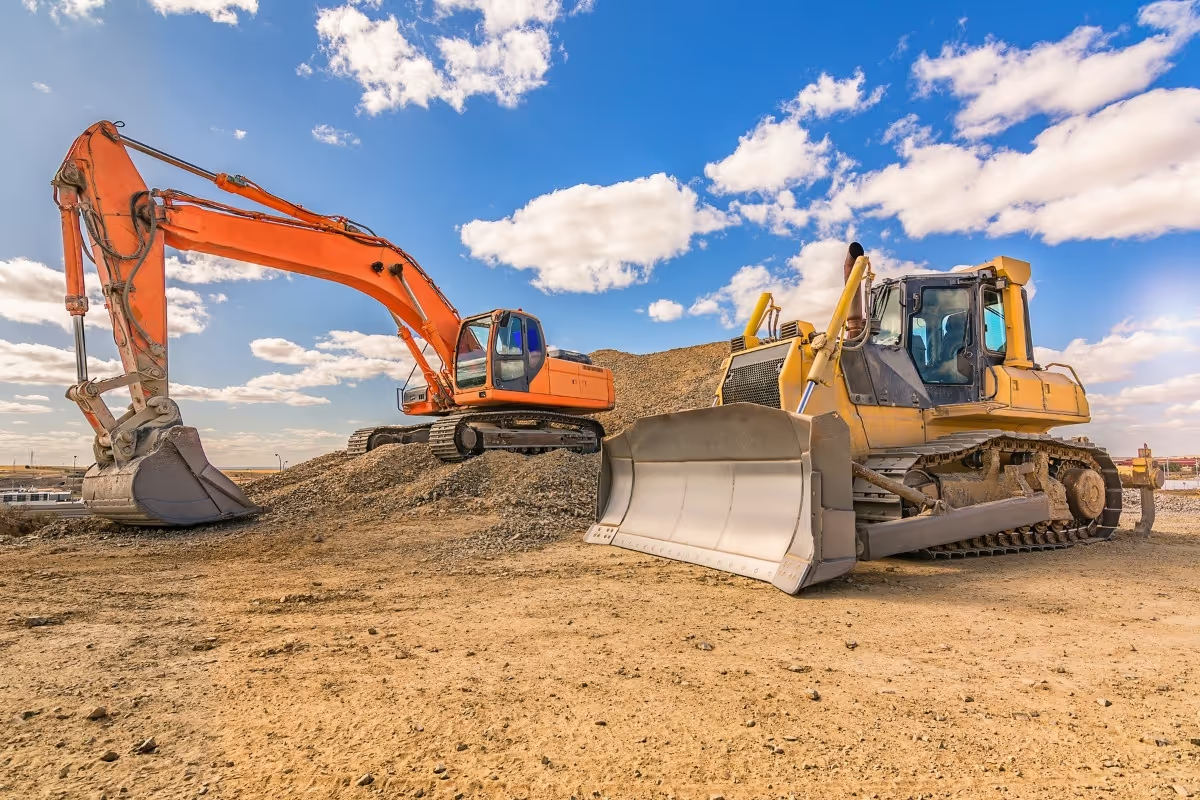
Heavy Equipment Financing for excavators, skid steers, loaders, and attachments used across Blainville.
Unexpected breakdowns are supported through
Truck Repair Financing, allowing fleets to manage repairs without disrupting cash flow.
Businesses needing repeated purchases during the year use an
Equipment Line of Credit for flexible, on-demand capital.
Companies looking to unlock equity often use
Refinancing & Sales Leaseback to strengthen cash flow while keeping equipment in service.
Asset-heavy operators choose
Asset-Based Lending when receivable and equipment value support borrowing.
Restaurants and food-service operators benefit from
Rent-Try-Buy when upgrading commercial kitchen equipment.
Carriers facing slow broker payments use
Invoice & Freight Factoring, which advances an advance percentage determined by the factor of freight invoices subject to lender review.
Operators can also review commonly financed assets on the
Eligible Equipment page.
When buying or refinancing business assets in Blainville, compare the structure and total ownership cost—not just the monthly payment. Availability and terms depend on equipment, business credit, cash flow and individual lenders.
| Equipment funding need | Option to compare | What to verify |
|---|---|---|
| Purchasing eligible construction machinery | Equipment loan or conditional sale | Equipment value, term, interest calculation, down payment, collateral, title and early-payout terms. |
| Using equipment while managing initial cash outlay | Equipment lease | Payment schedule, deposits, insurance, end-of-term purchase options, return conditions and total cost. |
| Purchasing from a used-equipment dealer or private seller | Used-equipment financing | Asset age, hours or mileage, inspection, seller verification, lien search and any lender limits. |
| Unlocking equity in owned machinery or vehicles | Equipment refinancing or sale-leaseback | Appraised value, current liens, payout amounts, advance against value, fees and continuing use of the asset. |
| Buying multiple assets or upgrading in stages | Equipment financing facility or separate leases | Each asset's eligibility, draw timing, security, documentation, amortization and combined payment burden. |
Next step: Compare equipment loans, leases and refinancing before requesting indicative terms. Examples above are educational, not offers or approvals.
Blainville companies operate in competitive, equipment-intensive industries with seasonal workloads and contract-driven revenue. Financing must fit real operational needs.
We provide:
Our lending partners understand the equipment used across construction, transportation, manufacturing, agriculture, hospitality, and service operations throughout the Laurentides.
Illustrative example only; not a statement of a specific funded client transaction.
A Blainville contractor needed to replace a compact loader before starting a new residential project. Their bank requested full financials and a long review period, which risked delaying the contract. The owner found a clean used loader at a private yard, and we structured financing based on asset condition, resale value, and a steady deposit history.
To manage expenses between billing cycles, we paired the equipment loan with a small factoring line tied to progress-billing invoices. This supported fuel, labour, and material costs while projects moved through approval and payment.
The contractor secured the equipment, maintained cash flow, and stayed on schedule for upcoming construction work.
Carriers running Laurentides–Montreal freight routes often combine truck financing with factoring to manage fuel, insurance, and maintenance while waiting 30–45 days for broker payments.
Construction and trades across Blainville rely on excavators, skid steers, compactors, and dump trucks. Financing reflects local project timelines and seasonal patterns.
Industrial zones across the Laurentides rely on CNC machines, forklifts, handling equipment, and production tools. Financing supports equipment upgrades and capacity expansion.
Nearby agricultural operations use processing, handling, and refrigeration equipment. Payment structures often follow seasonal cycles.
Restaurants and cafés use leasing and Rent-Try-Buy to upgrade kitchen and refrigeration equipment while keeping upfront spending low.
Clinics across the region finance imaging devices, diagnostic tools, and treatment equipment to maintain service quality.
Local IT, trades, and service firms finance tools, equipment, and systems that support their daily operations.
Resource-driven operations rely on durable equipment and flexible structures that adjust to workload changes.
Companies supporting regional aviation and fabrication operations often require specialized financing structures for technical equipment.
We confirm the equipment, the seller, and the structure that best fits your Blainville operation.
Usually: an equipment quote, 3–6 months of bank statements, ownership details, and serial/VIN information for used or private-sale units.
We match your file with lenders that understand Blainville’s industry mix and equipment needs.
You receive clear terms—payment, down payment (if any), and contract length.
Funds are paid directly to the dealer or seller. Approval and funding timelines vary by lender, application completeness, and required conditions.
Consistent deposits, reasonable leverage, complete documents, and a clear business use case.
Related resource: Browse our equipment financing by city directory for more local financing guides.
Illustrative, not an actual funded transaction: Consider a Blainville business in the Laurentides construction and industrial businesses with Autoroute 15 access segment planning to acquire a work truck, skid steer or shop machine. The equipment's invoice is only one part of the decision. The borrower would also need to consider transport, installation, insurance, maintenance, available cash for the initial contribution and the time before the new equipment can generate revenue. Compare a lease and a loan against the full project cost before committing to a vendor.
What can change the credit decision locally? In this example, seasonal work and Québec tax treatment. A credit team will evaluate whether the operator can keep up with payments if a contract starts late, a machine needs repairs or the next receivable takes longer to arrive. Actual bank statements and signed agreements are stronger evidence than an optimistic projection. Borrowers with older equipment should also document condition, hours or kilometres, repairs, liens and an appropriate asset valuation.
Which information makes a review cleaner? Request a detailed supplier invoice, identify where the equipment will be used, list existing equipment debt, prepare relevant business bank statements and explain why the asset fits the company. Pricing and terms vary with credit, collateral and documentation; lenders do not promise a particular approval or rate. Review financing structures, other Canadian cities and Mehmi's editorial standards.
These assets may qualify for commercial financing if used for an eligible business purpose. The lender reviews the specific make, model, condition, equipment purchase price, seller and applicant's capacity to repay. Being located in Blainville does not by itself ensure approval.
Recent complete business bank statements, financial reports if requested, existing debt payments and clear explanations of large or seasonal deposits help. For this market, consider seasonal work and Québec tax treatment. Provide signed contracts or invoices where they actually exist, not assumed future sales.
Potentially. Lenders may ask for year, serial number or VIN, photos, hours or kilometres, seller ID, proof of ownership, lien confirmation and an inspection or valuation. A private sale can require more verification than a dealer purchase.
Some newer firms can be considered, but owner credit, management experience, personal guarantees, additional equity or contracts may be important. Each lender has its own eligibility requirements; acceptance is never automatic.
There is no standard deposit or guaranteed zero-down program. Borrower credit, repayment capacity, asset resale market, lender policy and requested term influence the result. Request a written quote showing upfront funds, fees and cash required at funding.
An equipment loan may better match a straightforward ownership objective. An equipment lease can have a different ownership or end-of-term structure. Compare all instalments, tax treatment, purchase options and early payout clauses.
In Québec, GST and QST on purchase or lease payments need to be addressed in the total cash-flow budget; eligibility for ITCs and ITRs depends on the rules. Read the official tax guidance and budget any nonrecoverable taxes instead of comparing payments before tax.
Compare effective total cost, term, down payment, payment frequency, fees, insurance, asset ownership, residual or buyout and repayment restrictions. Estimate cash flow with a hypothetical payment calculator, then request financing options with complete equipment details.

.svg)