
This page covers equipment financing in Kelowna, British Columbia — who qualifies, what structures are available, how approvals work, and what local businesses need to know before applying. Kelowna is British Columbia's second-largest city (population 145,000+), located 400 kilometres east of Vancouver in the Okanagan Valley. It is the primary commercial and tourism hub for the Okanagan region, anchoring a distinctive economy centered on wine production and viticulture, orchard operations and fruit agriculture, tourism and hospitality serving visitors to the region and Okanagan lakes, professional services and commercial operations, and residential construction and development. Approval and funding timelines vary by lender, application completeness, and required conditions. British Columbia applies 7% PST (non-recoverable on equipment purchases); GST (5%) also applies and is recoverable for GST-registered businesses.
Kelowna occupies a distinctive position in British Columbia's economy and geography. Located 400 kilometres east of Vancouver in the heart of the Okanagan Valley, it is British Columbia's second-largest city by population (145,000+) and the primary commercial, tourism, and services hub for the entire Okanagan region. Kelowna's economy is built on wine production, fruit agriculture, tourism, and regional commerce.
The Okanagan Valley is Canada's premier wine region. Kelowna sits at the heart of this wine-producing district, home to dozens of wineries ranging from small boutique operations to large production facilities. The region produces internationally recognized wines — primarily Pinot Noir, Merlot, Chardonnay, and Riesling — with a reputation for quality and innovation. Wineries represent substantial capital investment in equipment, facility infrastructure, aging systems, and production capacity. Wine tourism drives significant visitor traffic to the region annually.
Kelowna's agricultural economy extends beyond wine to orchard operations. The Okanagan Valley is one of Canada's primary fruit-producing regions, with apples, cherries, peaches, and other tree fruits grown throughout the region. Orchard operations require substantial equipment — tractors, spraying systems, harvesting equipment, and storage infrastructure — tied to annual growing and harvest cycles.
The city's tourism economy is anchored by Okanagan Lakes (Okanagan Lake and Kalamalka Lake), which attract recreational boaters, swimmers, resort visitors, and water sports enthusiasts. Tourism operations, resorts, restaurants, and hospitality businesses serve a seasonal summer visitor economy supplemented by winter skiing at nearby Sun Peaks ski resort.
Kelowna's professional services, commercial real estate, and office employment sectors support the region's businesses and tourist population. Residential construction and development continue as the region experiences sustained population growth.
Approval and funding timelines vary by lender, application completeness, and required conditions. Whether you're a winery or wine producer, an orchard operator or fruit agriculture business, a tourism or hospitality operation, a professional services or commercial business, a construction contractor serving the region, or a commercial services operator serving the Okanagan hub, Mehmi structures financing around how Kelowna's economy actually operates.
Equipment can be sourced from Kelowna-area, BC, and Canada-wide dealers, private sellers, or auctions. High-hour and older units qualify regularly when they continue generating stable revenue and are properly documented.
Use the equipment payment calculator to model monthly payments before you apply.
When buying or refinancing business assets in Kelowna, compare the structure and total ownership cost—not just the monthly payment. Availability and terms depend on equipment, business credit, cash flow and individual lenders.
| Equipment funding need | Option to compare | What to verify |
|---|---|---|
| Purchasing eligible agricultural machinery | Equipment loan or conditional sale | Equipment value, term, interest calculation, down payment, collateral, title and early-payout terms. |
| Using equipment while managing initial cash outlay | Equipment lease | Payment schedule, deposits, insurance, end-of-term purchase options, return conditions and total cost. |
| Purchasing from a used-equipment dealer or private seller | Used-equipment financing | Asset age, hours or mileage, inspection, seller verification, lien search and any lender limits. |
| Unlocking equity in owned machinery or vehicles | Equipment refinancing or sale-leaseback | Appraised value, current liens, payout amounts, advance against value, fees and continuing use of the asset. |
| Buying multiple assets or upgrading in stages | Equipment financing facility or separate leases | Each asset's eligibility, draw timing, security, documentation, amortization and combined payment burden. |
Next step: Compare equipment loans, leases and refinancing before requesting indicative terms. Examples above are educational, not offers or approvals.
Kelowna's economy creates equipment financing demand across five distinct sectors with different financing patterns and annual crop/vintage cycles.
Wineries and wine producers — ranging from small boutique operations to large commercial wineries — finance production equipment, fermentation systems, aging infrastructure, bottling equipment, and facility systems tied to vintage cycles, production volumes, and wine tourism infrastructure. Wine production requires substantial capital investment in specialized equipment.
Orchard operations and fruit agriculture — apple, cherry, peach, and mixed fruit producers — finance tractors, spraying systems, harvesting equipment, storage and cold chain infrastructure, and irrigation systems tied to annual growing cycles and commodity prices. Agricultural equipment represents substantial capital investment with financing tied to crop cycles.
Tourism and hospitality services — resorts, restaurants, wine tour operators, and recreational businesses — finance facility infrastructure, kitchen equipment, lodging systems, and activity equipment tied to seasonal occupancy and expansion.
Professional services and commercial operations — serving Kelowna's businesses and regional economy — finance office equipment, computer systems, telecommunications infrastructure, and facility upgrades tied to growth and technology refresh.
Construction and residential development serving Kelowna's residential growth and Okanagan region demand — require equipment financing tied to development permits, construction timelines, and residential market activity.
For operators who want full ownership from day one, equipment loans provide a clear path — fixed payments, equity build, and refinancing options when working capital is needed.
Lenders assess five core factors — character, capacity, capital, collateral, and conditions — and the strength of your file across all five determines what gets approved, on what terms, and at what rate.
Character is your business track record. Years in operation, commercial bureau history, and whether bank statements reflect consistent, well-managed cash flow. Documentation requirements vary by lender, transaction size, business history, and credit profile. Established wineries with production histories and agricultural operations with crop records qualify frequently. Tourism operators with documented occupancy histories strengthen applications.
Capacity is whether your revenue supports the proposed payment. For wineries, production volumes and wine sales pipelines confirm capacity. For orchard operations, crop volumes and commodity price visibility. For tourism, seasonal occupancy and average daily rates. For professional services, client rosters and billable demand. For construction, project pipelines and workload.
Capital is your equity position. Kelowna's vineyards, orchard land, commercial real estate, and hospitality property have appreciated substantially. Owner-operated winery, orchard, or hospitality property is a strong capital indicator. Equipment owned free and clear strengthens applications. Residential property ownership in Kelowna's residential communities provides capital evidence.
Collateral is the asset itself. Winery and wine production equipment has specialized secondary markets. Agricultural equipment has BC and national auction and dealer secondary markets. Wine tourism and hospitality equipment has accessible secondary markets. Construction equipment has strong regional markets.
Conditions cover the deal structure — term length, payment structure, advance amount, and documentation requirements. Files over $250,000 may require financial statements. Files over $500,000 typically need three years of accountant-prepared statements plus interim financials. Agricultural and winery operations may have alternative underwriting based on production records and commodity market conditions.
Thresholds above reflect typical patterns across Mehmi's financing programs. Requirements vary by program and file.
Equipment loans — Full ownership from day one. Fixed payments, equity build, and the asset on your balance sheet. Best for long-lived winery, agricultural, hospitality, and facility assets Kelowna businesses plan to keep.
Equipment leasing — Lower upfront cost with end-of-term flexibility — return, renew, or purchase. BC's 7% PST applies to equipment value (non-recoverable); GST (5%) is recoverable for GST-registered businesses. Commonly used by wineries with equipment upgrade cycles, orchard operations managing seasonal asset needs, and hospitality operators with regular refresh schedules.
Conditional sales contracts — Fixed payments with a nominal buyout at the end. A common ownership path for winery, agricultural, and commercial vehicles throughout BC.
Truck and trailer financing — For Kelowna carriers, orchard operations, construction contractors, and wine distribution operators serving the Okanagan and broader BC regions.
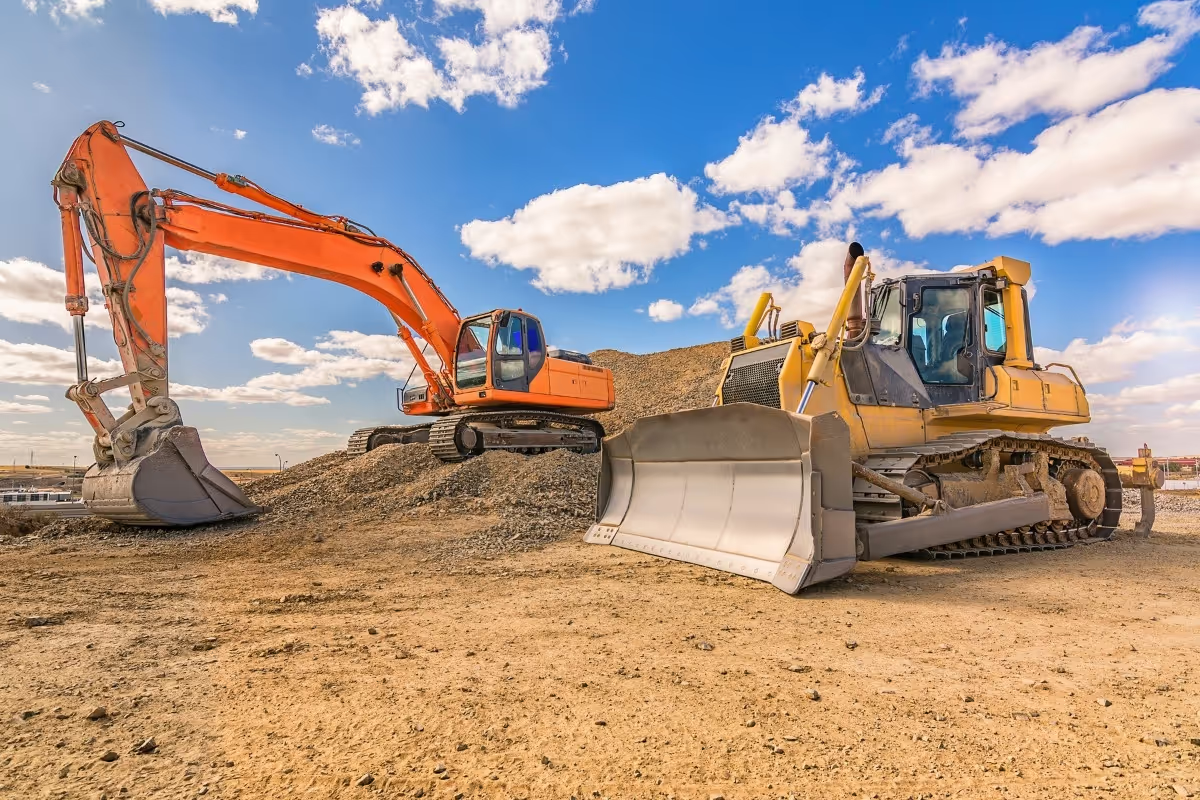
Heavy equipment financing — Excavators, concrete pumps, compactors, and construction assets for Kelowna's residential development pipeline and regional infrastructure projects.
Refinancing and sale-leaseback — Converts equity in owned equipment into working capital without requiring a sale. Supported on qualifying hard assets up to a reasonable percentage of current market value. Useful for established wineries, orchard operators, and hospitality businesses with substantial equipment portfolios.
Asset-based lending — For larger capital requirements backed by a portfolio of equipment or receivables. Relevant for established wineries, large orchard operations, hospitality businesses, and larger construction contractors with recurring equipment financing needs.
Equipment line of credit — A revolving draw facility for businesses financing equipment on a recurring basis — useful for wineries managing equipment replacement cycles, orchard operators acquiring seasonal equipment, or construction contractors adding capacity.
Invoice and freight factoring — Converts outstanding invoices into immediate working capital. Factoring approval is based primarily on your customers' creditworthiness — not yours. Useful for Kelowna wineries and agricultural suppliers managing receivables from wine distribution and regional customers.
Working capital loans — Short-term capital to bridge between vintage cycles, cover equipment costs ahead of harvest season, or manage timing between equipment acquisition and harvest/production revenue.
Review the eligible equipment guide to confirm what asset types qualify before applying.
This is a market reality specific to Kelowna's wine and agriculture economy that creates a financing pattern distinct from most other Canadian regions.
Wine production and orchard operations operate on vintage and crop cycles that differ fundamentally from traditional business operations. A winery may harvest grapes in September/October, age wine in barrels for 12–24 months, and not generate revenue until wine is bottled and sold — potentially 18–30 months after equipment investment. Equipment financing must account for this extended production cycle.
Agricultural commodity prices fluctuate based on global markets and local conditions. A winery's equipment investment is justified by current wine production volumes and pricing, but wine prices may decline during the vintage cycle, reducing margins. An orchard operation's equipment is justified by expected crop and commodity prices, but fruit prices may decline, creating cash flow pressure.
The financing challenge: wine and agricultural equipment is justified by production volumes and commodity prices — but the timing between equipment investment and revenue recognition can be substantial, and commodity prices may change during the production or vintage cycle.
The practical advice: Wineries and orchard operations seeking equipment financing should include documentation of production volumes, vintage or crop cycles, commodity price visibility, and risk management strategies. For wineries, include production records, wine sales pipelines, and aging timeline documentation showing when revenue arrives. For orchard operations, include crop volume history and commodity price visibility. For both, include risk management documentation (crop insurance, forward contracts, diversified crop/wine portfolios). The conversation with underwriters should be explicit: "Our production cycle runs [months], revenue arrives in [timeframe], and here's our commodity price visibility and risk management strategy."
Kelowna's wine economy is driven by vintage quality and wine pricing. Exceptional vintage years produce high-quality wines that command premium prices. Average or challenging vintage years produce lower-margin wines. Wine producers who have experienced strong vintage years with premium pricing are in a position to invest in production capacity to capture future premium vintages.
For Kelowna wineries, this creates a predictable dynamic: wineries that establish financing relationships and invest in production equipment during or immediately after strong, profitable vintage years are better positioned to expand production and capture future premium market opportunities than wineries that try to invest equipment during low-margin or challenging vintage years.
The winery that can say "We've experienced strong recent vintages and premium pricing; we're investing in production capacity to capture future premium vintage opportunities" has a fundamentally different credit profile than a winery in a down-pricing cycle.
Pre-qualifying now, understanding your equipment financing range, and having a clear conversation with Mehmi about what wine production or facility equipment would position you for future vintage expansion is the exercise. Your equipment financing capacity should align with recent vintage quality and pricing, with realistic downside scenario planning for variable vintage cycles.
Use the amortization calculator to model different vintage and commodity price scenarios before finalizing equipment investment.
Illustrative example only; not a statement of a specific funded client transaction.
A boutique winery in Kelowna — established in 2006, producing small-lot Pinot Noir, Chardonnay, and specialty wines — had experienced two exceptional recent vintage years (2021 and 2022) with strong critical reviews and premium pricing. The winery had achieved 95-point wine ratings from major critics, generating strong demand and wine club membership growth.
An opportunity arrived: the winery identified an adjacent property that could be developed with expanded vineyard and production capacity. With capacity expansion, the winery could increase annual production from 3,000 cases to 5,000 cases, capturing the strong demand generated by premium vintage quality and critical recognition.
The equipment investment: expanded fermentation tanks, barrel aging systems, bottling line equipment, and facility infrastructure — total quoted at $425,000 from a winery equipment supplier. Equipment needed to be in place before the next vintage cycle (September 2024) to accommodate expanded grape volumes and production.
The challenge: The winery's existing bank statements showed strong revenue from the recent premium vintages. However, the $425,000 file required substantial financial statement documentation. The winery's history was established but the equipment investment was contingent on sustained premium vintage pricing — commodity price declines could reduce margins significantly.
How Mehmi structured it: The file was submitted with the $425,000 wine production equipment package supported by three years of accountant-prepared financial statements, production records showing case volumes and growth, wine pricing documentation showing recent premium pricing and critical acclaim, wine club membership and sales pipeline documentation, the adjacent property acquisition or lease documentation, equipment supplier quotes with vintage-cycle timing, a comprehensive risk management discussion acknowledging vintage cycle and wine price volatility, and a capacity letter from the winery confirming the expansion opportunity and production timeline.
What made it work: The combination of an established boutique winery (18 years, profitable, growing), documented exceptional recent vintages with premium critical ratings and pricing, clear production volume growth trajectory, straightforward equipment deployment timeline aligned with vintage cycles, and explicit risk management discussion acknowledging vintage cycle volatility created a manageable specialty wine producer credit case. The critical ratings and premium pricing documented the quality foundation for expansion. The production volume and membership growth documented market demand. The risk management discussion showed winery owner sophistication and realistic planning.
Approval and funding timelines vary by lender, application completeness, and required conditions. Equipment delivery and installation completed before the 2024 vintage season. Expanded fermentation and aging capacity operational for the 2024 vintage. The winery successfully processed increased grape volumes from the adjacent vineyard in the 2024 vintage. Production expanded to approximately 4,800 cases in the 2024 vintage year. The winery continued receiving critical acclaim (93+ point ratings for 2024 vintage). The equipment line of credit was implemented for ongoing production equipment and barrel inventory expansion as the winery's reputation and demand continued to grow.
Kelowna's wine, agricultural, tourism, professional services, and construction economy generates a distinctive equipment financing profile. These are the asset types we see most frequently, each linked to its specific financing page:
Wine Production & Viticulture
Orchard & Fruit Agriculture
Tourism & Hospitality
Professional Services & Office
Construction & Commercial Development
Wine production and viticulture — Boutique wineries, commercial wine producers, and vineyard operations. Production equipment, fermentation systems, and aging infrastructure finance on vintage cycles and wine pricing. Kelowna is Canada's premier wine region.
Orchard operations and fruit agriculture — Apple, cherry, peach, and mixed fruit producers. Equipment finances on crop cycles and commodity prices. The Okanagan is one of Canada's primary fruit regions.
Tourism, hospitality, and recreation — Resorts, restaurants, wine tour operators, and recreational businesses serving Okanagan Lakes visitors. Equipment finances on seasonal occupancy and expansion.
Professional services and commercial operations — Law, accounting, consulting, and business services. Office equipment and IT infrastructure finance on business growth and technology refresh.
Construction and residential development — Residential and commercial development serving Kelowna's growth. Equipment finances on development permits and construction timelines. See the comprehensive guide to construction equipment financing.
Most equipment financing applications require:
For wineries: include production records showing case volumes and vintage histories, wine pricing documentation showing recent sales and critical ratings, wine club membership or sales pipeline documentation, vintage cycle and production timeline documentation, commodity price visibility for wine sales, equipment requirements tied to production expansion, and bank statements. Vintage records and wine pricing documentation are as critical as financial statements for winery files.
For orchard operations: include crop production records, land and acreage documentation, commodity price visibility, equipment requirements tied to production volumes, equipment supplier quotes, and bank statements.
For hospitality and tourism operators: include seasonal occupancy or average daily rate documentation, facility expansion plans, equipment requirements, and bank statements.
For professional services: include client roster documentation, staffing expansion plans, equipment requirements, and bank statements.
For construction contractors: include development permits, project pipelines, and equipment requirements alongside bank statements.
Dealer purchases process fastest — application-only files under $250,000 with a clean bureau are reviewed according to lender requirements.
Larger files over $250,000 may require financial statements. Files over $500,000 typically need three years of accountant-prepared statements plus interim financials. Wine and agricultural operations may have alternative underwriting based on production records and commodity market conditions.
Questions before applying Review the FAQ or explore all financing services to understand every option available.
Ready to get your equipment funded in Kelowna? Call us directly at 1-833-863-4644 or apply online to request financing options, subject to lender review.
Related resource: Browse our equipment financing by city directory for more local financing guides.
Q. How fast are equipment financing approvals in Kelowna?A. Approval and funding timelines vary by lender, application completeness, and required conditions. Application-only files under $250,000 with a clean bureau are reviewed according to lender requirements. Approval and funding timelines vary by lender, application completeness, and required conditions.
Q. I'm a boutique winery with strong recent vintages and critical ratings. What documents do I need for equipment financingA. Include your business bank statements (6 months), production records showing case volumes and vintage histories, wine pricing documentation showing recent sales pricing and any critical ratings or accolades, wine club membership data or direct sales pipeline, equipment requirements tied to production expansion, vintage cycle timeline documentation, and equipment supplier quotes. Vintage records and wine pricing documentation are as critical as financial statements for winery files.
Q. How do vintage cycles and wine pricing affect my equipment financingA. Wine production operates on vintage cycles with timing between equipment investment and revenue arriving 12–30 months later. Include documentation showing your production timeline, when revenue arrives, wine pricing visibility, and risk management strategies. Underwriters need to understand your vintage cycle and pricing environment to assess capacity accurately.
Q. What if I'm investing in equipment based on strong recent vintages but acknowledge wine price volatilityA. Include production records showing strong recent vintages with good pricing, critical ratings or accolades if applicable, and an honest risk management discussion acknowledging that wine prices are volatile. Wineries that demonstrate sophisticated understanding of pricing cycles and have documented risk management strategies (diversified wine portfolio, forward contracts, wine club subscriptions) strengthen applications.
Q. What is PST/GST treatment for leased equipment in BCA. BC applies 7% PST to equipment value (non-recoverable) and 5% GST (recoverable for GST-registered businesses). Consult with your accountant about how your lease structure affects PST and GST liability for your specific equipment type.
Q. Can I finance equipment if I'm an orchard operatorA. Yes. Include your business bank statements (6 months), land and acreage documentation, crop production records, commodity price visibility, equipment requirements tied to production volumes, and equipment supplier quotes. Land equity and production documentation provide capacity evidence for agricultural files.
Q. Can I finance equipment if I'm a hospitality or tourism operator in KelownaA. Yes. Include your business bank statements (6 months), seasonal occupancy or average daily rate documentation, facility expansion plans, equipment requirements, and equipment supplier quotes. Occupancy documentation and expansion plans provide capacity evidence.
Q. Can I refinance equipment I already ownA. Yes. A refinancing or sale-leaseback converts equity in owned equipment into working capital without requiring a sale. Supported on qualifying hard assets up to a reasonable percentage of current market value.
Q. What equipment types qualify in KelownaA. Wine production, agricultural, hospitality, professional services, and construction equipment all qualify. See the eligible equipment guide for the complete list.

.svg)