This page covers equipment financing in Kamloops, British Columbia — who qualifies, what structures are available, how approvals work, and what local businesses need to know before applying. Kamloops is British Columbia's third-largest city (population 90,000+), located 355 kilometres northeast of Vancouver in the interior of British Columbia. It is the primary commercial and services hub for interior BC and the Kootenay region, anchoring a distinctive economy centered on forestry and forest products, tourism and recreation, transportation and logistics serving interior BC supply chains, professional services and commercial operations, and residential construction and development. The city serves as a regional transportation and distribution hub on the Trans-Canada Highway. Approval and funding timelines vary by lender, application completeness, and required conditions. British Columbia applies 7% PST (non-recoverable on equipment purchases); GST (5%) also applies and is recoverable for GST-registered businesses.

Kamloops occupies a distinctive position in British Columbia's interior economy and geography. Located 355 kilometres northeast of Vancouver in the heart of interior British Columbia, it is British Columbia's third-largest city by population (90,000+) and the primary commercial, logistics, and services hub for the interior BC region and the broader Kootenay and Thompson-Nicola areas.
Kamloops's economy has historically been anchored by forestry and forest products. The region is surrounded by timber stands, and the city hosts sawmills, pulp and paper operations, and wood product manufacturers. While the forest products industry has evolved due to global market changes and environmental management, it remains significant to the regional economy. Logging operations, sawmills, and specialty wood product manufacturers continue throughout the region.
Kamloops's position on the Trans-Canada Highway makes it a natural transportation and logistics hub for interior BC. Distribution centres, transportation companies, and logistics operations serving the interior and accessing Vancouver and Alberta markets operate throughout the region. Highway 1 connectivity creates a major routing advantage for carriers and logistics operators.
Tourism is a growing economy component. Kamloops's location provides access to skiing (Sun Peaks Resort), hiking, fishing, and outdoor recreation. Tourism services, resorts, restaurants, and hospitality operations serve visitor populations from throughout BC and beyond.
Professional services, commercial real estate, and office employment support the region's businesses. Residential construction and development continue as the city experiences population growth.
Approval and funding timelines vary by lender, application completeness, and required conditions. Whether you're a forestry operation or forest products manufacturer, a transportation or logistics operator, a tourism or hospitality business, a professional services or commercial business, a construction contractor serving the region, or a commercial services operator serving interior BC's hub, Mehmi structures financing around how Kamloops's economy actually operates.
Equipment can be sourced from Kamloops-area, BC, and Canada-wide dealers, private sellers, or auctions. High-hour and older units qualify regularly when they continue generating stable revenue and are properly documented.
Use the equipment payment calculator to model monthly payments before you apply.
Kamloops's economy creates equipment financing demand across five distinct sectors with different financing patterns and regional supply chain dynamics.
Forestry and forest products operations — logging companies, sawmills, pulp and paper operations, and specialty wood product manufacturers — finance logging equipment, milling machinery, processing systems, and facility infrastructure tied to timber supply contracts and production volumes. Forest products equipment represents substantial capital investment with financing tied to supply agreements and log availability.
Transportation and logistics operations serving interior BC and connecting Vancouver and Alberta supply chains — finance trucks, trailers, specialized transport equipment, and depot infrastructure tied to freight volumes and regional routing. Kamloops's Highway 1 position creates logistics opportunity.
Tourism and hospitality services — resorts, restaurants, adventure tourism operators, and hospitality businesses — finance facility infrastructure, activity equipment, kitchen systems, and hospitality infrastructure tied to seasonal occupancy and expansion.
Professional services and commercial operations serving Kamloops's businesses and regional economy — finance office equipment, computer systems, telecommunications infrastructure, and facility systems tied to business growth and technology refresh.
Construction and residential development serving Kamloops's residential growth and interior BC demand — require equipment financing tied to development permits, construction timelines, and residential market activity.
For operators who want full ownership from day one, equipment loans provide a clear path — fixed payments, equity build, and refinancing options when working capital is needed.
Lenders assess five core factors — character, capacity, capital, collateral, and conditions — and the strength of your file across all five determines what gets approved, on what terms, and at what rate.
Character is your business track record. Years in operation, commercial bureau history, and whether bank statements reflect consistent, well-managed cash flow. Documentation requirements vary by lender, transaction size, business history, and credit profile. Forestry and logging operations with documented timber supply contracts qualify frequently. Transportation and hospitality operators with consistent operating histories strengthen applications.
Capacity is whether your revenue supports the proposed payment. For forestry operations, timber supply contracts and production volumes confirm capacity. For transportation and logistics, freight volumes and customer contracts. For tourism, seasonal occupancy and average daily rates. For professional services, client rosters and billable demand. For construction, project pipelines and workload.
Capital is your equity position. Kamloops's industrial property, forestry land, commercial real estate, and hospitality property have appreciated. Owner-operated forestry, facility, or hospitality property is a strong capital indicator. Equipment owned free and clear strengthens applications. Residential property ownership in Kamloops provides capital evidence.
Collateral is the asset itself. Forestry and logging equipment has regional and national secondary markets with established forestry equipment dealers. Sawmill and wood processing equipment has specialized secondary markets. Transportation and specialized trucks have national secondary markets. Tourism and hospitality equipment has accessible regional markets. Construction equipment has strong regional markets.
Conditions cover the deal structure — term length, payment structure, advance amount, and documentation requirements. Files over $250,000 may require financial statements. Files over $500,000 typically need three years of accountant-prepared statements plus interim financials. Forestry operations may have alternative underwriting based on timber supply contracts and commodity market conditions.
Thresholds above reflect typical patterns across Mehmi's financing programs. Requirements vary by program and file.
Equipment loans — Full ownership from day one. Fixed payments, equity build, and the asset on your balance sheet. Best for long-lived forestry, transportation, hospitality, and facility assets Kamloops businesses plan to keep.
Equipment leasing — Lower upfront cost with end-of-term flexibility — return, renew, or purchase. BC's 7% PST applies to equipment value (non-recoverable); GST (5%) is recoverable for GST-registered businesses. Commonly used by forestry operations with equipment upgrade cycles, transportation companies managing vehicle replacement schedules, and hospitality operators with regular refresh needs.
Conditional sales contracts — Fixed payments with a nominal buyout at the end. A common ownership path for forestry, transportation, and specialized equipment throughout BC.
Truck and trailer financing — For Kamloops carriers, logistics operators, forestry companies, and construction contractors serving interior BC and regional markets. Highway 1 operations frequently finance heavy-duty trucks and specialized transport vehicles.
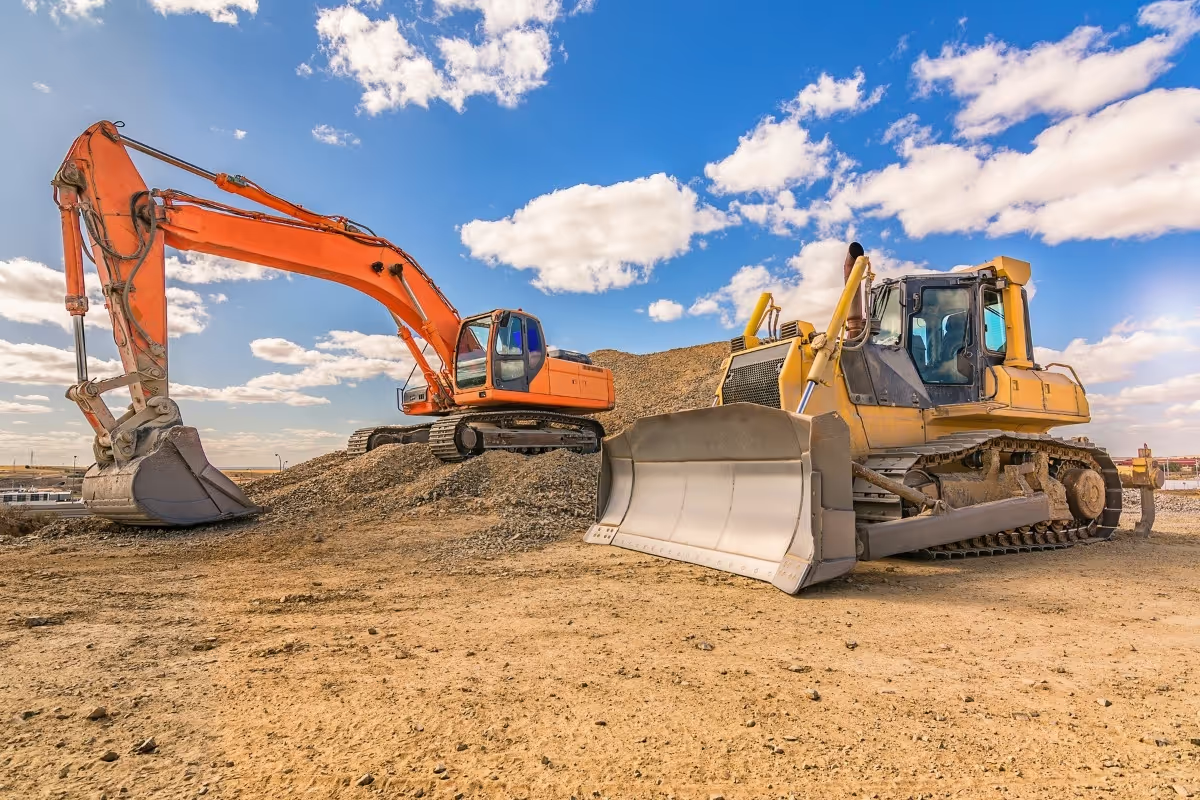
Heavy equipment financing — Excavators, concrete pumps, compactors, logging equipment, and construction assets for Kamloops's development pipeline and regional infrastructure projects.
Refinancing and sale-leaseback — Converts equity in owned equipment into working capital without requiring a sale. Supported on qualifying hard assets up to a reasonable percentage of current market value. Useful for established forestry operations, transportation companies, and hospitality businesses with substantial equipment portfolios.
Asset-based lending — For larger capital requirements backed by a portfolio of equipment or receivables. Relevant for established forestry operations, transportation fleets, hospitality businesses, and larger construction contractors with recurring equipment financing needs.
Equipment line of credit — A revolving draw facility for businesses financing equipment on a recurring basis — useful for forestry operations managing logging and processing equipment cycles, transportation companies acquiring seasonal capacity, or construction contractors adding equipment.
Invoice and freight factoring — Converts outstanding invoices into immediate working capital. Factoring approval is based primarily on your customers' creditworthiness — not yours. Useful for Kamloops forestry suppliers and transportation operators managing receivables from forest products companies and logistics customers.
Working capital loans — Short-term capital to bridge between timber sales cycles, cover equipment costs ahead of a busy season, or manage timing between equipment acquisition and production or freight revenue.
Review the eligible equipment guide to confirm what asset types qualify before applying.
This is a market reality specific to Kamloops's forestry economy that creates a financing pattern distinct from most other Canadian regions.
Interior BC's forestry has been dramatically affected by the mountain pine beetle epidemic, which killed millions of hectares of timber over the past 15+ years. This created short-term increases in available beetle-kill timber (salvage logging) but long-term decreases in healthy timber supply. Lumber mills and forestry operations have had to adapt equipment and operations to changing timber supply availability, quality, and location.
Environmental regulations also affect forestry operations. Changes in forestry regulations, stream protection requirements, and land use designations can affect log supply and require equipment changes. Forestry operations must navigate increasingly complex environmental compliance requirements.
The financing challenge: forestry equipment investment is justified by current timber supply and regulatory environment — but timber supply and regulations change. Equipment financed for beetle-kill salvage logging may have different utility when transitioning to managed harvest areas. Mills financed for specific log sizes and quality may need equipment changes as timber supply characteristics shift.
The practical advice: Forestry operations seeking equipment financing should include documentation of timber supply (salvage vs. managed harvest), log supply contracts, timber quality expectations, environmental compliance requirements, and realistic downside scenario planning acknowledging timber supply uncertainty. The conversation with underwriters should be explicit: "Our timber supply has shifted from beetle-kill salvage to managed harvest. Here's our current log supply documentation, here's how our equipment specifications match current timber availability, and here's our analysis of equipment value if timber supply characteristics change further."
Kamloops's forestry economy has transitioned from beetle-kill salvage (temporary spike in timber availability) to managed harvest (sustainable but lower long-term volumes). This creates a critical financing dynamic: forestry operations positioned for sustainable timber supply with documented harvest rights are fundamentally different from operations dependent on declining salvage opportunity.
For Kamloops forestry operations, this creates a predictable dynamic: operations that finance equipment based on clearly documented, contractually-secured timber supply are better positioned than operations that finance anticipating future timber availability or optimistic salvage scenarios.
The forestry operator who can say "We have timber supply contracts securing log volumes for the next five years; our equipment is right-sized for this supply; and we have secondary equipment value if supply changes" has a fundamentally different credit profile than an operator dependent on uncertain future salvage opportunity.
Pre-qualifying now, understanding your equipment financing range, and having a clear conversation with Mehmi about what forestry equipment is justified by clearly documented timber supply is the exercise. Your equipment financing should be contingent on firm timber supply documentation, not on optimistic or uncertain timber scenarios.
Use the amortization calculator to model different timber supply scenarios before finalizing equipment investment.
Illustrative example only; not a statement of a specific funded client transaction.
A specialty lumber mill in Kamloops — established in 1998, producing specialty wood products and value-added lumber — had benefited substantially from beetle-kill salvage logging during the 2000s-2010s pine beetle epidemic. The mill had processed high volumes of salvage timber at attractive margins. As beetle-kill timber declined (by 2020, most accessible salvage had been harvested), the mill needed to transition to managed harvest timber supply.
An opportunity arrived: the mill secured a long-term timber supply agreement with a provincial timber management company for managed harvest timber in the Thompson-Nicola region. The supply agreement guaranteed timber volumes for five years with pricing indexed to commodity prices. The timber was of different characteristics than beetle-kill salvage — larger logs, different species mix — requiring mill equipment adapted to the managed harvest log profile.
The equipment investment: new debarking and log scaling systems, updated milling headrig and sawing configuration, specialty lumber grading and sorting equipment — total quoted at $520,000 from a mill equipment supplier. Equipment needed to be installed and operational before the managed harvest timber supply began (month 2 of the supply agreement).
The challenge: The mill's existing bank statements showed profitable operations during the beetle-kill salvage period. The managed harvest timber supply agreement was definitive — but the $520,000 file required substantial financial statement documentation. The equipment investment was contingent on the timber supply transition being successful.
How Mehmi structured it: The file was submitted with the $520,000 milling equipment package supported by three years of accountant-prepared financial statements showing salvage-based profitability, the timber supply agreement confirming five-year managed harvest timber with volumes and pricing, detailed analysis comparing salvage timber characteristics to managed harvest characteristics, equipment specifications tied to managed harvest log profiles, equipment delivery and installation timeline aligned with timber supply agreement start, realistic timber supply and mill profitability analysis acknowledging transition challenges, secondary market analysis for the equipment (acknowledging value for managed harvest operations), and explicit discussion of transition risks and risk mitigation.
What made it work: The combination of an established mill (25 years, profitable, industry knowledge), definitive five-year managed harvest timber supply agreement with clearly documented volumes and pricing, realistic analysis of salvage-to-managed harvest transition, equipment specifications precisely matched to managed harvest timber characteristics, and explicit discussion of transition risks and mitigation strategies created a manageable forestry operation credit case. The timber supply agreement provided direct capacity evidence. The transition analysis demonstrated realistic planning. The risk discussion showed mill operator sophistication and realistic thinking.
Approval and funding timelines vary by lender, application completeness, and required conditions. Equipment delivery and installation completed on timeline. Milling equipment operational when managed harvest timber supply began. The mill successfully transitioned from salvage to managed harvest operations. Mill profitability was sustained through the transition (managed harvest timber at lower volumes but stable long-term supply offset declining salvage availability). The timber supply agreement was renewed for an additional five years. The equipment line of credit was implemented for ongoing mill equipment upgrades and optimization as managed harvest operations matured.
Kamloops's forestry, transportation, tourism, professional services, and construction economy generates a distinctive equipment financing profile. These are the asset types we see most frequently, each linked to its specific financing page:
Forestry & Forest Products
Transportation & Logistics
Tourism & Hospitality
Professional Services & Office
Construction & Industrial Development
Forestry and forest products — Logging operations, sawmills, pulp and paper operations, and specialty wood manufacturers. Equipment finances on timber supply contracts and production volumes. Interior BC forestry has transitioned from salvage to managed harvest operations.
Transportation and logistics — Carriers, logistics operators, and specialized transport serving interior BC supply chains. Equipment finances on freight volumes and Highway 1 connectivity. See the comprehensive guide to transportation and logistics equipment financing.
Tourism, hospitality, and recreation — Resorts, restaurants, adventure tourism, and hospitality businesses serving regional and visitor populations. Equipment finances on occupancy and expansion.
Professional services and commercial operations — Law, accounting, consulting, and business services. Equipment finances on business growth and technology refresh.
Construction and residential development — Residential and commercial development serving Kamloops and interior BC. Equipment finances on development permits and construction timelines. See the comprehensive guide to construction equipment financing.
Most equipment financing applications require:
For forestry operations: include timber supply contracts or agreements confirming timber volumes and availability, timber characteristics documentation, log supply history, equipment specifications tied to timber supply, equipment requirements analysis, and bank statements. Timber supply contracts are as critical as financial statements for forestry files.
For transportation and logistics operators: include customer contracts or freight agreements, regional routing and supply chain documentation, equipment requirements, and bank statements.
For hospitality and tourism operators: include seasonal occupancy or average daily rate documentation, facility expansion plans, equipment requirements, and bank statements.
For professional services: include client roster documentation, staffing expansion plans, equipment requirements, and bank statements.
For construction contractors: include development permits, project pipelines, and equipment requirements alongside bank statements.
Dealer purchases process fastest — application-only files under $250,000 with a clean bureau are reviewed according to lender requirements.
Larger files over $250,000 may require financial statements. Files over $500,000 typically need three years of accountant-prepared statements plus interim financials. Forestry operations may have alternative underwriting based on timber supply contracts and commodity market conditions.
Questions before applying Review the FAQ or explore all financing services to understand every option available.
Ready to get your equipment funded in Kamloops?Call us directly at 437-777-5901 or apply online today to get an approval subject to lender review.
Related resource: Browse our equipment financing by city directory for more local financing guides.
Q. How fast are equipment financing approvals in Kamloops?A. Approval and funding timelines vary by lender, application completeness, and required conditions. Application-only files under $250,000 with a clean bureau are reviewed according to lender requirements. Approval and funding timelines vary by lender, application completeness, and required conditions.
Q. I'm a forestry operation with a timber supply contract. What documents do I need for equipment financingA. Include your business bank statements (6 months), the timber supply agreement confirming volumes, timber characteristics, and pricing terms, timber availability and harvest schedule documentation, equipment specifications tied to timber supply characteristics, equipment delivery and operational timeline, secondary market analysis for the equipment, and equipment supplier quotes. Timber supply contracts are as critical as financial statements for forestry files.
Q. How do timber supply changes and environmental regulations affect my equipment financingA. Timber supply characteristics and regulatory environment affect equipment specifications and value. Include documentation showing your understanding of timber supply dynamics, how your equipment specifications match current timber characteristics, and your analysis of equipment value if timber supply shifts. Forestry operators who demonstrate sophisticated understanding of supply dynamics strengthen applications.
Q. I'm transitioning from salvage to managed harvest timber supply. What should I include in my equipment financing applicationA. Include timber supply agreements confirming managed harvest timber volumes and pricing, detailed analysis comparing salvage to managed harvest characteristics, equipment specifications tied to managed harvest log profiles, operational transition plan, and realistic profitability analysis acknowledging transition challenges. Explicit transition planning and risk management discussion strengthen applications.
Q. What is PST/GST treatment for leased forestry equipment in BCA. BC applies 7% PST to equipment value (non-recoverable) and 5% GST (recoverable for GST-registered businesses). Consult with your accountant about how your lease structure affects PST and GST liability for your specific equipment type.
Q. Can I finance equipment if I'm a transportation or logistics operatorA. Yes. Include your business bank statements (6 months), customer contracts or freight agreements, regional route documentation, equipment requirements, and equipment supplier quotes. Customer agreements and routing documentation provide capacity evidence.
Q. Can I finance equipment if I'm a hospitality or tourism operator in KamloopsA. Yes. Include your business bank statements (6 months), seasonal occupancy or average daily rate documentation, facility expansion plans, equipment requirements, and equipment supplier quotes. Occupancy documentation and expansion plans provide capacity evidence.
Q. Can I refinance equipment I already ownA. Yes. A refinancing or sale-leaseback converts equity in owned equipment into working capital without requiring a sale. Supported on qualifying hard assets up to a reasonable percentage of current market value.
Q. What equipment types qualify in KamloopsA. Forestry, transportation, hospitality, professional services, and construction equipment all qualify. See the eligible equipment guide for the complete list.
.avif)
.svg)