
This page covers equipment financing in Nanaimo, British Columbia — who qualifies, what structures are available, how approvals work, and what local businesses need to know before applying. Nanaimo is Vancouver Island's second-largest city and primary commercial centre, home to the Port of Nanaimo (a major coal export terminal and general cargo port), Nanaimo Harbour and waterfront industrial operations, a growing healthcare and professional services hub anchored by Nanaimo General Hospital and Nanaimo Regional General Hospital, a forest products and lumber manufacturing corridor, and a significant construction and trades economy serving Vancouver Island's residential and commercial growth. Approval and funding timelines vary by lender, application completeness, and required conditions.
Nanaimo holds a geographic and economic position on Vancouver Island that its population of 90,000 alone understates. It is the island's second-largest city and primary commercial centre — positioned midway between Victoria to the south and Courtenay-Comox to the north, serving as the distribution hub for the entire central and northern island. The Port of Nanaimo on the downtown waterfront operates as one of BC's three major coal export terminals (alongside Port Metro Vancouver and Prince Rupert) and handles general cargo, containerized freight, and bulk commodities. The adjacent industrial zone hosts lumber mills, forest products facilities, and marine fabrication shops. Departure Bay, immediately north of downtown, operates as the primary BC Ferries terminal connecting to Horseshoe Bay and the Lower Mainland.
Nanaimo's commercial corridors along Bowen Road, Cavendish Avenue, and the Harewood commercial area serve a local population and a regional catchment extending from Parksville and Qualicum Beach to the north through Ladysmith, Duncan, and the Cowichan Valley to the south. Nanaimo General Hospital and Nanaimo Regional General Hospital anchor a healthcare and professional services corridor. The residential construction market has been one of Vancouver Island's most active for the past five years, with growth concentrated in the Harewood, Departure Bay, and Woodstone developments.
Approval and funding timelines vary by lender, application completeness, and required conditions. Whether you're a Port of Nanaimo cargo handler, a lumber mill or forest products manufacturer, a construction contractor building in Harewood or Departure Bay, a healthcare provider serving Nanaimo General Hospital and the regional patient base, a BC Ferries-connected transportation or logistics business, a marine fabrication or boat building operation, or a commercial services business serving Vancouver Island's central hub, Mehmi structures financing around how Nanaimo's economy actually operates.
Equipment can be sourced from Vancouver Island and Lower Mainland dealers, private sellers, or auctions. High-hour and older units qualify regularly when they continue generating stable revenue and are properly documented.
Use the equipment payment calculator to model monthly payments before you apply.
When buying or refinancing business assets in Nanaimo, compare the structure and total ownership cost—not just the monthly payment. Availability and terms depend on equipment, business credit, cash flow and individual lenders.
| Equipment funding need | Option to compare | What to verify |
|---|---|---|
| Purchasing eligible construction machinery | Equipment loan or conditional sale | Equipment value, term, interest calculation, down payment, collateral, title and early-payout terms. |
| Using equipment while managing initial cash outlay | Equipment lease | Payment schedule, deposits, insurance, end-of-term purchase options, return conditions and total cost. |
| Purchasing from a used-equipment dealer or private seller | Used-equipment financing | Asset age, hours or mileage, inspection, seller verification, lien search and any lender limits. |
| Unlocking equity in owned machinery or vehicles | Equipment refinancing or sale-leaseback | Appraised value, current liens, payout amounts, advance against value, fees and continuing use of the asset. |
| Buying multiple assets or upgrading in stages | Equipment financing facility or separate leases | Each asset's eligibility, draw timing, security, documentation, amortization and combined payment burden. |
Next step: Compare equipment loans, leases and refinancing before requesting indicative terms. Examples above are educational, not offers or approvals.
Nanaimo's economy creates equipment financing demand across four distinct sectors with different financing patterns and market realities.
Port of Nanaimo and marine cargo operations require containers, forklifts, cargo handling equipment, and dock infrastructure tied to ship schedules and commodity export cycles. Coal exports follow market pricing and seasonal shipping patterns. General cargo and container volumes fluctuate with Lower Mainland and international demand. Equipment financing aligns with Port throughput cycles and the timing of cargo movement.
Forest products and lumber manufacturing operates at high capacity utilization and finances sawmill equipment, kiln systems, lumber grading and sorting machinery, and log handling systems tied to timber supply and lumber demand cycles. Mill shutdowns during seasonal slowdowns or equipment breakdowns create urgent financing needs that resolve within the production schedule. Island-wide log supply contracts influence equipment investment decisions.
Construction, trades, and residential development serving Vancouver Island's active housing market — including residential infill in Harewood, Departure Bay, and Woodstone, commercial construction, and utility infrastructure — require equipment financing tied to development permits, municipal servicing approvals, and construction timelines.
Healthcare providers and practitioners supporting Nanaimo General Hospital and Nanaimo Regional General Hospital — including surgical centres, diagnostic imaging clinics, rehabilitation facilities, and specialist physician offices — finance diagnostic and treatment equipment on revenue ramps tied to patient volumes and referral growth from the regional hospital network.
For operators who want full ownership from day one, equipment loans provide a clear path — fixed payments, equity build, and refinancing options when working capital is needed.
Lenders assess five core factors — character, capacity, capital, collateral, and conditions — and the strength of your file across all five determines what gets approved, on what terms, and at what rate.
Character is your business track record. Years in operation, commercial bureau history, and whether bank statements reflect consistent, well-managed cash flow. Documentation requirements vary by lender, transaction size, business history, and credit profile. Port and marine operators with established cargo handling contracts and documented vessel schedules qualify frequently. Forest products operators with long-term timber supply agreements strengthen applications.
Capacity is whether your revenue supports the proposed payment. For Port operations, cargo manifests and shipping contracts confirm volume. For lumber mills, production volume, timber supply agreements, and customer purchase orders. For construction, municipal development permits and general contractor workload projections. For healthcare providers, referral volume from Nanaimo General Hospital and patient appointment utilization demonstrate capacity.
Capital is your equity position. Nanaimo's waterfront industrial real estate and commercial property have appreciated substantially. Owner-occupied warehouse, mill, or dock space is a strong capital indicator. Equipment owned free and clear strengthens applications. Residential property ownership in Nanaimo's established neighbourhoods provides capital evidence.
Collateral is the asset itself. Port and cargo handling equipment has active regional and provincial secondary markets. Lumber mill equipment has national resale value and well-developed refurbishment networks. Construction equipment has strong regional markets. Healthcare diagnostic equipment has national and provincial refurbishment networks.
Conditions cover the deal structure — term length, payment structure, advance amount, and documentation requirements. Files over $250,000 may require financial statements. Files over $500,000 typically need three years of accountant-prepared statements plus interim financials.
Thresholds above reflect typical patterns across Mehmi's financing programs. Requirements vary by program and file.
Equipment loans — Full ownership from day one. Fixed payments, equity build, and the asset on your balance sheet. Best for long-lived mill, Port, construction, and healthcare assets Nanaimo businesses plan to keep.
Equipment leasing — Lower upfront cost with end-of-term flexibility — return, renew, or purchase. BC's 7% PST applies to equipment value; lease payment PST treatment is equipment-specific. Commonly used by construction contractors with shorter equipment cycles and healthcare providers managing diagnostic equipment refresh timelines.
Conditional sales contracts — Fixed payments with a nominal buyout at the end. A common ownership path for Port cargo equipment, lumber mill machinery, construction assets, and commercial vehicles throughout BC.
Truck and trailer financing — For Nanaimo carriers, construction contractors, and logistics operators serving Vancouver Island's interior and Lower Mainland connections. Port-adjacent and terminal operations frequently finance heavy-duty trucks.
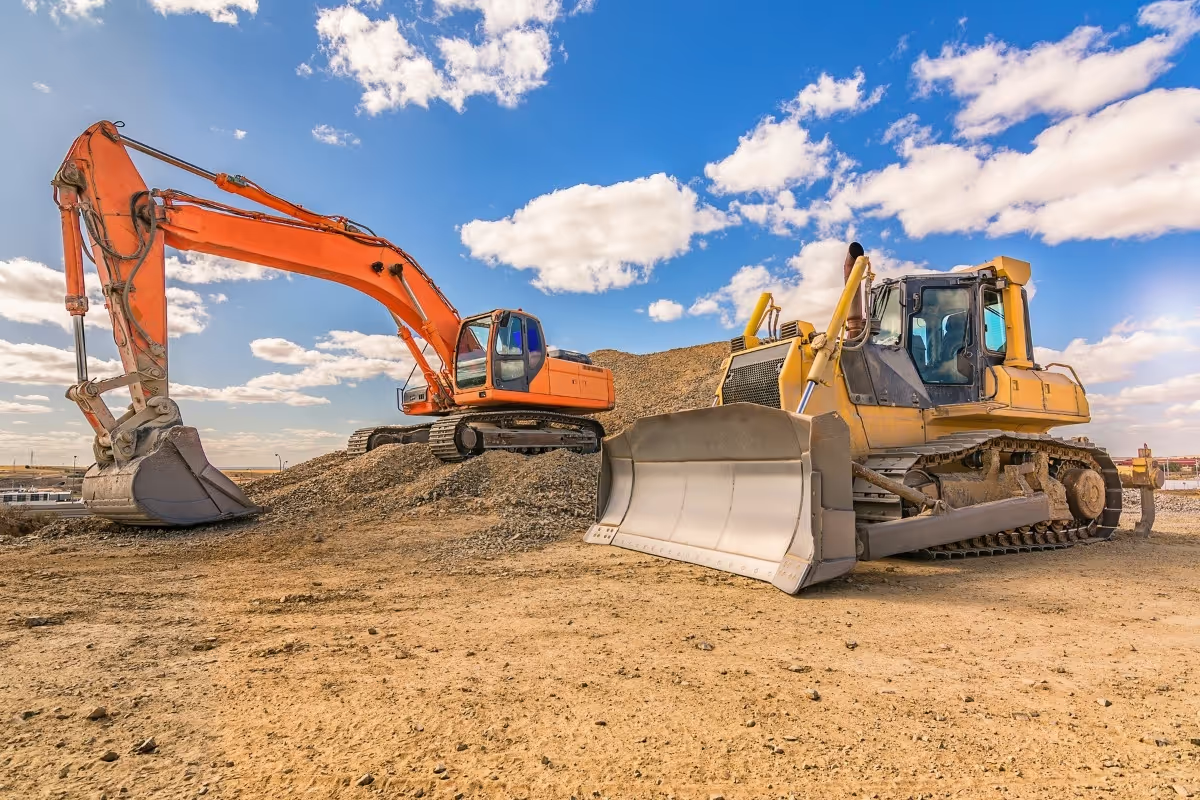
Heavy equipment financing — Excavators, concrete pumps, compactors, and construction assets for Nanaimo's Harewood, Departure Bay, and residential development pipeline.
Refinancing and sale-leaseback — Converts equity in owned equipment into working capital without requiring a sale. Supported on qualifying hard assets up to a reasonable percentage of current market value. Useful for established mills and Port operations with substantial equipment portfolios.
Asset-based lending — For larger capital requirements backed by a portfolio of equipment or receivables. Relevant for established Port cargo operations, lumber mills, and larger construction contractors with recurring equipment financing needs.
Equipment line of credit — A revolving draw facility for businesses financing equipment on a recurring basis — useful for construction contractors adding capacity phase by phase, or lumber operations managing equipment replacement cycles.
Invoice and freight factoring — Converts outstanding invoices into immediate working capital. Factoring approval is based primarily on your customers' creditworthiness — not yours. Useful for Nanaimo contractors managing 30–45 day receivables from general contractors and developers.
Working capital loans — Short-term capital to bridge between project payments, cover equipment costs ahead of a busy construction season, or manage timing between equipment installation and revenue ramp-up.
Review the eligible equipment guide to confirm what asset types qualify before applying.
This is a market reality specific to Nanaimo's Port operations and coal export economy that creates a financing pattern distinct from containerized or general cargo ports.
Coal exports through the Port of Nanaimo follow global commodity pricing, shipping availability, and seasonal shipping patterns. A coal company may operate at full capacity during high-price periods, then scale back during commodity downturns. The financing challenge: a cargo handling operator may need to finance new forklifts, loaders, or dock equipment in anticipation of a high-volume export season — but the decision to proceed rests on forward price projections and ship availability that are inherently uncertain.
Port operators who over-invest in equipment capacity during anticipated peak seasons face utilization shortfalls if commodity prices soften or shipping slows. Port operators who under-invest miss capacity opportunities when volumes arrive unexpectedly.
The underwriting reality: Port of Nanaimo cargo operators seeking equipment financing should provide clear documentation of current contracts, forward booking patterns, or commodity pricing expectations. For established operators with five-plus years of Port history, that documentation typically exists in the form of annual summaries, industry analyst reports, or forward contracts with shipping companies or commodity buyers.
The practical advice: Port of Nanaimo cargo handling operators should include current and forward cargo contracts, vessel booking schedules, or commodity pricing documentation alongside standard application materials. For established operators with long-term Port relationships, annual throughput summaries from the Port Authority or historical shipping manifests provide capacity evidence. The conversation with underwriters should be explicit: "We're financing this equipment to serve anticipated coal export volumes in the next 18 months, and here's our forward contract pipeline." That clarity accelerates approvals and structures terms around actual Port activity rather than worst-case utilization assumptions.
The Harewood residential expansion — driven by municipal servicing upgrades, transit-oriented development planning around the proposed Nanaimo rapid transit system, and infill intensification in established residential areas — has created one of Vancouver Island's most active construction markets outside the Greater Victoria area. The Departure Bay neighbourhood redevelopment and the Woodstone community expansion have added 3,000+ housing units in planning or construction over the past 24 months.
For Nanaimo construction contractors, this creates a predictable forward pipeline: as residential development density increases, demand for concrete work, underground servicing, and mid-rise construction will outrun available contractor capacity in the same way suburban expansion has created equipment shortages in other growing Canadian markets.
The contractors who are best positioned to capture this demand are those who have established financing relationships and equipment capacity before the pipeline peaks — not those who try to scale up after project awards arrive. Pre-qualifying now, understanding your equipment financing range, and having a clear conversation with Mehmi about what fleet additions would position you for the Nanaimo region's next phase of growth is the exercise.
Nanaimo's building permit activity is publicly documented. Your equipment financing capacity should align with forward permit visibility.
Use the amortization calculator to model different equipment scenarios before the residential growth pipeline accelerates further.
Illustrative example only; not a statement of a specific funded client transaction.
A mid-sized sawmill on the outskirts of Nanaimo — operating since 2005, processing 150 million board feet annually of Vancouver Island timber — had been operating at consistent 85 percent capacity utilization. A major timber supply contract with a large forestry company operating across the central island provided steady log supply, and the mill's primary customer base consisted of export lumber dealers and Lower Mainland building material distributors.
A timber supply opportunity arrived: the forestry company offered a five-year supply agreement providing an additional 50 million board feet annually, contingent on the mill upgrading its sorting and grading line and installing a new kiln system to accommodate higher throughput and premium-grade product demand. The equipment investment was quoted at $520,000 from a Vancouver equipment supplier.
The challenge: The mill's existing bank statements showed strong, consistent cash flow. The five-year timber supply agreement was definitive and provided clear forward revenue. But $520,000 equipment financing crossed the threshold requiring financial statements — and the mill's accountant-prepared statements would need three years of history plus interim financials.
How Mehmi structured it: The file was submitted with the complete $520,000 equipment package supported by three years of accountant-prepared financial statements, the current year interim financials (through September), the equipment supplier quote, the five-year timber supply agreement (with commercial terms confirmed), and a capacity letter from the mill operator confirming current production and the revenue impact of the new supply agreement. The long-term supply contract served as direct capacity evidence and justified the equipment investment.
What made it work: The combination of established mill operations, three years of audited financials, and a definitive five-year timber supply agreement created a straightforward credit case. The mill's 85 percent existing capacity and the documented supply commitment provided clear evidence that new equipment would immediately move to higher utilization. The supply agreement was specific enough that underwriters could model revenue impact independently.
Approval and funding timelines vary by lender, application completeness, and required conditions. Equipment delivery from the supplier coordinated with mill shutdown for installation. New kiln and sorting line operational within six weeks. Mill capacity immediately increased to 95 percent utilization. The mill's throughput increased from 150 million board feet to 200 million annually within 12 months, and the forestry company renewed the supply agreement for an additional five years. The asset-based lending facility was noted as a future tool for managing larger capital investments.
Nanaimo's Port and cargo, lumber manufacturing, construction, and healthcare services economy generates a distinctive equipment financing profile. These are the asset types we see most frequently, each linked to its specific financing page:
Port & Cargo Operations
Lumber Manufacturing
Construction & Trades
Healthcare Services
Port, logistics, and transportation — Port of Nanaimo cargo handling, material handling and logistics operations, warehousing and bulk commodity storage serving Nanaimo's coal export terminal and general cargo operations. Equipment from forklifts to cargo loaders to container systems finance on Port activity cycles and forward booking patterns. See the comprehensive guide to transportation and logistics equipment financing.
Manufacturing and wholesale — forest products — Sawmills, lumber manufacturers, and forest products operations processing Vancouver Island timber. Sawmill equipment, kiln systems, grading and sorting machinery, and log handling systems finance on timber supply agreements and lumber demand. See the comprehensive guide to manufacturing equipment financing.
Construction and contractors — Residential development in Harewood, Departure Bay, and Woodstone; commercial construction; and civil infrastructure throughout central Vancouver Island. Excavators, concrete pumps, compactors, and mid-rise construction equipment serve one of Vancouver Island's most active housing markets outside Greater Victoria. See the comprehensive guide to construction equipment financing.
Healthcare services and medical practices — Nanaimo General Hospital, Nanaimo Regional General Hospital, diagnostic imaging centres, surgical facilities, and specialist physician offices. Diagnostic and treatment equipment financing supports healthcare providers serving Nanaimo and the regional referral base.
Marine fabrication and boat building — Marine shops, boat building operations, and waterfront industrial businesses serving BC's marine industry.
Hospitality and food service — Restaurants and food service operators across Nanaimo's commercial corridors and waterfront areas access kitchen, refrigeration, and service equipment financing.
Most equipment financing applications require:
For Port of Nanaimo cargo operations: include cargo manifests, vessel booking schedules, or forward shipping contracts confirming volume alongside bank statements. Commodity pricing documentation or forward export contracts accelerate approvals.
For lumber mills and forest products: timber supply agreements and customer purchase orders alongside bank statements confirm capacity and investment justification.
For construction contractors: municipal development permits, general contractor workload projections, or project timelines alongside bank statements confirm forward workload.
For healthcare providers: referral volume from Nanaimo General Hospital and patient appointment utilization documentation alongside bank statements confirm capacity.
Dealer purchases process fastest — application-only files under $250,000 with a clean bureau are reviewed according to lender requirements.
Larger files over $250,000 may require financial statements. Files over $500,000 typically need three years of accountant-prepared statements plus interim financials.
Questions before applying Review the FAQ or explore all financing services to understand every option available.
Ready to get your equipment funded in Nanaimo? Call us directly at 1-833-863-4644 or apply online to request financing options, subject to lender review.
Related resource: Browse our equipment financing by city directory for more local financing guides.
Q. How fast are equipment financing approvals in Nanaimo?A. Approval and funding timelines vary by lender, application completeness, and required conditions. Application-only files under $250,000 with a clean bureau are reviewed according to lender requirements. Construction contractor files with complete project timelines and permit documentation are assessed according to lender requirements. Approval and funding timelines vary by lender, application completeness, and required conditions.
Q. I operate a cargo handling business at the Port of Nanaimo. What documents do I need for equipment financingA. Include your business bank statements (6 months), cargo manifests or vessel booking schedules confirming volume and forward activity, shipping contracts or commodity pricing documentation, and the equipment quote. Forward booking patterns and contract documentation create clear capacity evidence for Port operations.
Q. I'm a lumber mill operator. Does my timber supply agreement strengthen my applicationA. Yes, significantly. Include your timber supply agreement alongside three years of accountant-prepared financial statements, interim financials (if your file exceeds $250,000), and the equipment quote. A definitive long-term timber supply contract provides direct capacity evidence and justifies the equipment investment.
Q. What happens if commodity prices drop during my loan termA. Your financing obligation remains fixed and unchanged. Equipment financing payments are not commodity-price-dependent. The conversation with underwriters should acknowledge commodity cycles, but financing terms assume your ability to manage the business through normal commodity fluctuations.
Q. I'm a construction contractor building in Harewood. What documents support my applicationA. Include your business bank statements (6 months), municipal development permits for the projects you're building, general contractor workload projections or project timelines, and the equipment quote. Documented project pipeline and permit activity provide capacity evidence.
Q. Can I refinance equipment I already ownA. Yes. A refinancing or sale-leaseback converts equity in owned equipment into working capital without requiring a sale. Supported on qualifying hard assets up to a reasonable percentage of current market value.
Q. What is PST treatment for leased equipment in BCA. BC applies 7% PST to leased equipment. PST treatment is equipment-specific — consult with your accountant about how your lease structure affects PST liability for your specific equipment type.
Q. What equipment types qualify in NanaimoA. Port and cargo handling equipment, sawmill and lumber manufacturing machinery, construction and heavy equipment, and healthcare diagnostic and surgical systems all qualify. See the eligible equipment guide for the complete list.

.svg)