
This page covers equipment financing in Richmond, British Columbia — who qualifies, what structures are available, how approvals work, and what local businesses need to know before applying. Richmond is Metro Vancouver's airport city — home to Vancouver International Airport (YVR), Canada's second-busiest air cargo gateway, the South Arm of the Fraser River industrial waterfront, one of Metro Vancouver's most productive ALR farming zones, a major cold chain and food processing corridor on No. 3 Road and Cambie Road, and sustained residential and commercial construction along the Brighouse and Oval District growth areas. Approval and funding timelines vary by lender, application completeness, and required conditions.
Richmond is the only city in Metro Vancouver where you can finance an aircraft tow tractor in the morning and a field tractor for a cranberry bog in the afternoon. Its economic geography is genuinely unique: the entire city sits on the Fraser River delta, bounded by YVR to the west, the South Arm of the Fraser to the south, and the North Arm to the north. The airport anchors Canada's second-largest air cargo operation. The ALR (Agricultural Land Reserve) preserves some of the most productive farmland in BC — blueberries, cranberries, vegetables, and greenhouse crops — in the city's southeast. The South Arm industrial waterfront runs cold storage, fish processing, marine services, and container operations. And No. 3 Road, Cambie Road, and the Brighouse core push dense commercial and residential development northward.
Approval and funding timelines vary by lender, application completeness, and required conditions. Whether you're an aviation ground support operator at YVR, a cold chain logistics company in the Crestwood Industrial area, a food processor or seafood operation on the South Arm waterfront, a farm or greenhouse business on the Richmond ALR, a construction contractor building in the Brighouse or Hamilton neighbourhoods, or a healthcare business serving Richmond's dense residential population, Mehmi structures financing around how Richmond's multi-layered economy actually operates.
Equipment can be sourced from Greater Vancouver dealers, the Lower Mainland market, private sellers, or auctions. High-hour and older units qualify regularly when they continue generating stable revenue and are properly documented.
Use the equipment payment calculator to model monthly payments before you apply.
When buying or refinancing business assets in Richmond, compare the structure and total ownership cost—not just the monthly payment. Availability and terms depend on equipment, business credit, cash flow and individual lenders.
| Equipment funding need | Option to compare | What to verify |
|---|---|---|
| Purchasing eligible agricultural machinery | Equipment loan or conditional sale | Equipment value, term, interest calculation, down payment, collateral, title and early-payout terms. |
| Using equipment while managing initial cash outlay | Equipment lease | Payment schedule, deposits, insurance, end-of-term purchase options, return conditions and total cost. |
| Purchasing from a used-equipment dealer or private seller | Used-equipment financing | Asset age, hours or mileage, inspection, seller verification, lien search and any lender limits. |
| Unlocking equity in owned machinery or vehicles | Equipment refinancing or sale-leaseback | Appraised value, current liens, payout amounts, advance against value, fees and continuing use of the asset. |
| Buying multiple assets or upgrading in stages | Equipment financing facility or separate leases | Each asset's eligibility, draw timing, security, documentation, amortization and combined payment burden. |
Next step: Compare equipment loans, leases and refinancing before requesting indicative terms. Examples above are educational, not offers or approvals.
Richmond's economy creates equipment financing needs that are more diverse per square kilometre than almost any other Canadian city.
Aviation ground support operators at YVR — providing aircraft pushback, towing, baggage handling, gate services, and cargo ramp support — finance aircraft tow tractors, ground power units, baggage tugs, and cargo handling equipment that depreciates predictably and generates revenue on every flight cycle. YVR's cargo throughput has grown consistently as transpacific freight volumes through the Lower Mainland have expanded, making ground support equipment a recurring capital need for operators under Air Canada ground handling contracts, WestJet service agreements, and cargo operator service arrangements.
Cold chain logistics and food processing operators in the Crestwood Industrial area, along Cambie Road, and on the South Arm waterfront — refrigerated warehousing companies, seafood processors, produce distributors, and Asian food import and distribution businesses serving Metro Vancouver's grocery and food service markets — finance cold storage infrastructure, reefer trucks, forklifts, and processing equipment. The cold chain sector in Richmond is among the most concentrated in BC outside of the Lower Mainland Port industrial areas, driven by YVR's air cargo gateway position and Richmond's direct Sea Island and South Arm water access.
ALR farm and greenhouse operators — growing blueberries, cranberries, vegetables, herbs, and greenhouse specialty crops in Richmond's southeast quadrant and along No. 5 Road — finance tractors, irrigation systems, field sprayers, and greenhouse climate equipment. Richmond's ALR land is among the most intensively cultivated in Metro Vancouver, and the capital investment per acre reflects both the land value and the market proximity to YVR air export and the region's grocery distribution network.
Construction contractors active on Richmond's residential intensification — the Brighouse TOD (transit-oriented development) corridor, the Hamilton neighbourhood build-out near the South Arm, and the Oval District mixed-use pipeline — work in a compressed site environment where equipment availability directly determines project throughput.
For operators who want full ownership from day one, equipment loans provide a clear path — fixed payments, equity build, and refinancing options when working capital is needed.
Lenders assess five core factors — character, capacity, capital, collateral, and conditions — and the strength of your file across all five determines what gets approved, on what terms, and at what rate.
Character is your business track record. Years in operation, commercial bureau history, and whether bank statements reflect consistent, well-managed cash flow. Documentation requirements vary by lender, transaction size, business history, and credit profile.
Capacity is whether your revenue supports the proposed payment. For aviation ground support operators, ground handling agreements or service contracts with named airline clients provide forward revenue context that strengthens larger files. For cold chain and food processing businesses, supply agreements with named grocery distributors or seafood buyers anchor capacity on larger transactions. For ALR farm operators, farm income declarations and direct-market sales records provide the seasonal revenue picture.
Capital is your equity position. Richmond's real estate values — even for ALR farmland, which carries significant per-acre value despite use restrictions — create strong equity positions for established operators. ALR land equity is a meaningful capital indicator when included in a complete personal net worth statement.
Collateral is the asset itself. Aviation ground support equipment has an active YVR and broader North American secondary market. Cold storage and reefer equipment has established BC and national markets. Agricultural equipment has a Metro Vancouver and BC-wide secondary market. Construction iron has the highly liquid Greater Vancouver secondary market.
Conditions cover the deal structure — term length, payment structure, advance amount, and documentation requirements. Files over $250,000 may require financial statements. Files over $500,000 typically need three years of accountant-prepared statements plus interim financials.
Thresholds above reflect typical patterns across Mehmi's financing programs. Requirements vary by program and file.
Equipment loans — Full ownership from day one. Fixed payments, equity build, and the asset on your balance sheet. Common for cold storage infrastructure, agriculture equipment, and aviation ground support assets Richmond businesses plan to keep long-term.
Equipment leasing — Lower upfront cost with end-of-term flexibility — return, renew, or purchase. In British Columbia, 7% PST applies to most equipment purchases and may apply to certain lease structures — confirm the full tax treatment with your accountant before committing to a structure.
Conditional sales contracts — Fixed payments with a nominal buyout at the end. Common for commercial vehicles, farm equipment, and construction iron across BC.
Truck and trailer financing — For Richmond cold chain carriers running reefer routes between YVR air cargo, the South Arm waterfront, and Metro Vancouver's grocery distribution network, and for logistics operators on the No. 3 Road and Cambie Road commercial corridors.
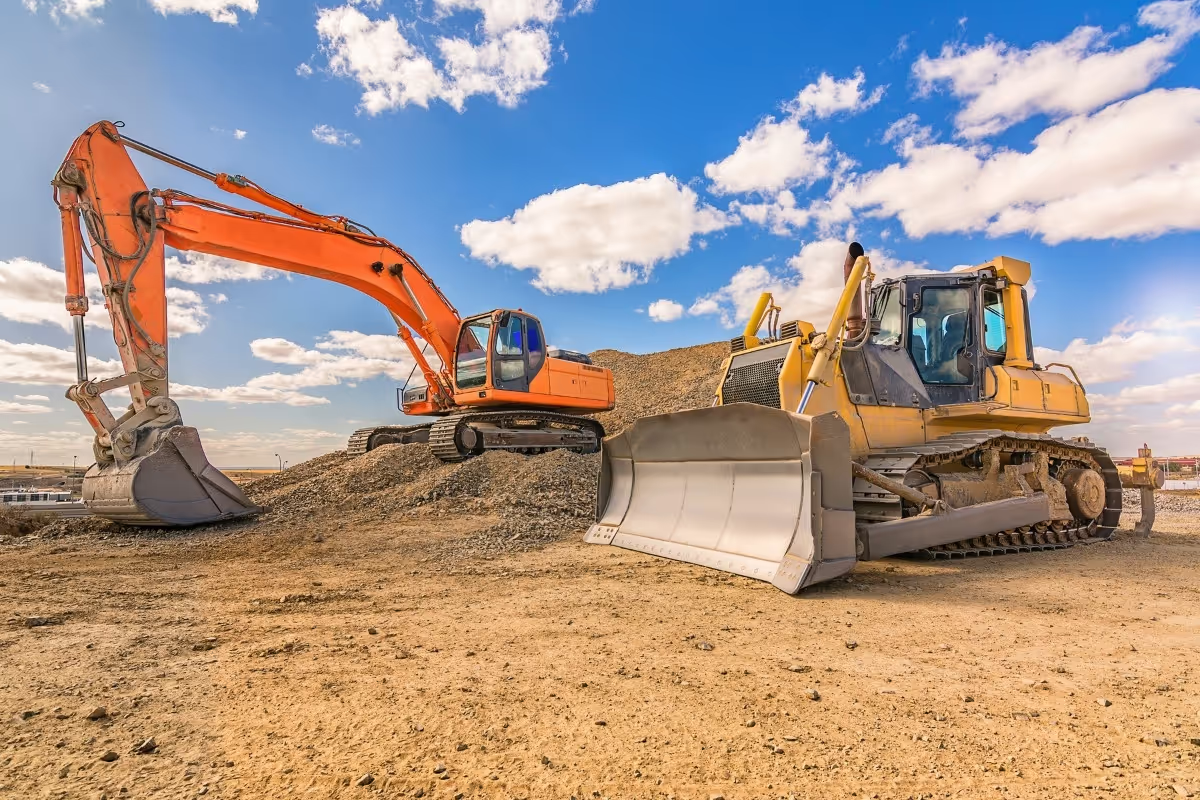
Heavy equipment financing — Excavators, compactors, and construction assets for Richmond's active Brighouse TOD, Hamilton, and Oval District construction pipeline.
Refinancing and sale-leaseback — Converts equity in owned equipment into working capital without requiring a sale. Supported on qualifying hard assets up to a reasonable percentage of current market value.
Asset-based lending — For larger capital requirements backed by a portfolio of equipment or receivables. Relevant for cold storage operators and food processors with significant asset holdings.
Equipment line of credit — A revolving draw facility for businesses financing equipment on a recurring basis — useful for aviation ground support operators cycling equipment across YVR contract renewals.
Invoice and freight factoring — Converts outstanding invoices into immediate working capital. Factoring approval is based primarily on your customers' creditworthiness — not yours. Useful for Richmond seafood processors and food distributors managing 30–45 day receivables from grocery chains and foodservice distributors.
Working capital loans — Short-term capital to bridge seasonal cash flow for farm operators, cover pre-season greenhouse infrastructure investment, or manage timing between cold storage equipment delivery and first tenant invoicing.
Review the eligible equipment guide to confirm what asset types qualify before applying.
Two Richmond-specific realities affect equipment financing in ways that operators frequently underestimate.
BC PST is 7% on most equipment purchases and is generally not recoverable as an ITC. Unlike Ontario's HST (fully recoverable) or Alberta (no PST), BC PST is a real, permanent cost on equipment purchases. On a $180,000 aircraft tow tractor, that's $12,600 in non-recoverable PST. On a $350,000 cold storage unit, it's $24,500. On a $480,000 excavator, it's $33,600. Every Richmond operator making a significant equipment purchase should confirm BC PST treatment for their specific asset category with their accountant before committing to a structure — because in some cases a lease structure may result in PST being applied differently than on an outright purchase, which can affect total cost.
ALR farmland equity is invisible in bank statements but is among the most valuable capital in Metro Vancouver. Richmond's ALR land — despite the use restrictions that prevent residential development — carries significant market value per acre, reflecting the scarcity of agricultural land in Metro Vancouver and the long-term optionality that ALR holders retain. A blueberry or cranberry farm operator on No. 5 Road with 10 acres of ALR land may hold $2–5 million in land equity that simply does not appear in farm income tax filings or bank statements.
For Richmond ALR operators applying for equipment financing, a personal net worth statement that explicitly includes ALR farmland at current assessed or recent comparable sale value transforms files that might read as cash-flow-thin into well-secured transactions. This is the same principle that applies to Saskatchewan dairy operators including quota value — the most important capital assets often require active documentation to be visible to a lender.
YVR handles over 300,000 tonnes of air cargo annually, making it Canada's second-busiest air cargo gateway. The cold chain infrastructure serving that cargo — refrigerated warehousing along Cambie Road and Crestwood Industrial, reefer transport between YVR air cargo facilities and Metro Vancouver distribution centres, and blast-freeze and temperature-controlled storage for transpacific seafood and perishable food products — operates under contracts that are typically renewed on one to three-year cycles aligned with airline freight rate agreements and grocery chain procurement calendars.
The financing mistake we see in Richmond's cold chain sector parallels what we see in Northern Ontario's forestry and Saskatchewan's grain sectors: operators financing equipment on the maximum useful life term (often 72–84 months for cold storage and refrigeration equipment) without considering what happens if the contract driving the revenue doesn't renew at the same scale.
A Richmond cold storage operator with a three-year refrigerated warehousing agreement serving an air cargo forwarder should structure the financing term to align with that contract period — not finance to the equipment's maximum 84-month life, accepting the lower monthly payment, and then face residual obligations on the back end if the contract renews at lower volume or changes character.
The structuring principle is the same everywhere in this series: finance to the contract, not to the asset. The slightly higher monthly payment on a 36-month term versus a 60-month term on cold storage equipment is a reasonable premium for the optionality it preserves at contract renewal.
Use the amortization calculator to model the payment difference between term lengths before committing to a structure.
Illustrative example only; not a statement of a specific funded client transaction.
A Richmond-based temperature-controlled logistics operator with two refrigerated trailers running between YVR air cargo facilities and Metro Vancouver grocery distribution centres was awarded a new three-year contract with an air freight forwarder handling transpacific perishable goods from Japan and Chile. The contract required dedicated refrigerated capacity on a daily basis — necessitating a third reefer trailer and a medium-duty refrigerated straight truck for local distribution.
The challenge: The combined equipment cost was $310,000. The operator had four years of operating history, consistent bank statement deposits tied to air cargo contract billing cycles, and a clean bureau — but the bank's commercial lending team quoted three to four weeks for review of a file this size.
How Mehmi structured it: The file was submitted with three months of bank statements, the new air freight forwarder contract confirming the three-year term and daily dedicated capacity requirement, and the equipment dealer invoices. The contract provided the forward revenue context that the bank statements — which reflected existing two-trailer operations — couldn't project forward. The term was structured at 36 months, matched to the initial contract period.
What made it work: The air freight contract was the capacity evidence. Without it, the underwriter assessed existing revenue only. With it, the file immediately reflected a known, signed revenue increase from a named, creditworthy air freight client operating through YVR.
Approval and funding timelines vary by lender, application completeness, and required conditions. Equipment delivered and operational before the contract start date. The operator fulfilled the three-year contract on schedule, earning a contract extension for an additional two years. The invoice and freight factoring facility was noted as a complementary tool for managing the 30-day payment cycle typical of air freight forwarder invoicing.
Richmond's aviation, cold chain, agriculture, construction, and commercial services economy generates one of the most distinctive equipment financing profiles in Metro Vancouver. These are the asset types we see most frequently, each linked to its specific financing page:
Aviation & Air Cargo
Cold Chain, Food Processing & Logistics
Agriculture (Richmond ALR)
Construction
Transportation
Transportation and trucking — Cold chain reefer carriers, air cargo logistics operators, and regional distribution businesses running between YVR, the South Arm waterfront, and Metro Vancouver's food distribution network.
Aviation and aerospace — YVR ground support operators, air cargo handling companies, and aviation service businesses serving Canada's second-busiest airport access aviation and ground support equipment financing.
Manufacturing and wholesale — Seafood processors, produce distributors, Asian food import and distribution businesses, and cold chain warehouse operators serving Metro Vancouver's food distribution network from Richmond's South Arm and Crestwood industrial zones.
Farming and agriculture — Blueberry, cranberry, vegetable, and greenhouse operators in Richmond's ALR southeast quadrant and No. 5 Road corridor access farm equipment and irrigation financing. See our agricultural equipment financing guide.
Construction and contractors — Residential and mixed-use development in the Brighouse TOD zone, Hamilton, and the Oval District; commercial construction along No. 3 Road and Cambie Road; and civil infrastructure throughout Richmond. See the comprehensive guide to construction equipment financing.
Medical, dental and wellness — Richmond Hospital anchors the regional health services sector. Dental practices, clinics, and wellness businesses serving Richmond's dense residential population access diagnostic and treatment equipment financing.
Hospitality and food service — Restaurants and food service operators across Richmond's No. 3 Road and Alexandra Road dining corridors access kitchen, refrigeration, and service equipment financing.
Most equipment financing applications require:
For aviation and air cargo files: ground handling agreements, service contracts, or air freight forwarder contracts provide forward revenue context that significantly strengthens files above application-only thresholds. Include contract documentation with every initial submission.
For cold chain and food processing files: supply agreements with named grocery distributors, seafood buyers, or air freight clients anchor capacity on larger transactions.
For ALR farm files: include a personal net worth statement that explicitly values ALR farmland at current comparable sale values alongside farm income declarations. ALR land equity is the most important capital asset for Richmond farm operators and must be actively documented to be visible to lenders.
Dealer purchases process fastest — application-only files under $250,000 with two to three or more years in business and a clean bureau are reviewed according to lender requirements.
BC PST applies at 7% on most equipment purchases and is generally not recoverable as an ITC. Confirm PST treatment for your specific asset type and structure with your accountant before committing.
Larger files over $250,000 may require financial statements depending on your profile. Files over $500,000 typically need three years of accountant-prepared statements plus interim financials.
Questions before applying Review the FAQ or explore all financing services to understand every option available.
Ready to get your equipment funded in Richmond? Call us directly at 1-833-863-4644 or apply online to request financing options, subject to lender review.
Related resource: Browse our equipment financing by city directory for more local financing guides.
Q. How fast are equipment financing approvals in Richmond?A. Approval and funding timelines vary by lender, application completeness, and required conditions. Application-only files under $250,000 with two to three or more years in business and a clean bureau are reviewed according to lender requirements. Approval and funding timelines vary by lender, application completeness, and required conditions.
Q. Can I finance aircraft tow tractors and ground support equipment for YVR operationsA. Yes. Aircraft tow tractors, baggage tugs, ground power units, and related aviation ground support equipment qualify under equipment financing programs. Ground handling agreements or service contracts with named airline or cargo clients strengthen capacity evidence on larger files. Include contract documentation with the initial submission.
Q. Does BC PST apply to my equipment purchase in RichmondA. Yes. British Columbia charges 7% PST on most equipment purchases, and unlike GST, it is generally not recoverable as an input tax credit. On a $300,000 cold storage unit, that's $21,000 in non-recoverable PST. PST treatment on leases may differ from purchases in some cases. Confirm the specific treatment for your asset type with your accountant before committing.
Q. I farm ALR land in Richmond — does my land equity help my equipment applicationA. Significantly — but only if it appears explicitly in your net worth statement. ALR land in Richmond carries substantial value per acre and is a meaningful capital asset that does not appear in farm income statements or bank deposits. Include ALR farmland at current comparable sale values in every farm equipment application. This is often the difference between a file that reads as cash-flow-thin and one that reads as well-secured.
Q. How should I finance cold storage equipment tied to a YVR air cargo contractA. Structure the financing term to match the contract period, not the equipment's maximum useful life. A three-year air cargo warehousing contract supports a 36-month financing term — not a 72-month term that leaves payment obligations extending past the contract horizon. See the Mehmi's Take section above.
Q. Can I finance equipment for a seafood processing or cold chain operationA. Yes. Cold storage units, reefer trucks, forklifts, and food processing equipment are all eligible assets. Supply agreements with named grocery distributors, seafood buyers, or air freight clients provide capacity context that strengthens files above application-only thresholds.
Q. What documents do I need to applyA. For most files: bank statements, government ID, business registration, and an equipment quote or bill of sale. For aviation files, add ground handling agreements or airline contracts. For cold chain files, add distribution or warehousing agreements. For ALR farm files, add farm income declarations and a net worth statement with ALR land values. Files over $250,000 may require financial statements.

.svg)