
This page covers equipment financing in Waterloo, Ontario — who qualifies, what structures are available, how approvals work, and what local businesses need to know before applying. Waterloo's tech-forward economy, advanced manufacturing base, and growing professional services sector create distinct financing needs that standard bank timelines don't always serve. Approval and funding timelines vary by lender, application completeness, and required conditions.
Waterloo is one of Canada's most economically dynamic cities — home to a world-class university corridor, a dense cluster of technology companies, precision manufacturers, and a growing professional services sector that punches well above its population size. Equipment financing in Waterloo tends to look different from most Ontario cities: the assets are more varied, the businesses younger, and the timelines tighter. A tech startup scaling production hardware, a precision manufacturer upgrading CNC capacity, or a medical services operator fitting out a new clinic can't afford a six-week bank review cycle.
Approval timelines depend on lender review and complete documents. Application-only files under $250,000 are assessed according to the lender's eligibility and documentation requirements.
Whether you're sourcing equipment from a Waterloo-area dealer, a private seller, or an out-of-province auction, Mehmi structures financing around how your business actually generates revenue — not just what last year's tax return looked like.
Use the equipment payment calculator to model monthly payments before you commit.
When buying or refinancing business assets in Waterloo, compare the structure and total ownership cost—not just the monthly payment. Availability and terms depend on equipment, business credit, cash flow and individual lenders.
| Equipment funding need | Option to compare | What to verify |
|---|---|---|
| Purchasing eligible manufacturing machinery | Equipment loan or conditional sale | Equipment value, term, interest calculation, down payment, collateral, title and early-payout terms. |
| Using equipment while managing initial cash outlay | Equipment lease | Payment schedule, deposits, insurance, end-of-term purchase options, return conditions and total cost. |
| Purchasing from a used-equipment dealer or private seller | Used-equipment financing | Asset age, hours or mileage, inspection, seller verification, lien search and any lender limits. |
| Unlocking equity in owned machinery or vehicles | Equipment refinancing or sale-leaseback | Appraised value, current liens, payout amounts, advance against value, fees and continuing use of the asset. |
| Buying multiple assets or upgrading in stages | Equipment financing facility or separate leases | Each asset's eligibility, draw timing, security, documentation, amortization and combined payment burden. |
Next step: Compare equipment loans, leases and refinancing before requesting indicative terms. Examples above are educational, not offers or approvals.
In a city where capital moves fast and growth cycles compress, preserving cash is often more strategic than ownership. A $200,000 CNC machining centre purchased outright removes working capital that a Waterloo precision manufacturer might need for raw materials, talent, or the next contract deposit. Financed over 48–60 months, that same machine earns revenue while the business stays liquid.
There are a few patterns specific to Waterloo worth understanding before you structure a deal:
Technology and hardware companies in the Waterloo Region often face rapid equipment cycles — what's competitive today may be outdated in three years. Equipment leasing options are particularly well suited here because they allow businesses to return or upgrade at term end rather than being stuck with depreciating hardware. The CCA treatment of leases versus loans is worth confirming with your accountant, as the classification affects how quickly you can recover costs on your tax return.
Precision manufacturers and fabricators along the Waterloo industrial corridor — serving automotive supply chains, aerospace, and advanced manufacturing clients — often need replacement or upgrade equipment on short notice when a machine fails or a new contract demands additional capacity. Speed of approval matters as much as rate in these situations.
Medical, dental, and wellness operators in the Waterloo-Kitchener area are expanding rapidly alongside population growth in the region. Financing diagnostic, imaging, and treatment equipment preserves the clinic's working capital and often makes the monthly cost more predictable than a large upfront purchase.
For operators who want full ownership from day one, equipment loans provide a straightforward path — fixed payments, equity build, and the ability to refinance against the asset later if working capital is needed.
Understanding how a file gets assessed before you apply puts you in a much stronger position. Lenders evaluate five core factors — character, capacity, capital, collateral, and conditions — and the strength of your file across all five determines what gets approved, at what rate, and on what terms.
Character is your track record. Years in business, commercial bureau history (Equifax/PayNet), and whether bank statements show consistent, well-managed cash flow. Documentation requirements vary by lender, transaction size, business history, and credit profile. Newer businesses — common in Waterloo's startup ecosystem — aren't automatically excluded, but they typically need additional support: a strong deposit, a personal guarantee, verified contract revenue, or a co-signer.
Capacity is your ability to carry the new payment. Lenders want to see that monthly revenue comfortably supports the proposed obligation. A Waterloo SaaS company with recurring subscription revenue, or a precision manufacturer with a signed OEM supply contract, presents a much cleaner capacity picture than a business with irregular deposits and no supporting documentation.
Capital is your equity position. Down payments vary by risk profile — stronger files often require little to nothing upfront, while profiles with thinner credit history or newer businesses may require 10–25%. Bringing a reasonable deposit typically improves rate, reduces term requirements, and signals to lenders that the business has genuine skin in the game.
Collateral is the asset itself. Lenders assess age, condition, and resale value. For manufacturing and industrial equipment, well-maintained assets commonly qualify up to 15 model years on stronger profiles. Technology-adjacent equipment — servers, production hardware, specialized lab gear — can be trickier from a collateral standpoint because residual values drop faster. Expect lenders to weight deposit requirements and term length accordingly.
Conditions include the overall deal structure — term length (typically 24–84 months), advance amount, and documentation requirements. Larger transactions may require additional financial statements, interim reporting, projections, or other underwriting documents depending on the lender and file.
Thresholds above reflect typical patterns across Mehmi's financing programs. Requirements vary by program and file.
Equipment loans — Full ownership from day one. Payments build equity and the asset sits on your balance sheet. Best for long-lived assets a Waterloo business intends to keep — CNC machines, industrial presses, HVAC systems.
Equipment leasing — Lower upfront cost with end-of-term flexibility — return, renew, or purchase. A strong fit for Waterloo tech and medical operators where equipment cycles faster than asset lifespans. CCA classification should be confirmed with your accountant before signing.
Conditional sales contracts — Fixed payments with a nominal buyout at term end. A clean ownership path commonly used for manufacturing equipment, commercial vehicles, and industrial assets.
Truck and trailer financing — For Waterloo-region carriers, distributors, and service businesses running routes along Highway 7, 8, and 85 connecting to the 401 corridor.
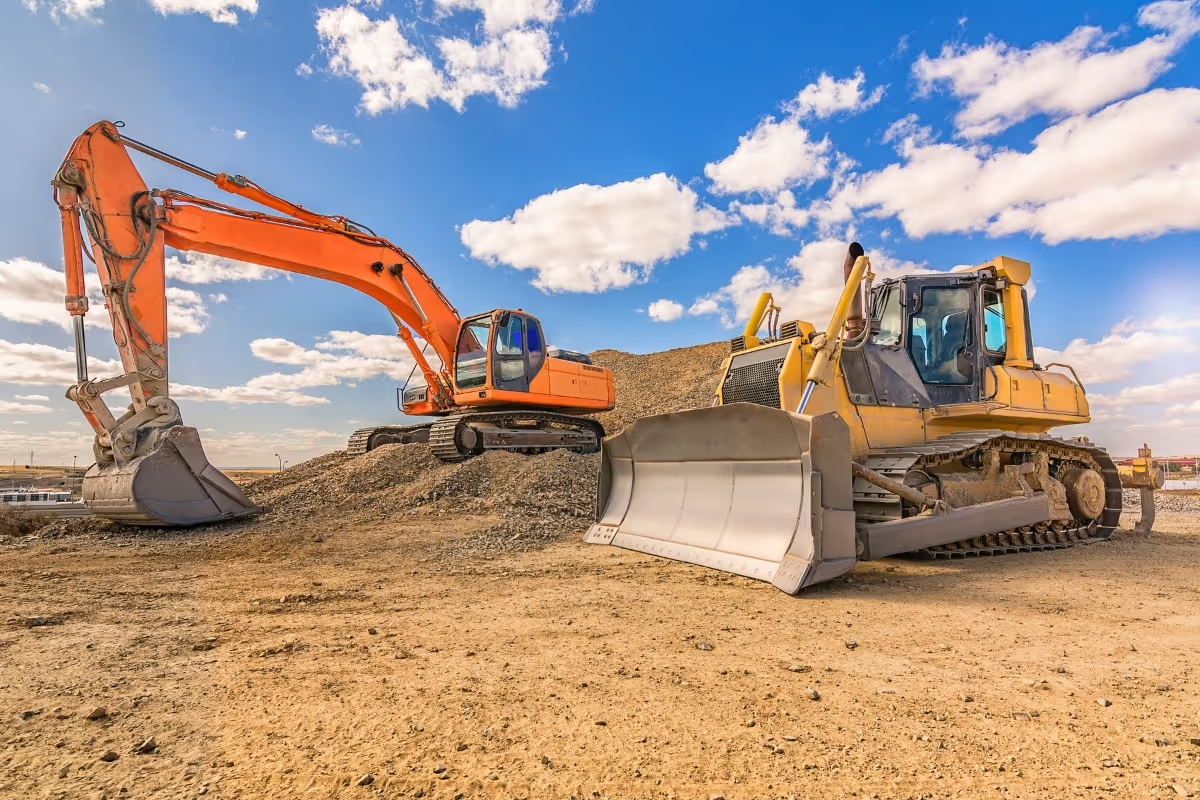
Heavy equipment financing — Excavators, cranes, compactors, and large industrial machinery for construction and infrastructure projects across Waterloo Region.
Refinancing and sale-leaseback — If you own equipment outright or have equity in it, a sale-leaseback converts that equity into working capital without requiring a sale. Supported on qualifying hard assets up to a reasonable percentage of current market value. Particularly useful for Waterloo manufacturers who've paid down equipment but need operating cash for growth.
Asset-based lending — For larger capital requirements backed by a portfolio of equipment or receivables. Common for scaling manufacturers and mid-size operators with significant asset bases.
Equipment line of credit — A revolving draw facility for businesses that finance equipment on a recurring basis — useful for operators cycling assets, adding tooling regularly, or running ongoing fleet needs.
Invoice and freight factoring — Converts outstanding invoices into immediate working capital. Factoring approval is based primarily on your customers' creditworthiness — not yours — so Credit-review practices vary by factoring provider. Useful for Waterloo manufacturers and service businesses waiting 30–60 days on customer payments while carrying operational costs month to month.
Working capital loans — Short-term capital to cover operational gaps, growth costs, or bridge periods between equipment payments and incoming revenue.
Confirm which assets qualify before applying through the eligible equipment guide.
Waterloo's technology sector creates a financing nuance that rarely comes up in agricultural or transport-heavy cities: technology and production hardware depreciates faster than most physical assets. A server rack, automated testing system, or specialized production unit that costs $300,000 today may have a resale market value of 30–40% of that in three years.
This matters because lenders assess collateral based on what they could recover if the deal goes wrong. For technology-heavy assets with thin secondary markets, you should expect:
The practical response is to pair thorough documentation — showing how the equipment directly generates revenue — with a reasonable deposit and a term that doesn't outlast the asset's productive life. A lease structure is often better suited than a loan for technology-adjacent assets precisely because it doesn't leave you holding a depreciating asset on your balance sheet at the end of a long term.
This is a genuine difference between financing a CNC machine and financing a server cluster — and one that US-focused content or generic equipment financing guides almost always miss in the Canadian context.
Waterloo's business culture moves fast. Growth contracts, scaling decisions, and equipment needs often emerge on timelines that traditional bank credit processes aren't built for. A precision manufacturer who gets a new OEM supply contract in week one and needs equipment by week four can't wait eight weeks for a bank credit committee.
At Mehmi, we see this pattern regularly — a Waterloo business that's fully creditworthy, has the revenue to support the payment, and loses the opportunity because their primary bank moves on commercial credit at a pace designed for a different era.
The lesson: don't wait until you're under timeline pressure to think about equipment financing. Approval and funding timelines vary by lender, application completeness, and required conditions. When the opportunity comes, you have a prepared application to submit for lender review.
Use the amortization calculator to understand what different term and deposit combinations cost over time before the pressure is on.
Illustrative example only; not a statement of a specific funded client transaction.
A Waterloo precision manufacturer supplying machined components to an aerospace subcontractor experienced a critical failure on their primary turning centre. The machine — a 12-year-old CNC lathe that had been well-maintained and running reliably — seized mid-shift during a production run. With a delivery deadline 18 days out and a contractual penalty clause for late delivery, they needed a replacement or supplementary unit funded and installed as quickly as possible.
The challenge: The business had four years of operating history, solid revenue, and no derogatory bureau marks — but the asset they needed was a used CNC turning centre from a private seller in southern Ontario, not a dealer purchase. Private-sale verification adds steps, and the asset type — specialized precision machining equipment — required condition documentation before lenders would advance.
How Mehmi structured it: We fast-tracked the private-sale verification process — lien search, seller documentation, serial number confirmation, and condition photos obtained. The file was submitted as an application-only deal, supported by three months of bank statements showing strong, consistent deposits and a copy of the aerospace supply contract demonstrating ongoing revenue. The business's four years of operating history and clean bureau positioned the file well.
What would have killed it: A file under two years in business without a strong deposit or co-signer would have required additional documentation that stretched the timeline past the contract deadline. A poorly documented private-sale asset — missing condition photos or a clear lien search — would have triggered additional due diligence.
Approval and funding timelines vary by lender, application completeness, and required conditions. The supply contract was fulfilled without penalty. The manufacturer's relationship with their aerospace client remained intact — which, in Waterloo's tight-knit industrial supply chain, was worth more than the equipment cost itself.
Manufacturing and wholesale — Precision manufacturers, fabricators, and component suppliers along the Waterloo industrial corridor serving automotive, aerospace, and advanced manufacturing clients. See also our guide on equipment finance rates in Canada.
Technology and business services — IT infrastructure, production hardware, server and network equipment, and specialized tooling for Waterloo's technology cluster — one of the most concentrated in North America.
Medical, dental and wellness — Clinics, dental practices, imaging centres, and wellness operators across Waterloo-Kitchener finance diagnostic and treatment equipment with predictable monthly structures.
Construction and contractors — Residential, commercial, and infrastructure development across Waterloo Region, including the significant growth corridors in north Waterloo and along the ION transit expansion. Read more in our comprehensive guide to construction equipment financing.
Transportation and trucking — Regional carriers and logistics operators serving Waterloo Region's dense industrial and commercial base via Highway 7, 8, and the 401 interchange at Cambridge.
Hospitality and food service — Restaurants, catering operations, and food service businesses across Waterloo and Kitchener access kitchen, refrigeration, and service equipment financing.
Farming and agriculture — Agricultural operations in Woolwich, Wellesley, and Wilmot townships surrounding Waterloo access agricultural equipment financing with seasonal payment structures where applicable.
Natural resources and energy — Environmental, utility, and industrial service operators across the broader Waterloo Region.
Aviation and aerospace — Regional aviation operations and aerospace supply chain businesses in the Waterloo-Wellington area access specialized equipment financing for ground support and production assets.
Most equipment financing applications require:
Dealer purchases process fastest — application-only files under $250,000 for businesses with two to three or more years in business and a clean bureau are reviewed according to lender requirements.
Approval and funding timelines vary by lender, application completeness, and required conditions.
Larger files over $250,000 may require financial statements depending on the program and your profile. Files over $500,000 typically need three years of accountant-prepared statements plus interim financials. Over $1 million, expect a full structured credit submission.
Factoring files are assessed on your customers' credit — Credit-review practices vary by factoring provider.
Questions before applying Review the FAQ or explore the full range of financing services to understand every option available.
Ready to get your equipment funded in Waterloo? Call us directly at 1-833-863-4644 or apply online to request financing options, subject to lender review.
Related resource: Browse our equipment financing by city directory for more local financing guides.
Q. How fast are equipment financing approvals in Waterloo?A. Approval and funding timelines vary by lender, application completeness, and required conditions. Application-only files under $250,000 with two to three or more years in business and a clean bureau are reviewed according to lender requirements — important in a city where growth timelines move quickly.
Q. Can a newer Waterloo tech or startup business qualify for equipment financingA. Yes, though it typically requires additional support — a stronger deposit, personal guarantee, verified contract revenue, or a co-signer. The strength of the business case and the clarity of revenue generation matter significantly for newer operators.
Q. Is leasing better than a loan for technology equipment in WaterlooA. Often yes, particularly for hardware with faster depreciation cycles. A lease allows you to return or upgrade at term end rather than holding a depreciating asset on your balance sheet. That said, the right structure depends on your tax situation, cash flow, and how long you'll use the equipment — confirm with your accountant before signing.
Q. Does HST apply to leased equipment in OntarioA. Yes. Ontario charges HST on each lease payment, not just on the purchase price at acquisition. If your business is HST-registered, you can generally claim input tax credits, but the timing differs from a purchase or loan. Confirm the most tax-efficient structure with your accountant before committing.
Q. Can I finance private-sale equipment in WaterlooA. Yes. Private-sale financing is fully supported and includes lien searches, seller verification, serial number confirmation, and condition photo review. The process adds a small amount of time but is straightforward when documentation is prepared in advance.
Q. Do I need strong personal credit to qualifyA. Not necessarily. Cash flow and business revenue carry significant weight alongside credit history. Factoring files are assessed entirely on your customers' creditworthiness — Credit-review practices vary by factoring provider for factoring.
Q. Can I refinance equipment I already own in WaterlooA. Yes. A refinancing or sale-leaseback converts equity in owned equipment into working capital without requiring a sale. Supported on qualifying hard assets up to a reasonable percentage of current market value.
Q. What documents do I need to applyA. For most files: bank statements, government ID, business registration, and an equipment quote or bill of sale. Private-sale files require condition photos and seller verification. Files over $250,000 may require financial statements depending on the program and your credit profile.

.svg)