
This page covers equipment financing in Richmond Hill, Ontario — who qualifies, what structures are available, how approvals work, and what local businesses need to know before applying. Richmond Hill is York Region's second-largest city, a city of over 220,000 residents anchored by sustained high-density residential and mixed-use construction, one of the GTA's most concentrated dental and healthcare practice markets, a significant technology and life sciences business cluster along the Highway 404/407 ETR corridor, and the Yonge Street commercial spine connecting the city south to Toronto and north to Newmarket. Approval and funding timelines vary by lender, application completeness, and required conditions.
Richmond Hill is a city that has been building continuously for three decades — and shows no sign of stopping. Its position between Toronto and the northern GTA, served by Highway 404, the 407 ETR, Yonge Street, and the Viva rapid transit system running to the future Yonge North Subway Extension, makes it one of the most sought-after residential and commercial destinations in Ontario. The city's residential construction market is among the most active in York Region, with high-rise towers along Yonge Street, stacked townhouses in the Elgin Mills and Bayview areas, and single-family subdivisions still opening in Oak Ridges and Jefferson.
Approval and funding timelines vary by lender, application completeness, and required conditions. Whether you're a construction contractor working on Richmond Hill's high-rise and mid-rise development pipeline, a dental or healthcare practice expanding in one of Ontario's most densely serviced suburban medical corridors, a precision manufacturer or life sciences company in the business parks along Highway 404, or a service and logistics operator running the Yonge/404 corridor between Toronto and the northern GTA, Mehmi structures financing around how York Region's economy actually operates.
Equipment can be sourced from GTA dealers, private sellers, or auctions. High-hour and older units qualify regularly when they continue generating stable revenue and are properly documented.
Use the equipment payment calculator to model monthly payments before you apply.
When buying or refinancing business assets in Richmond Hill, compare the structure and total ownership cost—not just the monthly payment. Availability and terms depend on equipment, business credit, cash flow and individual lenders.
| Equipment funding need | Option to compare | What to verify |
|---|---|---|
| Purchasing eligible healthcare equipment | Equipment loan or conditional sale | Equipment value, term, interest calculation, down payment, collateral, title and early-payout terms. |
| Using equipment while managing initial cash outlay | Equipment lease | Payment schedule, deposits, insurance, end-of-term purchase options, return conditions and total cost. |
| Purchasing from a used-equipment dealer or private seller | Used-equipment financing | Asset age, hours or mileage, inspection, seller verification, lien search and any lender limits. |
| Unlocking equity in owned machinery or vehicles | Equipment refinancing or sale-leaseback | Appraised value, current liens, payout amounts, advance against value, fees and continuing use of the asset. |
| Buying multiple assets or upgrading in stages | Equipment financing facility or separate leases | Each asset's eligibility, draw timing, security, documentation, amortization and combined payment burden. |
Next step: Compare equipment loans, leases and refinancing before requesting indicative terms. Examples above are educational, not offers or approvals.
Richmond Hill's economy creates financing patterns across three distinct sectors, each with its own character.
Construction contractors active on Richmond Hill's sustained development pipeline — the high-rise residential towers rising along Yonge Street between Major Mackenzie Drive and Highway 7, the stacked townhouse projects filling in the Bayview and Leslie Street corridors, the Elgin Mills secondary plan area, and the civil infrastructure work that accompanies all of it — operate in a construction market where equipment speed and availability directly translate to project awards. Approval and funding timelines vary by lender, application completeness, and required conditions. The GTA construction equipment market is competitive and fast-moving; the Vaughan and Markham equipment dealers who serve Richmond Hill contractors regularly have popular models with weeks-long wait times. Financing that closes on the operator's timeline rather than the institution's matters here.
Dental and healthcare practices in Richmond Hill represent one of the densest concentrations of private practice healthcare in Ontario. The city's Yonge Street corridor, the Bayview Avenue medical office cluster, the Major Mackenzie Medical Centre node, and the strata office buildings scattered across the city's commercial zones are home to hundreds of dental practices, specialist clinics, physiotherapy offices, and allied health businesses. These are high-revenue, equipment-intensive businesses whose capital investments — dental chairs, cone beam CT scanners, digital impression systems, sterilization centres — are predictable and recurring.
Technology and precision manufacturers in the business parks along Highway 404 — at the Woodbine Avenue and 16th Avenue interchanges, and along the East Beaver Creek Road industrial corridor in the 404/407 node — produce electronics components, photonics equipment, aerospace parts, and specialty industrial goods. CNC machining centres, laser cutting systems, and precision manufacturing equipment are the core assets for these companies, which often supply clients in the GTA's aerospace and automotive manufacturing sectors.
For operators who want full ownership from day one, equipment loans provide a clear path — fixed payments, equity build, and refinancing options when working capital is needed.
Lenders assess five core factors — character, capacity, capital, collateral, and conditions — and the strength of your file across all five determines what gets approved, on what terms, and at what rate.
Character is your business track record. Years in operation, commercial bureau history, and whether bank statements reflect consistent, well-managed cash flow. Documentation requirements vary by lender, transaction size, business history, and credit profile. Richmond Hill's established business community — many dental and medical practices with ten or more years of operation, construction companies with consistent York Region project histories — tends to present strong character profiles.
Capacity is whether your revenue supports the proposed payment. Dental and healthcare practices with predictable patient appointment volumes and insurance billing cycles present some of the most straightforward capacity pictures in commercial financing. For construction contractors, project award letters or letters of intent from developers confirm forward revenue beyond what bank statements alone convey. For technology manufacturers, purchase orders from named clients anchor the capacity argument for larger deals.
Capital is your equity position. Richmond Hill's real estate market — both commercial and residential — has appreciated significantly, and homeownership here is a strong capital indicator for personal guarantee assessments on owner-operated businesses.
Collateral is the asset itself. GTA construction iron has a highly liquid secondary market. Dental and medical equipment has a national and US secondary market with established dealer and refurbishment networks. Precision manufacturing equipment has active markets, with value depending heavily on model year, condition, and software/tooling state.
Conditions cover the deal structure — term length, payment structure, advance amount, and documentation requirements. Files over $250,000 may require financial statements. Files over $500,000 typically need three years of accountant-prepared statements plus interim financials.
Thresholds above reflect typical patterns across Mehmi's financing programs. Requirements vary by program and file.
Equipment loans — Full ownership from day one. Fixed payments, equity build, and the asset on your balance sheet. Preferred by dental and medical practices building long-term equity in treatment infrastructure.
Equipment leasing — Lower upfront cost with end-of-term flexibility — return, renew, or purchase. Common for technology and manufacturing equipment on shorter technology cycles. Ontario's 13% HST applies to lease payments — ITCs are recoverable for HST-registered businesses.
Conditional sales contracts — Fixed payments with a nominal buyout at the end. Common for construction iron, commercial vehicles, and manufacturing assets throughout Ontario.
Truck and trailer financing — For Richmond Hill service and logistics operators running the Yonge/Highway 404 corridor between the northern GTA and Toronto, and the 407 ETR east-west connection across York Region.
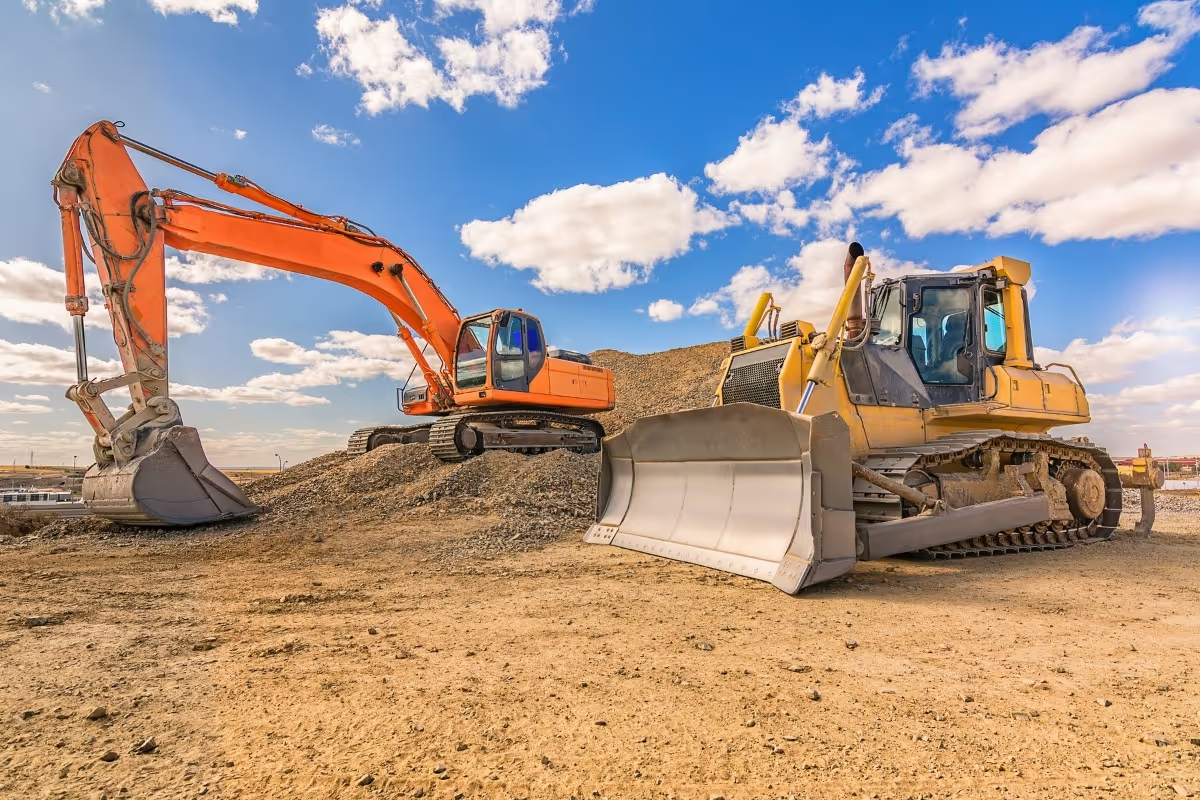
Heavy equipment financing — Excavators, concrete pumps, compactors, and construction assets for Richmond Hill's high-rise, mid-rise, and subdivision development pipeline.
Refinancing and sale-leaseback — Converts equity in owned equipment into working capital without requiring a sale. Useful for Richmond Hill contractors and manufacturers who have built equity across operational cycles.
Asset-based lending — For larger capital requirements backed by a portfolio of equipment or receivables. Relevant for established Richmond Hill construction and manufacturing operations.
Equipment line of credit — A revolving draw facility for businesses financing equipment on a recurring basis — useful for dental group practices expanding across multiple Richmond Hill locations, or manufacturers adding capacity phase by phase.
Invoice and freight factoring — Converts outstanding invoices into immediate working capital. Factoring approval is based primarily on your customers' creditworthiness — not yours. Useful for Richmond Hill subcontractors managing 30–45 day receivables from GTA developers.
Working capital loans — Short-term capital to bridge between project payments, cover a dental practice's operational costs between equipment installation and patient volume ramp-up, or manage timing between a manufacturer's equipment delivery and first production invoice.
Review the eligible equipment guide to confirm what asset types qualify before applying.
Two operational realities specific to the Richmond Hill GTA construction market catch contractors — particularly those newer to York Region's pace — more often than any other issue.
The GTA equipment market moves faster than any other construction market in Canada. A specific excavator model sitting at a Vaughan or Markham dealer on Monday morning is frequently sold by Wednesday. Contractors who browse equipment without having financing pre-arranged or at least pre-qualified regularly lose machines they've already mentally committed to — and in some cases lose project windows that depended on that specific machine being available. Approval and funding timelines vary by lender, application completeness, and required conditions.
The solution is straightforward but requires a mindset shift: treat financing as a pre-construction activity, not a response to finding equipment. Know your pre-qualified range before you start looking. When you find the right machine, call with the details and close the financing the after verification and funding conditions are met you decide.
The 407 ETR toll cost is real and is not budgeted by most contractors who are new to York Region work. Moving equipment between job sites across Richmond Hill — from a Bayview Avenue project to a project on Yonge Street north of Major Mackenzie — often involves the 407 ETR. A heavy equipment transport trailer crossing the 407 ETR pays toll charges based on vehicle class and distance that can run $40–$120 per crossing, depending on the axle configuration of the carrier. For a contractor running multiple sites across Richmond Hill and Markham simultaneously, weekly 407 ETR charges can add hundreds of dollars of mobilization cost per week that simply didn't exist on their last project in Barrie or Oshawa.
This affects equipment financing decisions in a specific way: contractors underestimating total operating costs per site sometimes structure financing more aggressively than their actual project margin supports. Build 407 ETR mobilization costs into your project cost model before setting a financing payment you're comfortable with.
Richmond Hill has one of the densest dental practice markets in Ontario. The competition for patients — particularly in the Yonge Street and Bayview Avenue corridors — is real, and practice differentiation on technology, patient experience, and treatment capability matters.
The most common dental equipment financing mistake we see in Richmond Hill is practices financing individual pieces of equipment in isolation — a single chair now, a cone beam scanner in eight months, a sterilization centre next year — rather than planning and financing a complete operatory build-out from the start.
The problems with sequential piece-by-piece financing are twofold. First, the total cost of financing three separate transactions over eighteen months almost always exceeds the cost of a single structured facility covering the complete build. Each transaction has its own fees, documentation requirements, and approval steps. Second, the practice's revenue-generating capacity is limited by whichever piece of equipment hasn't arrived yet — a fully equipped treatment room generates patient revenue from day one; a partially equipped room sits at reduced capacity for months waiting for the next piece.
The better structure: plan the full operatory package before approaching any equipment vendor, get a complete quote covering chairs, delivery systems, imaging, sterilization, and cabinetry, and finance the entire package in a single facility at the outset. The monthly payment on a complete $250,000 operatory package is not dramatically higher than on a single chair — and the practice opens fully equipped, generating full revenue from the first appointment.
See the 50k equipment lease approval checklist as a starting point for understanding what documentation a dental operatory file requires.
Illustrative example only; not a statement of a specific funded client transaction.
A dental practice on Yonge Street in Richmond Hill — operating since 2016, serving a primarily residential patient base in the Oak Ridges and Jefferson communities — had outgrown its original two-operatory configuration. Consistent appointment waitlists and a 14-week new patient booking window confirmed that a two-operatory expansion into adjacent unit space was operationally justified.
The full equipment package — two A-dec treatment centres, a Carestream CS 3600 intraoral scanner, updated sterilization centre, and cabinetry package — was quoted at $218,000 from an authorized Toronto-area dental equipment dealer.
The challenge: The practice had previously financed equipment as individual pieces, leaving the principal unfamiliar with single-facility structuring for a larger package. The bank's healthcare lending team quoted six weeks for credit review. The contractor finishing the renovation was giving a four-week completion timeline.
How Mehmi structured it: The complete $218,000 package was submitted as a single application-only file, supported by three months of practice bank statements, the dental equipment dealer invoice, and a brief revenue note confirming appointment waitlist status and current monthly billings. The file was below the financial statement threshold for this profile.
What made it work: Single-facility submission covering the complete package rather than four separate transactions. The dealer invoice provided clear asset documentation. The bank statement pattern — consistent predictable deposits consistent with a busy dental practice — required no additional capacity context.
Approval and funding timelines vary by lender, application completeness, and required conditions. Equipment ordered after verification and funding conditions are met. Both operatories commissioned within three days of the renovation completion, generating patient revenue from week one of full occupancy. The practice eliminated the new patient waitlist within five months and added a part-time associate dentist, supported by the additional operatory capacity.
Richmond Hill's construction, dental and healthcare, technology manufacturing, and commercial services economy generates a distinctive equipment financing profile. These are the asset types we see most frequently, each linked to its specific financing page:
Construction
Dental & Medical
Technology & Precision Manufacturing
Transportation
Construction and contractors — High-rise residential and mixed-use development along Yonge Street; mid-rise and stacked townhouse projects in the Bayview, Leslie, and Elgin Mills corridors; and civil infrastructure throughout Richmond Hill and York Region. See the comprehensive guide to construction equipment financing.
Medical, dental and wellness — One of Ontario's most concentrated dental and allied health practice markets. Dental practices, specialist clinics, physiotherapy offices, orthodontic practices, and wellness businesses across Richmond Hill's Yonge Street and Bayview Avenue corridors access complete operatory and diagnostic equipment financing.
Manufacturing and wholesale — Precision manufacturers, electronics component producers, photonics companies, and aerospace suppliers in Richmond Hill's Highway 404 business park corridor access CNC, laser, and production equipment financing.
Technology and business services — Technology and professional services companies in Richmond Hill's commercial and business park zones, including firms linked to the Toronto-York Region innovation cluster.
Transportation and trucking — Service, delivery, and logistics operators running the Yonge/Highway 404 and 407 ETR corridors across York Region and the broader GTA.
Hospitality and food service — Restaurants, cafes, and food service operators along Richmond Hill's Yonge Street and Bayview Avenue commercial corridors access kitchen, refrigeration, and service equipment financing.
Aviation and aerospace — Precision component and aerospace parts manufacturers in Richmond Hill's industrial parks serving the GTA aerospace supply chain.
Most equipment financing applications require:
For dental and medical files: the complete equipment package invoice from an authorized dealer, alongside bank statements showing consistent practice billings, is typically sufficient for application-only approvals under $250,000. A brief note on patient volume or appointment booking status adds useful context.
For construction files: a project award letter or developer letter of intent alongside bank statements strengthens capacity evidence on GTA project files.
Dealer purchases process fastest — application-only files under $250,000 with two to three or more years in business and a clean bureau are reviewed according to lender requirements.
Private-sale purchases require lien search, seller verification, serial number confirmation, and condition photos — fully supported and may require additional lender review even when documentation is complete.
Larger files over $250,000 may require financial statements depending on your profile. Files over $500,000 typically need three years of accountant-prepared statements plus interim financials.
Questions before applying Review the FAQ or explore all financing services to understand every option available.
Ready to get your equipment funded in Richmond Hill? Call us directly at 1-833-863-4644 or apply online to request financing options, subject to lender review.
Related resource: Browse our equipment financing by city directory for more local financing guides.
Q. How fast are equipment financing approvals in Richmond Hill?A. Approval and funding timelines vary by lender, application completeness, and required conditions. Application-only files under $250,000 with two to three or more years in business and a clean bureau are assessed according to lender requirements — including for dental operatory packages when the complete dealer invoice is submitted at the outset.
Q. The GTA equipment market moves fast. Can I get approval quickly enough to hold a machine A. Prepare your documents and seek pre-qualification before looking for equipment. When you identify a machine, contact us with its details. Final approval and funding depend on the lender's requirements.
Q. Should I finance dental equipment as a complete package or piece by pieceA. As a complete package, strongly. A single facility covering the full operatory build-out costs less in total financing fees than multiple sequential transactions, and the practice opens fully equipped — generating full patient revenue from day one rather than operating at reduced capacity for months. See the Mehmi's Take section above.
Q. What is the 407 ETR and how does it affect my equipment costsA. The 407 ETR is the private toll highway running east-west across York Region and beyond. Equipment transport trailers pay tolls based on vehicle class and distance — typically $40–$120 per crossing for heavy equipment carriers. For contractors working multiple Richmond Hill sites simultaneously, weekly 407 ETR charges are a real operating cost that should be built into project cost models before setting equipment financing payment levels.
Q. Can I finance precision manufacturing equipment like CNC machines or laser cuttersA. Yes. CNC machining centres, laser cutting systems, press brakes, and related precision manufacturing equipment qualify under standard manufacturing equipment programs. Application-only approvals are available under $250,000 for established operators. Larger files typically require financial statements. Purchase orders or supply contracts from named clients strengthen larger manufacturing files.
Q. Can I refinance equipment I already ownA. Yes. A refinancing or sale-leaseback converts equity in owned equipment into working capital without requiring a sale. Supported on qualifying hard assets up to a reasonable percentage of current market value.
Q. What documents do I need to applyA. For most files: bank statements, government ID, business registration, and an equipment quote or bill of sale. For dental files, the complete equipment package invoice from an authorized dealer. For construction files, a developer letter or project award alongside bank statements. Files over $250,000 may require financial statements depending on the program and your credit profile.

.svg)