
This page covers equipment financing in Saanich, British Columbia — who qualifies, what structures are available, how approvals work, and what local businesses need to know before applying. Saanich is the largest municipality in the Capital Regional District by population, home to roughly 120,000 residents across a diverse landscape that includes the urban corridors along Shelbourne Street and Quadra Street, the rural and semi-rural Saanich Peninsula with its concentration of small farms and market gardens, major institutional anchors including the University of Victoria and Royal Jubilee Hospital, and one of the most active residential infill and densification construction markets on Vancouver Island. Approval and funding timelines vary by lender, application completeness, and required conditions.
Saanich is where Greater Victoria lives. As the largest single municipality in the Capital Regional District — larger by population than the City of Victoria itself — it contains the residential neighbourhoods, the institutional corridors, the small farms, and much of the construction activity that keeps the region's economy moving. The Saanich Peninsula to the north, sheltered by the Olympic Mountain rainshadow and warmed by one of Canada's mildest climates, supports a concentration of small-scale farms, market gardens, nurseries, and agri-tourism operations that makes it one of BC's most productive horticultural zones per acre. The urban areas along Shelbourne, Quadra, and McKenzie support the construction, healthcare, and service industries that serve 120,000 residents. And the Trans-Canada Highway connector through Saanich links the CRD to the rest of Vancouver Island.
Approval and funding timelines vary by lender, application completeness, and required conditions. Whether you're a construction contractor working on infill residential projects in the Gordon Head or Lambrick Park neighbourhoods, a landscaping or civil contractor serving the institutional campuses at UVic and Royal Jubilee Hospital, a small farm or market garden operation on the Saanich Peninsula financing irrigation or production equipment, a healthcare or dental practice serving Saanich's residential population, or a service business running the Trans-Canada corridor, Mehmi structures financing around how Greater Victoria's economy actually operates.
Equipment can be sourced from Greater Victoria dealers, Lower Mainland, private sellers, or Vancouver Island auctions. High-hour and older units qualify regularly when they continue generating stable revenue and are properly documented.
Use the equipment payment calculator to model monthly payments before you apply.
When buying or refinancing business assets in Saanich, compare the structure and total ownership cost—not just the monthly payment. Availability and terms depend on equipment, business credit, cash flow and individual lenders.
| Equipment funding need | Option to compare | What to verify |
|---|---|---|
| Purchasing eligible construction machinery | Equipment loan or conditional sale | Equipment value, term, interest calculation, down payment, collateral, title and early-payout terms. |
| Using equipment while managing initial cash outlay | Equipment lease | Payment schedule, deposits, insurance, end-of-term purchase options, return conditions and total cost. |
| Purchasing from a used-equipment dealer or private seller | Used-equipment financing | Asset age, hours or mileage, inspection, seller verification, lien search and any lender limits. |
| Unlocking equity in owned machinery or vehicles | Equipment refinancing or sale-leaseback | Appraised value, current liens, payout amounts, advance against value, fees and continuing use of the asset. |
| Buying multiple assets or upgrading in stages | Equipment financing facility or separate leases | Each asset's eligibility, draw timing, security, documentation, amortization and combined payment burden. |
Next step: Compare equipment loans, leases and refinancing before requesting indicative terms. Examples above are educational, not offers or approvals.
Saanich's economy creates equipment financing needs that are genuinely distinct from every other BC city in this series.
Construction contractors working on Saanich's active residential densification and infill market — strata replacements in the Royal Oak and Tillicum corridors, infill townhouse and low-rise projects in Gordon Head and Lambrick Park, and the institutional construction around the UVic campus and Shelbourne Valley Action Plan zones — operate in one of Vancouver Island's tightest construction markets. Equipment that arrives on a job site days after a project award wins work that slower-financed competitors lose. The BC construction season on southern Vancouver Island is more forgiving than most of Canada — the mild climate extends the active work window — but the competition for skilled trades and project capacity is intense.
Saanich Peninsula farm and market garden operators — growing vegetables, berries, flowers, and specialty crops in the ALR (Agricultural Land Reserve) belt running from Keating Cross Road north through Central Saanich toward Sidney — finance irrigation systems, tractors, field equipment, cold storage, and production infrastructure. The Peninsula's microclimate enables year-round growing of certain crops and extended seasons for others, making the capital investment in infrastructure meaningful. BC PST applies to most agricultural equipment purchases in British Columbia — a real cost to understand before committing to a structure.
Landscaping and civil contractors serving Greater Victoria's dense institutional and residential market — the UVic grounds, the Royal Jubilee campus, Saanich's extensive park system, and the residential and strata developments that dot the municipality — finance compact excavators, skid steers, and grounds maintenance equipment on operating cycles that span the full calendar year.
Healthcare and dental practices serving Saanich's residential population — clustered around the Saanich Town Centre, the Uptown retail corridor, and the Royal Jubilee Hospital healthcare node on Fort Street — finance diagnostic and treatment equipment as the region's population ages and demand for healthcare services continues to grow.
For operators who want full ownership from day one, equipment loans provide a clear path — fixed payments, equity build, and refinancing options when working capital is needed.
Lenders assess five core factors — character, capacity, capital, collateral, and conditions — and the strength of your file across all five determines what gets approved, on what terms, and at what rate.
Character is your business track record. Years in operation, commercial bureau history, and whether bank statements reflect consistent, well-managed cash flow. Documentation requirements vary by lender, transaction size, business history, and credit profile.
Capacity is whether your revenue supports the proposed payment. For construction and landscaping contractors, project letters of intent or strata contracts from property management companies confirm forward revenue. For farm and market garden operators on the Peninsula, provincial farm income declarations and CSA (community-supported agriculture) subscription records alongside bank statements provide a complete capacity picture.
Capital is your equity position. Saanich's real estate market — even for the smaller residential and farm properties on the Peninsula — carries significant value, and homeownership here is a meaningful capital indicator for personal guarantee assessments.
Collateral is the asset itself. Compact construction equipment and landscaping machinery has an active Greater Victoria secondary market. Agricultural equipment suited to the Peninsula's small-farm scale — compact tractors, irrigation systems, cold storage — has a more limited but functional local secondary market.
Conditions cover the deal structure — term length, payment structure, advance amount, and documentation requirements. Files over $250,000 may require financial statements. Files over $500,000 typically need three years of accountant-prepared statements plus interim financials.
Thresholds above reflect typical patterns across Mehmi's financing programs. Requirements vary by program and file.
Equipment loans — Full ownership from day one. Fixed payments, equity build, and the asset on your balance sheet. Best for long-lived construction, agricultural, and institutional service assets Saanich businesses plan to keep.
Equipment leasing — Lower upfront cost with end-of-term flexibility — return, renew, or purchase. In British Columbia, PST applies to lease payments in addition to GST — confirm the full tax treatment with your accountant before structuring a lease.
Conditional sales contracts — Fixed payments with a nominal buyout at the end. A common ownership path for commercial vehicles, farm equipment, and construction iron throughout BC.
Truck and trailer financing — For Saanich service and delivery operators running the Trans-Canada connector through to Victoria, McKenzie Avenue, and the Douglas Street corridor, and for Peninsula farm operators moving product to Saanich Organics distribution points and Victoria Public Market.
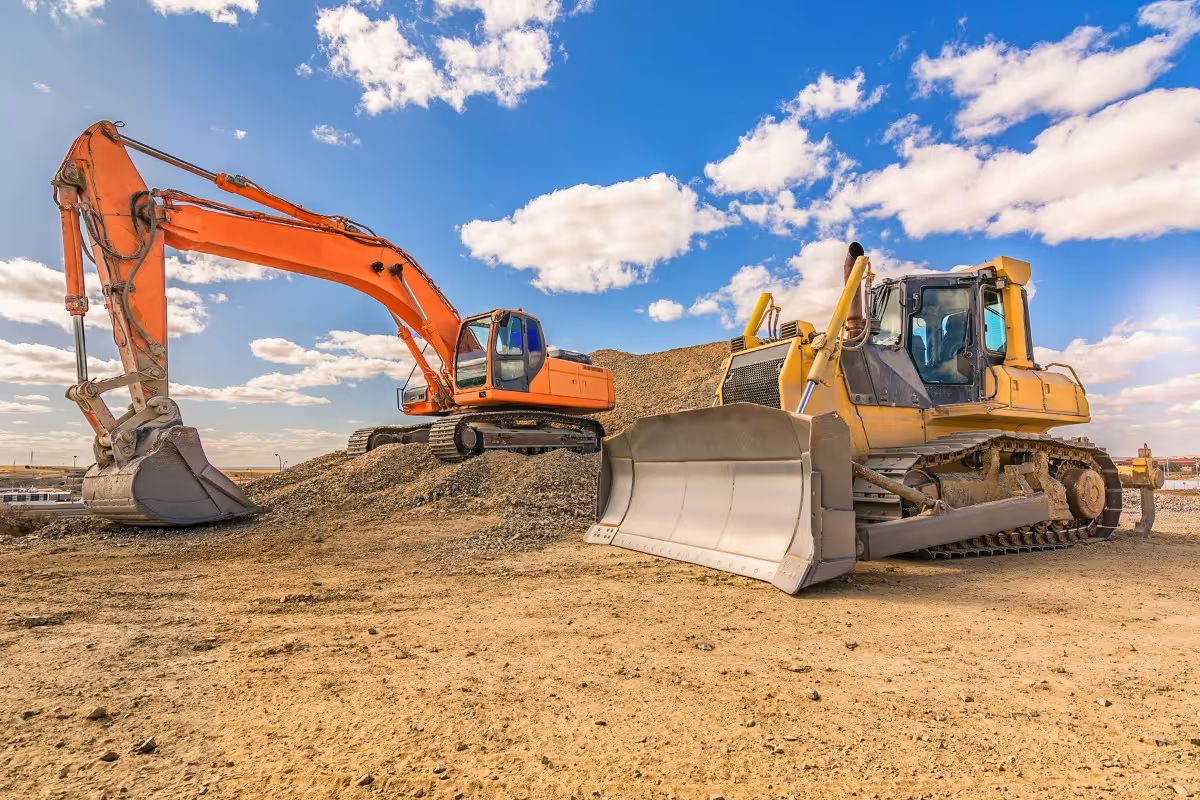
Heavy equipment financing — Excavators, compactors, and construction assets for residential infill, institutional, and civil projects across Saanich and the broader CRD.
Refinancing and sale-leaseback — Converts equity in owned equipment into working capital without requiring a sale. Supported on qualifying hard assets up to a reasonable percentage of current market value.
Asset-based lending — For larger capital requirements backed by a portfolio of equipment or receivables. Relevant for growing construction and landscaping businesses with significant fleets serving multiple institutional clients across the CRD.
Equipment line of credit — A revolving draw facility for businesses financing equipment on a recurring basis — useful for contractors expanding their capabilities across multiple Saanich project phases.
Invoice and freight factoring — Converts outstanding invoices into immediate working capital. Factoring approval is based primarily on your customers' creditworthiness — not yours. Useful for Saanich subcontractors managing 30–45 day receivables from general contractors or property management companies.
Working capital loans — Short-term capital to bridge between project payments, cover pre-season farm infrastructure investment, or manage timing between equipment delivery and first invoice.
Review the eligible equipment guide to confirm what asset types qualify before applying.
British Columbia applies a 7% PST on most equipment purchases — separate from and in addition to the federal 5% GST. Unlike Ontario's HST (fully recoverable as an ITC) or Alberta (no PST), BC PST is generally not recoverable as an input tax credit for most businesses. It is a real, permanent cost.
For a Saanich Peninsula market garden operator purchasing a $45,000 compact tractor, the BC PST is $3,150 — a genuine out-of-pocket expense that doesn't come back. For a construction contractor purchasing a $280,000 excavator, it's $19,600. On a $500,000 equipment purchase, BC PST adds $35,000 that will not be recovered.
This changes the total cost of ownership calculation in two meaningful ways. First, it raises the effective purchase price versus what the same operator would pay in Alberta. Second, it affects the lease-versus-loan decision: PST treatment on leases in BC can differ depending on the structure, and in some cases leasing may result in PST being applied to monthly payments rather than the full capital cost — which can improve cash flow even if the total tax amount is similar. The specifics depend on the lease structure and equipment type.
The practical advice for Saanich operators: before committing to a purchase or lease structure on any equipment over $50,000, have a brief conversation with your accountant about BC PST treatment for your specific asset and business category. The GST is straightforward and recoverable. The PST requires a separate, BC-specific analysis.
The Saanich Peninsula's mild climate is its greatest asset, but it creates a financing timing trap that catches small-farm and market garden operators every spring.
Because the Peninsula can start field work earlier than almost anywhere else in Canada, the pressure to be operationally ready by late February or early March is real. Irrigation systems need to be in the ground, cold storage needs to be commissioned, and tractors need to be serviceable before the first CSA boxes ship or the first farmers' market weekend arrives. These capital needs are predictable — they come every year at the same time — but the financing conversation often starts too late.
The pattern: an operator identifies a need for a new drip irrigation system or cold storage unit in January, starts the financing process in February, and discovers mid-March that documentation is still outstanding or that the structure they chose has a PST implication they hadn't accounted for. Meanwhile the growing season has already started.
The better approach is to treat the fall — October through December — as the planning window for next season's capital equipment. This is when crop planning is done, CSA subscriptions are renewed, and the farm's financial picture for the year is clearest. Starting a financing conversation in October or November for equipment needed in February or March creates the lead time to choose the right structure, gather the right documents, and fund well before the first field day.
Use the amortization calculator to model seasonal payment structures if standard monthly payments don't align with the Peninsula's crop revenue calendar.
Illustrative example only; not a statement of a specific funded client transaction.
A certified organic market garden on Oldfield Road in Saanich — growing mixed vegetables and cut flowers for two Victoria-area farmers' markets and a 120-member CSA program — had been operating for six years. The operation needed a walk-in cold storage unit ($38,000) and an expanded drip irrigation system covering two additional field sections ($27,000) to increase production capacity and extend the harvestable season of leafy greens into November.
The challenge: Total requirement was $65,000 — above the operator's comfort with cash purchase but below the threshold where most banks engaged with agricultural operators quickly. The operator had started looking in March, when the growing season was already opening and vendors had lead times of four to six weeks.
How Mehmi structured it: Both assets were submitted as a single file under application-only thresholds, supported by three years of farm income declarations, three months of bank statements showing CSA subscription deposits and farmers' market revenue, and vendor quotes from a Victoria-area cold storage supplier and an irrigation equipment dealer in Saanich. The farm income declarations and CSA member list provided the capacity context that bank statements — seasonal and variable — couldn't fully convey alone.
What would have stalled it: Starting in March meant the cold storage wouldn't be commissioned until late April at the earliest — missing most of the spring season. A discussion with the accountant in October the prior year would have identified the BC PST treatment for cold storage (commercial cold storage units may attract PST depending on classification) and the most efficient financing structure before procurement.
Approval and funding timelines vary by lender, application completeness, and required conditions. Cold storage commissioned in mid-April. The operator extended leafy green harvests by eight weeks into November, increased CSA membership to 155 members the following season, and noted the financing conversation should have started in the fall. The working capital loan was flagged as a complementary tool for bridging early-season input costs against summer CSA revenue.
Saanich's construction, horticulture, healthcare, landscaping, and commercial services economy generates a distinctive equipment profile. These are the asset types we see most frequently, each linked to its specific financing page:
Construction & Civil
Saanich Peninsula Agriculture & Horticulture
Transportation & Service
Medical & Dental
Construction and contractors — Residential infill and densification in Gordon Head, Lambrick Park, Tillicum, and Royal Oak; institutional construction at UVic and Royal Jubilee Hospital; and strata replacement and renovation across Saanich's aging condominium and townhouse stock. See the comprehensive guide to construction equipment financing.
Farming and agriculture — Market garden operators, small-scale vegetable and berry producers, nurseries, and ALR farm operations on the Saanich Peninsula, where BC's mildest microclimate supports year-round and extended-season production. See our agricultural equipment financing guide.
Medical, dental and wellness — Royal Jubilee Hospital anchors a significant healthcare services cluster in the CRD. Clinics, dental practices, physiotherapy clinics, and wellness businesses serving Saanich's residential population access diagnostic and treatment equipment financing.
Technology and business services — Technology and professional services businesses linked to the University of Victoria's research and innovation ecosystem, including the SEOS (School of Earth and Ocean Sciences) and engineering programs that generate spin-off commercial activity.
Hospitality and food service — Restaurants, catering businesses, and food service operators across Saanich's commercial corridors and the farm-to-table hospitality sector connected to the Saanich Peninsula's agricultural base access kitchen, refrigeration, and service equipment financing.
Transportation and trucking — Service and delivery operators running Trans-Canada Highway connector routes through Saanich, Peninsula produce transport, and commercial delivery serving the CRD's residential and institutional base.
Manufacturing and wholesale — Light industrial and specialty manufacturing businesses in Saanich's industrial parks along Quadra Street and the Uptown commercial zone access equipment financing for production and distribution assets.
Most equipment financing applications require:
For agricultural and horticulture files: farm income declarations, CSA subscription records, or farmers' market vendor agreements alongside bank statements provide the capacity context that seasonal revenue patterns require. Confirm BC PST treatment for your specific equipment type and structure before applying.
Dealer purchases process fastest — application-only files under $250,000 with two to three or more years in business and a clean bureau are reviewed according to lender requirements.
Private-sale purchases require lien search, seller verification, serial number confirmation, and condition photos — fully supported and may require additional lender review even when documentation is ready.
Larger files over $250,000 may require financial statements depending on your profile. Files over $500,000 typically need three years of accountant-prepared statements plus interim financials.
Questions before applying Review the FAQ or explore all financing services to understand every option available.
Ready to get your equipment funded in Saanich? Call us directly at 1-833-863-4644 or apply online to request financing options, subject to lender review.
Related resource: Browse our equipment financing by city directory for more local financing guides.
Q. How fast are equipment financing approvals in Saanich?A. Approval and funding timelines vary by lender, application completeness, and required conditions. Application-only files under $250,000 with two to three or more years in business and a clean bureau are reviewed according to lender requirements. Agricultural infrastructure files with seasonal revenue may benefit from supplementary documentation — farm income declarations and CSA or market records alongside bank statements.
Q. Does BC PST apply to equipment purchases in SaanichA. Yes. British Columbia charges 7% PST on most equipment purchases, and unlike GST, it is generally not recoverable as an input tax credit. On a $280,000 excavator, that's $19,600 in non-recoverable PST. PST treatment on leases can differ from purchases in some cases. Confirm the specific treatment for your asset type and business category with your accountant before committing to a structure.
Q. I'm a Saanich Peninsula farm operator — when should I start the financing conversationA. October or November for equipment needed the following spring. The Peninsula's early growing season creates time pressure in February and March that leaves no room for document gathering or structure decisions. Starting in fall gives you the lead time to confirm BC PST treatment, choose the right structure, gather farm income declarations, and fund before the first field day. See the Mehmi's Take section above.
Q. Can I finance a cold storage unit or irrigation system for a small farmA. Yes. Agricultural infrastructure including drip irrigation systems, cold storage units, and field equipment qualifies for financing. Farm income declarations, CSA membership records, or farmers' market vendor documentation alongside bank statements provide the capacity context for seasonal revenue operations. BC PST treatment for agricultural equipment and infrastructure varies — confirm with your accountant.
Q. My construction work is mostly infill residential in Saanich — do compact excavators and skid steers qualify?A. Yes. Compact and mini excavators, skid steers, and related equipment used for residential infill and landscaping work qualify under standard construction equipment financing programs. application-only approvals under $250,000 for established operators with clean bureaus are reviewed according to lender requirements.
Q. Can I refinance equipment I already ownA. Yes. A refinancing or sale-leaseback converts equity in owned equipment into working capital without requiring a sale. Supported on qualifying hard assets up to a reasonable percentage of current market value.
Q. What documents do I need to applyA. For most files: bank statements, government ID, business registration, and an equipment quote or bill of sale. For agricultural files, add farm income declarations and seasonal revenue documentation. For larger files, financial statements may be required. Confirm BC PST treatment before applying on any transaction over $50,000.

.svg)