
This page covers equipment financing in Repentigny, Quebec — who qualifies, what structures are available, how approvals work, and what local businesses need to know before applying. Repentigny is the largest city in the L'Assomption MRC and the commercial and industrial hub of eastern Lanaudière — a city of 100,000 people positioned on the north shore of the St. Lawrence at the junction of Autoroute 40 and Route 138, with sustained residential growth, a significant manufacturing and industrial base, and a transportation corridor connecting Greater Montréal to Joliette, Trois-Rivières, and Quebec City via the north shore highway network. Approval and funding timelines vary by lender, application completeness, and required conditions.
Cette page couvre le financement d'équipement à Repentigny, Québec — qui est admissible, quelles structures sont disponibles, comment fonctionne l'approbation, et ce que les entreprises locales doivent savoir avant de soumettre leur dossier.
Repentigny sits at a geographic crossroads that defines its economic character. It is close enough to Montréal — 30 kilometres east on Autoroute 40 — to function as a bedroom community for the city's workforce, yet it has built enough independent industrial and commercial density to anchor the eastern end of the Montréal metropolitan corridor on the north shore. The Autoroute 40 industrial parks in Le Gardeur and the Parc industriel de Repentigny along Boulevard Iberville house manufacturers, food processors, light industrial operations, and logistics companies that serve both the Montréal market and the expanding Lanaudière regional economy. The Route 138 corridor running northeast toward L'Assomption, Saint-Sulpice, and Berthierville links Repentigny to the agricultural and resource communities of the Lanaudière interior.
Approval and funding timelines vary by lender, application completeness, and required conditions. Whether you're a construction contractor building the residential subdivisions expanding through Le Gardeur, Iberville-Est, and the Route 343 growth corridor, a manufacturer in the Parc industriel de Repentigny or the Le Gardeur industrial zone, a carrier running Autoroute 40 freight between Montréal and the east, or a healthcare business serving Repentigny's growing population, Mehmi structures financing around how Lanaudière's industrial economy actually operates.
Equipment can be sourced from Repentigny and Lanaudière dealers, Greater Montréal, private sellers, or auctions. High-hour and older units qualify regularly when they continue generating stable revenue and are properly documented.
Use the equipment payment calculator to model monthly payments before you apply.
When buying or refinancing business assets in Repentigny, compare the structure and total ownership cost—not just the monthly payment. Availability and terms depend on equipment, business credit, cash flow and individual lenders.
| Equipment funding need | Option to compare | What to verify |
|---|---|---|
| Purchasing eligible manufacturing machinery | Equipment loan or conditional sale | Equipment value, term, interest calculation, down payment, collateral, title and early-payout terms. |
| Using equipment while managing initial cash outlay | Equipment lease | Payment schedule, deposits, insurance, end-of-term purchase options, return conditions and total cost. |
| Purchasing from a used-equipment dealer or private seller | Used-equipment financing | Asset age, hours or mileage, inspection, seller verification, lien search and any lender limits. |
| Unlocking equity in owned machinery or vehicles | Equipment refinancing or sale-leaseback | Appraised value, current liens, payout amounts, advance against value, fees and continuing use of the asset. |
| Buying multiple assets or upgrading in stages | Equipment financing facility or separate leases | Each asset's eligibility, draw timing, security, documentation, amortization and combined payment burden. |
Next step: Compare equipment loans, leases and refinancing before requesting indicative terms. Examples above are educational, not offers or approvals.
Repentigny's economy creates financing patterns shaped by its dual role as an industrial centre and a Montréal commuter suburb.
Construction contractors active on Repentigny's sustained residential development — the new subdivisions pushing south and east through Le Gardeur toward the St. Lawrence waterfront, the infill projects in the older Repentigny centre, and the commercial intensification along Boulevard Iberville and Chemin Duplessis — operate in a Quebec construction market where speed to mobilize after a project award is a competitive differentiator. Approval and funding timelines vary by lender, application completeness, and required conditions. The Lanaudière construction season is compressed — the corridor from Montréal east through Repentigny has a real spring melt and ground condition window — and contractors who are financing-ready before the season opens capture more projects per year.
Manufacturers in Repentigny's industrial parks — producing metal fabrications, plastic components, specialty food products, building materials, and light industrial goods for the Montréal and Lanaudière supply chains — finance CNC machining centres, press brakes, laser cutting systems, and production equipment tied to supply contracts with named regional clients. Financing against supply contract documentation rather than historical financial statements alone accelerates approvals on larger manufacturing files.
Carriers running Autoroute 40 — the Trans-Quebec highway east from Montréal toward Trois-Rivières, Quebec City, and Atlantic Canada — and Route 138 along the north shore of the St. Lawrence handle freight that connects Montréal's distribution network to Lanaudière's industrial and agricultural base and the broader eastern Quebec market.
For operators who want full ownership from day one, equipment loans provide a clear path — fixed payments, equity build, and refinancing options when working capital is needed.
Lenders assess five core factors — character, capacity, capital, collateral, and conditions — and the strength of your file across all five determines what gets approved, on what terms, and at what rate.
Character is your business track record. Years in operation, commercial bureau history, and whether bank statements reflect consistent, well-managed cash flow. Documentation requirements vary by lender, transaction size, business history, and credit profile.
Capacity is whether your revenue supports the proposed payment. For Repentigny manufacturers, supply contracts or purchase orders from named clients in Montréal's industrial and retail supply chain provide forward revenue context that strengthens files beyond what bank statements alone convey. For construction contractors, letters of intent from residential developers or general contractors confirm capacity on project-driven files.
Capital is your equity position. Down payments vary by risk profile and asset type. The required contribution varies by lender, asset, business profile, and transaction. Homeownership in Repentigny's established residential corridors is a meaningful capital indicator for owner-operated businesses.
Collateral is the asset itself. Construction iron has a highly active Quebec and Greater Montréal secondary market. Manufacturing equipment — CNC, press brakes, laser cutters — has national and international secondary markets. Commercial vehicles have an active Quebec secondary market.
Conditions cover the deal structure — term length, payment structure, advance amount, and documentation requirements. Files over $250,000 may require financial statements. Files over $500,000 typically need three years of accountant-prepared statements plus interim financials.
Thresholds above reflect typical patterns across Mehmi's financing programs. Requirements vary by program and file.
Equipment loans — Full ownership from day one. Fixed payments, equity build, and the asset on your balance sheet. Best for long-lived manufacturing and construction assets Repentigny businesses plan to keep.
Equipment leasing — Lower upfront cost with end-of-term flexibility — return, renew, or purchase. GST and QST apply separately in Quebec at approximately 14.975% combined — confirm the most efficient structure with your accountant.
Conditional sales contracts — Fixed payments with a nominal buyout at the end. A common ownership path for commercial vehicles, construction iron, and light manufacturing equipment across Quebec.
Truck and trailer financing — For Repentigny carriers running Autoroute 40 east toward Trois-Rivières and Quebec City, Route 138 along the north shore, and regional distribution routes serving the Lanaudière industrial and commercial base.
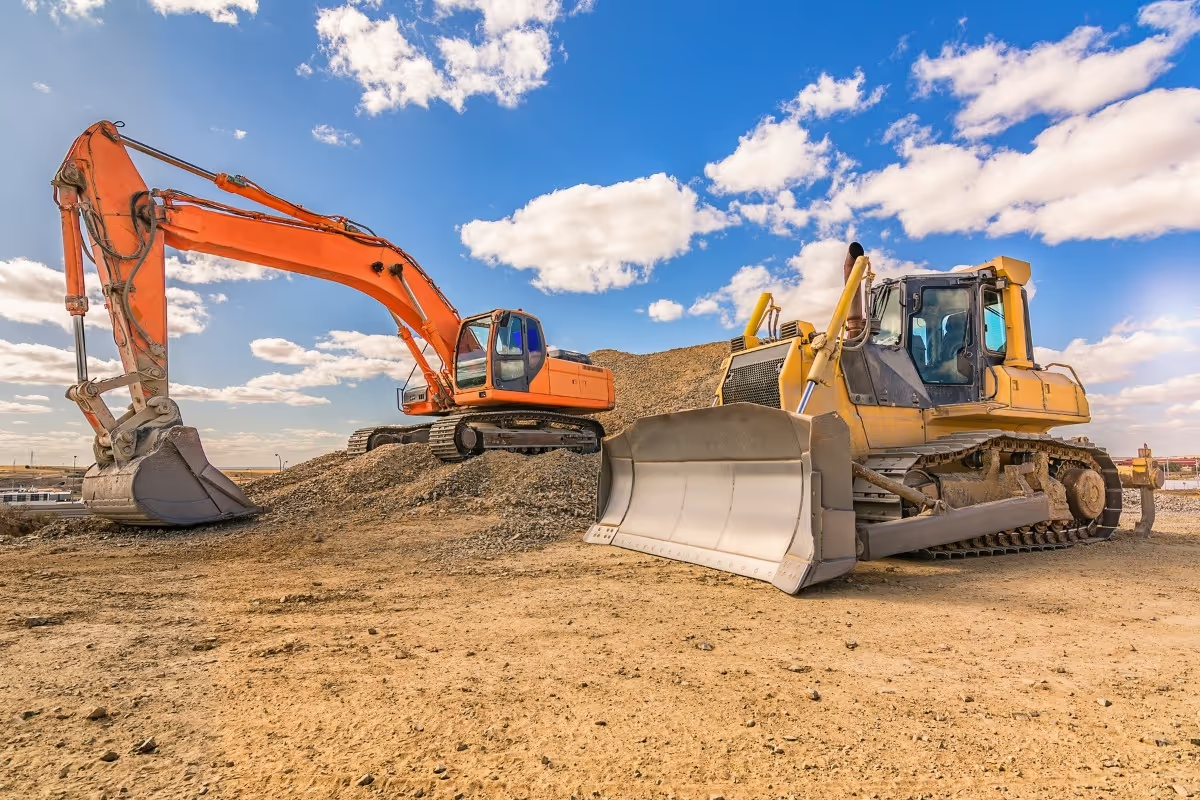
Heavy equipment financing — Excavators, concrete pumps, compactors, motor graders, and construction assets for residential, commercial, and civil projects across Repentigny and the L'Assomption MRC.
Refinancing and sale-leaseback — Converts equity in owned equipment into working capital without requiring a sale. Note: Quebec refinancing requires a Vendor of Convenience (VOC) under select programs — confirm this requirement and its associated cost before submitting.
Asset-based lending — For larger capital requirements backed by a portfolio of equipment or receivables. Relevant for growing Repentigny manufacturers and construction companies with significant asset holdings.
Equipment line of credit — A revolving draw facility for businesses financing equipment on a recurring basis — useful for contractors expanding their fleet seasonally or manufacturers adding capacity phase by phase.
Invoice and freight factoring — Converts outstanding invoices into immediate working capital. Factoring approval is based primarily on your customers' creditworthiness — not yours. Useful for Repentigny manufacturers and subcontractors managing 30–60 day receivables from Montréal-area industrial clients.
Working capital loans — Short-term capital to bridge between project payments, cover pre-season mobilization costs, or manage timing between equipment delivery and first invoice payment.
Review the eligible equipment guide to confirm what asset types qualify before applying.
Three regulatory and program realities apply specifically in Quebec that Repentigny businesses need to understand before applying.
Private sales are restricted under several lender programs. TFG Financial does not finance private sales in Quebec under any circumstances. Other programs that permit private sales nationally apply additional Quebec-specific documentation requirements. If you are purchasing used construction equipment or a manufacturing machine from a private seller in Quebec, confirm financing program eligibility before negotiating the purchase price or signing any agreement.
Refinancing in Quebec requires a Vendor of Convenience (VOC) under select programs. A VOC is a licensed equipment dealer who formally acts as the vendor in a refinancing or sale-leaseback transaction. This adds a VOC fee — typically a percentage of the transaction value — and process steps that must be built into your timeline and cost planning before submitting.
GST and QST are billed separately in Quebec. Unlike Ontario's single 13% HST, Quebec applies 5% federal GST and 9.975% provincial QST as separate taxes, for a combined rate of approximately 14.975%. Both are recoverable as ITCs and ITRs for registered businesses, but managed through two separate tax accounts. Confirm the most efficient structure with your accountant before signing on larger transactions.
This is a logistics and planning reality that is specific to construction and equipment operators working across the Montréal north shore — and Repentigny sits right at the pinch point.
Repentigny is on the north shore of the St. Lawrence, connected to the south shore and to the Island of Montréal by a limited number of bridge crossings. The Pont Pie-IX — which connects the island of Montréal directly to the north shore at Rivière-des-Prairies — and the Pont Louis-Bisson at Saint-Charles-Borromée serve as the primary equipment transport crossing points for contractors moving between Montréal and Repentigny. Both crossings are subject to meaningful congestion during peak hours, and oversize equipment loads on the north shore highway network require advance SAAQ (Société de l'assurance automobile du Québec) permitting for loads exceeding standard dimension and weight limits.
For a construction contractor mobilizing an excavator or a concrete pump from a supplier in Montréal to a project in Le Gardeur, the routing, permit requirements, and crossing timing are real operational planning considerations — not afterthoughts. Equipment that arrives at a project site three days after the scheduled start date because of permit delays or crossing logistics delays is a cost the contractor absorbs directly.
The practical advice: when financing equipment that will need to be transported across the St. Lawrence or moved along the Autoroute 40 north shore corridor, build the SAAQ permit timeline — typically five to ten business days for standard oversize loads — into your project mobilization plan before you sign the equipment purchase agreement or the project contract. Approval and funding timelines vary by lender, application completeness, and required conditions. The permitting can take longer than the financing.
Repentigny's construction market has a rhythm that is shaped by the Quebec construction calendar more than any other single factor. The ground on the north shore of the St. Lawrence thaws later than in Montréal — a week or two behind the island — and spring road weight restrictions come into force in early March across Lanaudière's secondary road network, restricting heavy equipment movements until the thaw is complete.
The pattern we see consistently: a contractor wins a project in April, needs equipment on-site by early May, and starts the financing process in mid-April. They discover that the specific excavator or skid steer they want is committed to another buyer, that the dealer's next available unit is three weeks out, or that their documentation requires a quick financial statement request that adds two business days. May starts without equipment on-site, and the first weeks of the season are lost.
The better approach follows what we recommend to contractors across Quebec's compressed-season markets: treat October and November as the planning window for next season's capital equipment. This is when the current season's projects are winding down, the financial picture for the year is clearest, and dealers have inventory to discuss. A contractor who has a pre-qualification conversation in November knows exactly what they qualify for, what documents they need, and what approval timelines look like. When April arrives and a project is awarded, the call to Mehmi is a confirmation call, not a starting call.
Use the amortization calculator to model payment scenarios during the off-season so you're making informed decisions before the pressure of a project window.
Illustrative example only; not a statement of a specific funded client transaction.
A Repentigny-based civil and earthworks contractor had been operating for six years, primarily servicing residential lots in Le Gardeur and the Route 343 growth corridor for two established Lanaudière developers. A late-March project award required two excavators simultaneously to complete grading and service installation on a 90-lot subdivision before the May concrete pour window.
Their single excavator would not cover the work volume. Two additional units were available at a Repentigny-area dealer — one new mid-size excavator and one used unit from dealer inventory.
The challenge: The contractor needed both units confirmed and on-site by the first week of May — approximately five weeks from the project award date. They had not previously financed more than one unit simultaneously. The SAAQ permit for moving the used unit from the dealer's Lachenaie yard to the project site in Le Gardeur needed to be initiated immediately.
How Mehmi structured it: Both units were submitted as a single simultaneous application — the new unit as an application-only file, the used unit as a dealer-inventory file with clear documentation on machine year, hours, and condition. Supporting documents included three months of bank statements, the developer project award letter confirming the 90-lot scope and May concrete deadline, and the dealer invoice for both units.
What made it work: The project award letter provided unambiguous capacity evidence — forward revenue from a named developer against a defined project scope. The SAAQ permit process was initiated by the dealer on the after verification and funding conditions are met the financing application was submitted, running in parallel rather than sequentially.
Approval and funding timelines vary by lender, application completeness, and required conditions. SAAQ permit obtained in seven business days. Both excavators on-site by May 1. The contractor completed the grading and service installation phase on schedule and was awarded the Phase 2 service installation contract the following month. The invoice and freight factoring facility was noted as a tool for managing the 45-day payment cycle typical of Lanaudière residential developer invoicing.
Repentigny's construction, manufacturing, transportation, and health services economy generates a distinctive equipment financing profile. These are the asset types we see most frequently, each linked to its specific financing page:
Construction
Manufacturing
Transportation
Medical & Dental
Construction and contractors — Residential development in Le Gardeur, Iberville-Est, and the Route 343 growth corridor; commercial construction along Boulevard Iberville and Chemin Duplessis; and civil infrastructure throughout the L'Assomption MRC. See the comprehensive guide to construction equipment financing.
Manufacturing and wholesale — Metal fabricators, plastic component manufacturers, food processors, and industrial suppliers in the Parc industriel de Repentigny and Le Gardeur industrial zones, supplying Montréal and Lanaudière commercial and industrial markets.
Transportation and trucking — Autoroute 40 east freight carriers, Route 138 north shore distributors, and regional logistics businesses serving Lanaudière's industrial and commercial supply chain.
Medical, dental and wellness — Centre hospitalier régional de Lanaudière in Saint-Charles-Borromée anchors regional health services for the L'Assomption MRC. Dental practices, clinics, and wellness businesses serving Repentigny's growing population access diagnostic and treatment equipment financing.
Hospitality and food service — Restaurants and food service operators across Repentigny's Boulevard Iberville and Chemin Duplessis commercial corridors access kitchen, refrigeration, and service equipment financing.
Technology and business services — Professional services and technology businesses supporting Repentigny's commercial sector and the broader Lanaudière regional economy.
Most equipment financing applications require:
For construction files: a project award letter or developer letter of intent alongside bank statements strengthens capacity evidence on seasonal project files. Include it with every initial submission for residential development contracts.
For manufacturing files: supply contracts or purchase orders from named clients accelerate approvals on files above application-only thresholds.
Dealer purchases process fastest — application-only files under $250,000 with two to three or more years in business and a clean bureau are reviewed according to lender requirements.
Private sales in Quebec are restricted under certain programs — confirm eligibility before committing to a purchase agreement. Call Mehmi first.
Refinancing in Quebec requires a Vendor of Convenience (VOC) under select programs — confirm this requirement and its associated cost before submitting a refinancing file.
Approval and funding timelines vary by lender, application completeness, and required conditions.
Larger files over $250,000 may require financial statements depending on your profile. Files over $500,000 typically need three years of accountant-prepared statements plus interim financials.
Questions before applying Review the FAQ or explore all financing services to understand every option available.
Ready to get your equipment funded in Repentigny? Call us directly at 1-833-863-4644 or apply online to request financing options, subject to lender review.
Related resource: Browse our equipment financing by city directory for more local financing guides.
Q. / A. How fast are approvals in Repentigny?Approval and funding timelines vary by lender, application completeness, and required conditions. Application-only files under $250,000 with two to three or more years in business and a clean bureau are reviewed according to lender requirements. Approval and funding timelines vary by lender, application completeness, and required conditions.
Q. / A. Can I buy used equipment from a private seller in QuebecNot through all programs. TFG Financial does not permit private sales in Quebec under any circumstances. Other programs apply additional Quebec-specific documentation requirements. Confirm program eligibility before negotiating or signing a private purchase agreement.
Q. / A. What is a Vendor of Convenience and when do I need one for refinancingA VOC is a licensed equipment dealer who formally acts as the vendor in a refinancing or sale-leaseback transaction. Select lenders require a VOC on all Quebec refinancing files. The VOC charges a fee — typically a percentage of the transaction value — that must be built into your cost planning before submitting.
Q. / A. How does Quebec's GST + QST affect my financing decisionQuebec's combined rate is approximately 14.975% (5% GST + 9.975% QST), billed separately and managed through two tax accounts. Both are recoverable for registered businesses. Confirm with your accountant whether a lease or purchase structure optimizes your ITC and ITR recovery for your specific cash flow timing.
Q. / A. What is a SAAQ permit and do I need one to move construction equipmentSAAQ (Société de l'assurance automobile du Québec) issues oversize and overweight vehicle permits for loads exceeding standard highway dimensions and weight limits. Most full-size excavators and concrete pumps on transport trailers require a SAAQ permit to move on Quebec highways. The permit process typically takes five to ten business days — initiate it at the same time as the financing application, not after funding.
Q. / A. When should I start the financing conversation for next season's construction equipment?October or November. The Lanaudière construction season opens in April or early May, and the pre-season pressure leaves no room for documentation gathering or structure decisions. Approval and funding timelines vary by lender, application completeness, and required conditions.
Q. / A. Can I refinance equipment I already own in RepentignyYes, through qualifying programs. A refinancing or sale-leaseback converts equity in owned equipment into working capital. Quebec refinancing requires a Vendor of Convenience under select programs — confirm before submitting.
Q. / A. What documents do I need to applyFor most files: bank statements, government ID, business registration, and an equipment quote or bill of sale. For construction files, add a project award letter or developer letter of intent. For manufacturing files, add supply contracts or purchase orders. Private-sale files require confirmation of program eligibility first. Files over $250,000 may require financial statements.

.svg)