
This page covers equipment financing in Niagara Falls, Ontario — who qualifies, what structures are available, how approvals work, and what local businesses need to know before applying. Niagara Falls is one of the world's most visited tourist destinations and Canada's most concentrated hospitality and entertainment economy outside of major urban centres — a city of 100,000 anchored by the Niagara Falls tourist corridor along Fallsview Boulevard and Clifton Hill, the Fallsview Casino Resort, the Rainbow Bridge US border crossing, a significant manufacturing base along the QEW and Thorold Stone Road industrial corridors, and the Niagara wine region extending through the city's southern boundaries toward Niagara-on-the-Lake. Approval and funding timelines vary by lender, application completeness, and required conditions.
Niagara Falls occupies a position unlike any other city in Ontario's economy. It is simultaneously one of the world's most-visited natural attractions, a major US border crossing on the Rainbow Bridge connecting to Lewiston, New York, a significant manufacturing city with a substantial industrial base along the QEW and Thorold Stone Road corridors, and the northern anchor of the Niagara wine region that runs south through the Niagara Escarpment's tender fruit belt toward Niagara-on-the-Lake.
The tourism economy along the Fallsview Boulevard and Clifton Hill corridors — encompassing the Fallsview Casino Resort, the Marriott, Hilton, and Sheraton fallsview hotels, dozens of attractions along Clifton Hill, and the tourist retail and dining district — generates more hospitality revenue per square kilometre than almost anywhere in Canada outside downtown Toronto. The industrial corridors on Thorold Stone Road and the QEW Queenston interchange area house chemical manufacturers, food processors, metal fabricators, and logistics operations serving both the Ontario market and the US border trade via the Rainbow Bridge.
Approval and funding timelines vary by lender, application completeness, and required conditions. Whether you're a construction contractor building in the Lundy's Lane or Mountain Road growth corridors, a food and beverage manufacturer or industrial operator in the Thorold Stone Road industrial area, a tourism or hospitality business managing the seasonal Fallsview corridor, or a carrier serving the Rainbow Bridge cross-border freight corridor, Mehmi structures financing around how Niagara Falls' distinctive dual economy actually operates.
Equipment can be sourced from Niagara Region and Hamilton-area dealers, private sellers, or auctions. High-hour and older units qualify regularly when they continue generating stable revenue and are properly documented.
Use the equipment payment calculator to model monthly payments before you apply.
When buying or refinancing business assets in Niagara Falls, compare the structure and total ownership cost—not just the monthly payment. Availability and terms depend on equipment, business credit, cash flow and individual lenders.
| Equipment funding need | Option to compare | What to verify |
|---|---|---|
| Purchasing eligible manufacturing machinery | Equipment loan or conditional sale | Equipment value, term, interest calculation, down payment, collateral, title and early-payout terms. |
| Using equipment while managing initial cash outlay | Equipment lease | Payment schedule, deposits, insurance, end-of-term purchase options, return conditions and total cost. |
| Purchasing from a used-equipment dealer or private seller | Used-equipment financing | Asset age, hours or mileage, inspection, seller verification, lien search and any lender limits. |
| Unlocking equity in owned machinery or vehicles | Equipment refinancing or sale-leaseback | Appraised value, current liens, payout amounts, advance against value, fees and continuing use of the asset. |
| Buying multiple assets or upgrading in stages | Equipment financing facility or separate leases | Each asset's eligibility, draw timing, security, documentation, amortization and combined payment burden. |
Next step: Compare equipment loans, leases and refinancing before requesting indicative terms. Examples above are educational, not offers or approvals.
Niagara Falls' economy generates financing demand across two very different profiles that rarely appear together in the same Ontario city.
Construction contractors working on Niagara Falls' residential and commercial growth — the Lundy's Lane secondary plan area running west from the Fallsview tourist corridor, the Mountain Road residential growth north of the QEW, and the infill and commercial development along Morrison Street, McLeod Road, and the Kalar Road corridor — operate in one of southern Ontario's more active mid-size construction markets. The city's sustained tourism revenue creates commercial construction demand that tracks visitor numbers and hotel occupancy — when the Fallsview corridor is adding rooms and attractions, contractors are busy; when the sector pauses, demand moderates.
Food and beverage manufacturers, chemical producers, and industrial operators in Niagara Falls' manufacturing base — concentrated in the Thorold Stone Road industrial corridor, the Montrose Road business park, and the QEW Queenston interchange industrial area — produce a range of goods from consumer food products and agricultural processing to specialty chemicals and industrial supplies. Many of these operations have US export exposure given the proximity of the Rainbow Bridge and the Lewiston-Queenston Bridge crossing.
Hospitality and tourism businesses along the Fallsview Boulevard and Clifton Hill corridors — hotels, restaurant groups, entertainment operators, and commercial laundry and food service supply businesses servicing the hotel strip — represent the dominant economic sector in Niagara Falls by revenue volume. Financing here primarily involves kitchen equipment, commercial refrigeration, food service infrastructure, and maintenance and utility equipment supporting the tourist corridor's continuous operation.
For operators who want full ownership from day one, equipment loans provide a clear path — fixed payments, equity build, and refinancing options when working capital is needed.
Lenders assess five core factors — character, capacity, capital, collateral, and conditions — and the strength of your file across all five determines what gets approved, on what terms, and at what rate.
Character is your business track record. Years in operation, commercial bureau history, and whether bank statements reflect consistent, well-managed cash flow. Documentation requirements vary by lender, transaction size, business history, and credit profile.
Capacity is whether your revenue supports the proposed payment. For construction contractors, project award letters from developers or the City of Niagara Falls confirm forward workload. For manufacturers, purchase orders or supply agreements from named clients strengthen larger files. For hospitality businesses, the pattern of bank deposits that follow Niagara Falls' tourism calendar — strong May through October, meaningful December holiday period, quieter January through April — requires explanation alongside the bank statements to prevent misreading.
Capital is your equity position. Niagara Falls' real estate market includes both the high-value Fallsview tourist corridor commercial properties and the more modestly priced residential areas — homeownership in either is a meaningful capital indicator.
Collateral is the asset itself. Construction iron has the active Ontario secondary market. Industrial manufacturing equipment has national markets. Commercial food service and hospitality equipment has a functional secondary market through commercial kitchen dealers and refurbishers.
Conditions cover the deal structure — term length, payment structure, advance amount, and documentation requirements. Files over $250,000 may require financial statements. Files over $500,000 typically need three years of accountant-prepared statements plus interim financials.
Thresholds above reflect typical patterns across Mehmi's financing programs. Requirements vary by program and file.
Equipment loans — Full ownership from day one. Fixed payments, equity build, and the asset on your balance sheet. Best for long-lived construction, manufacturing, and hospitality infrastructure assets.
Equipment leasing — Lower upfront cost with end-of-term flexibility — return, renew, or purchase. Ontario's 13% HST applies to lease payments — fully recoverable as ITCs for HST-registered businesses. Well suited for hospitality equipment on 3–5 year replacement cycles.
Conditional sales contracts — Fixed payments with a nominal buyout at the end. Common for construction iron, commercial vehicles, and industrial capital equipment.
Truck and trailer financing — For Niagara Falls carriers running the QEW toward Hamilton and Toronto, the Rainbow Bridge corridor for US cross-border freight, and the Lewiston-Queenston Bridge connecting to the US interstate network via I-190 and I-290.
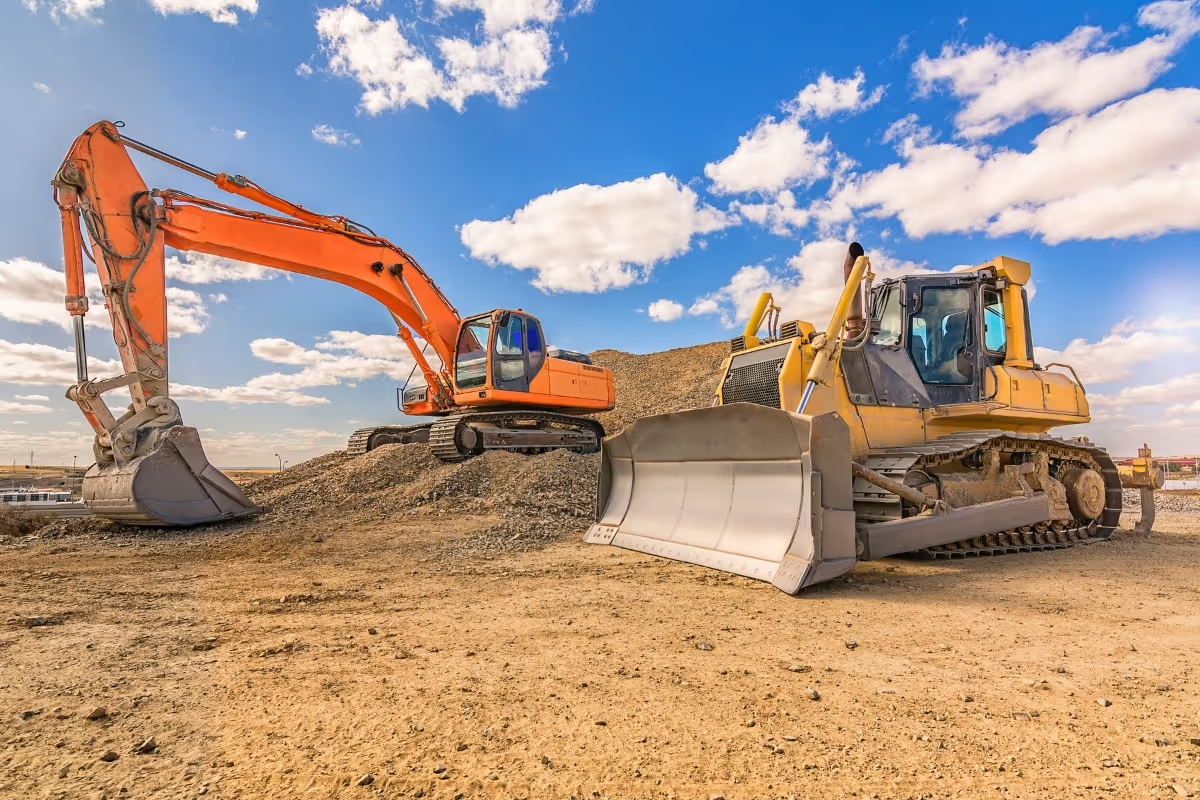
Heavy equipment financing — Excavators, concrete pumps, compactors, and construction assets for Niagara Falls' Lundy's Lane and Mountain Road residential growth, and commercial construction across the city.
Refinancing and sale-leaseback — Converts equity in owned equipment into working capital without requiring a sale. Useful for established Niagara Falls hospitality operators and manufacturers who have built equity in operational assets.
Asset-based lending — For larger capital requirements backed by a portfolio of equipment or receivables. Relevant for established manufacturers and larger hospitality group operators.
Equipment line of credit — A revolving draw facility for hospitality businesses managing recurring equipment refresh cycles or manufacturers adding capacity incrementally.
Invoice and freight factoring — Converts outstanding invoices into immediate working capital. Factoring approval is based primarily on your customers' creditworthiness — not yours. Useful for Niagara Falls manufacturers managing 30–60 day receivables from US and Canadian food and industrial clients.
Working capital loans — Short-term capital to bridge between tourist season peaks and quiet-season operating costs, cover equipment purchases ahead of the summer opening, or manage construction project timing.
Review the eligible equipment guide to confirm what asset types qualify before applying.
This is the most consistent financing challenge for Niagara Falls hospitality and service businesses, and it's specific to the city's extraordinary tourism concentration.
Niagara Falls' tourist corridor runs at peak capacity from late May through the October long weekend, with a meaningful secondary season during the December Festival of Lights period. From January through April, tourist traffic drops sharply — some businesses close entirely, others operate at 20–30 percent of summer capacity. A business that generates 70 percent of its annual revenue in five months has a bank statement pattern that is entirely normal for Niagara Falls but looks, to an underwriter pulling a random three-month bank statement window in February, like a business in serious trouble.
The compounding factor is that hospitality equipment purchases often need to happen in March and April — before the summer season opens, not during it. A restaurant or catering operation investing in a new commercial kitchen line, a hotel replacing food service equipment, or an attractions operator purchasing maintenance machinery needs that equipment ready for May 1. That means financing in February or March, when bank statements are at their quietest and least representative of the business's actual annual capacity.
The practical advice: Niagara Falls hospitality businesses applying for equipment financing should always submit the full previous year's T2 or financial statements alongside bank statements, even for files that would normally qualify as application-only. A three-month bank statement in February shows a quiet business. A full year of financials shows a Niagara Falls tourist economy operator — a completely different credit picture. Including a brief written note on the seasonal business model adds the final clarity.
Niagara Falls has one of the most concentrated pre-season equipment financing windows in Canada. The period from February 15 through April 30 is when the majority of Niagara Falls hospitality operators make capital equipment decisions — replacing commercial kitchen equipment, upgrading hotel food service infrastructure, adding capacity before the summer rush arrives. Every operator on the Fallsview strip and every restaurant on Clifton Hill is making the same calculation at the same time.
The problem isn't the decision to finance pre-season — that's the right call. The problem is that most operators present the financing application with the worst possible bank statement window (February–March) and no context about why May through October looks different.
The solution is counter-intuitive: don't try to hide the seasonality. Explain it. The Niagara Falls tourist economy is one of the most well-documented seasonal business environments in Canada. An underwriter who understands the city — or who receives a simple, clear explanation of the seasonal model — will assess the file on annual capacity, not on three months of February deposits. An underwriter who doesn't receive that context will see a quiet business and apply conservative criteria.
The specific documentation approach: include the prior year's full financial statements, a brief business description noting the seasonal tourism model and peak season months, and any hotel or restaurant group supply agreements that demonstrate the forward season's bookings or purchasing commitments. For Fallsview corridor operators with group sales contracts or pre-booked convention catering agreements, those documents are among the best capacity evidence available.
Illustrative example only; not a statement of a specific funded client transaction.
A Niagara Falls restaurant group operating two licensed dining rooms in the Fallsview tourist corridor — combined capacity of 280 seats serving the hotel and fallsview tourism market — needed to replace aging commercial cooking and refrigeration equipment ahead of the summer season. Total equipment requirement was $215,000, sourced from an authorized commercial kitchen equipment dealer in Hamilton.
The challenge: The application was submitted in early March. Bank statements for December, January, and February showed combined deposits significantly below the monthly average that a $215,000 equipment file would typically require to demonstrate comfortable payment coverage. The previous summer had been the group's strongest in three years — but that was not visible in the current statement window.
How Mehmi structured it: The file was submitted with the prior year's T2 corporate tax return confirming the full annual revenue, three months of bank statements with a written note identifying the peak tourist season months and typical seasonal revenue split, the commercial kitchen equipment dealer invoice, and documentation of confirmed group bookings for the upcoming May–October season from two Fallsview hotel catering accounts.
What made it work: The T2 showed the full annual revenue picture. The seasonal explanation eliminated interpretive ambiguity. The hotel catering account confirmations provided forward capacity evidence — documented restaurant group supply commitments from named hotel clients.
Approval and funding timelines vary by lender, application completeness, and required conditions. Equipment delivered and commissioned before the May 1 opening. The group's summer season ran at full kitchen capacity from opening weekend. The working capital loan was recommended for bridging the January–March quiet period in future years without dipping into operating reserves.
Niagara Falls' construction, manufacturing, hospitality, transportation, and health services economy generates a distinctive equipment financing profile. These are the asset types we see most frequently, each linked to its specific financing page:
Construction
Manufacturing & Industrial
Transportation
Medical & Dental
Hospitality and food service — Canada's most concentrated tourism and hospitality economy outside downtown Toronto. Hotel food service operations, licensed restaurants, catering groups, and entertainment operators along Fallsview Boulevard and Clifton Hill access kitchen, refrigeration, and food service equipment financing. Seasonal revenue documentation is essential — see the gotcha section above.
Construction and contractors — Residential development in Lundy's Lane and Mountain Road secondary plan areas; commercial and hotel construction along the Fallsview corridor; and infrastructure throughout Niagara Falls. See the comprehensive guide to construction equipment financing.
Manufacturing and wholesale — Food processors, chemical manufacturers, metal fabricators, and industrial supply businesses in the Thorold Stone Road and Montrose Road industrial parks with access to both Ontario markets and US export via the border crossings.
Transportation and trucking — QEW corridor carriers, cross-border Rainbow Bridge and Lewiston-Queenston freight operators, and temperature-controlled supply chain businesses serving the Niagara Falls hospitality and food service sector.
Medical, dental and wellness — Niagara Health — Greater Niagara General Site anchors health services for Niagara Falls and the region. Dental practices, clinics, and wellness businesses across the city's residential corridors access diagnostic and treatment equipment financing.
Natural resources and energy — The Niagara River's hydroelectric generating stations — Ontario Power Generation's Sir Adam Beck complex near Queenston — support a utility services and infrastructure maintenance sector in the Niagara gorge area.
Technology and business services — Niagara College's Niagara Falls campus and the growing cross-border technology and services corridor serving both Ontario and New York State markets.
Most equipment financing applications require:
For hospitality and tourism businesses: always include the prior year's full financial statements or T2 alongside bank statements, even for smaller files. Three months of February deposits do not represent a Niagara Falls tourist economy business. Include a brief note on the seasonal model. For Fallsview operators with hotel catering contracts or group booking commitments, include those documents as forward capacity evidence.
For construction files: project award letters from developers alongside bank statements.
For manufacturing files: supply agreements or purchase orders from named Ontario or US clients strengthen larger files.
Dealer purchases process fastest — application-only files under $250,000 with a clean bureau are reviewed according to lender requirements.
Larger files over $250,000 may require financial statements. Files over $500,000 typically need three years of accountant-prepared statements plus interim financials.
Questions before applying Review the FAQ or explore all financing services to understand every option available.
Ready to get your equipment funded in Niagara Falls? Call us directly at 1-833-863-4644 or apply online to request financing options, subject to lender review.
Related resource: Browse our equipment financing by city directory for more local financing guides.
Q. How fast are equipment financing approvals in Niagara Falls?A. Approval and funding timelines vary by lender, application completeness, and required conditions. Application-only files under $250,000 with a clean bureau are reviewed according to lender requirements. Hospitality files with full-year financial statements and seasonal model documentation included at submission typically move as quickly as year-round business files.
Q. My business makes most of its money May through October. Will quiet winter bank statements cause problemsA. Only if you don't explain the seasonal model. Always submit full-year financial statements or T2 corporate returns alongside current bank statements. A three-month window in February or March represents the quietest period of a Niagara Falls tourist economy business. The full year shows the actual picture. Include a brief note identifying peak months and the seasonal revenue split. See the gotcha section above.
Q. I need kitchen equipment ready before the May tourist season opens. Can I finance in March when my deposits are at their lowestA. Yes — and you should. Pre-season is exactly the right time to finance equipment that needs to be operational for the summer. The key is submitting the prior year's financials alongside current statements, not relying on three months of winter deposits to tell the story. Hotel catering agreements or group booking confirmations for the upcoming season add forward capacity evidence. See the Mehmi's Take section above.
Q. I operate on the Fallsview strip. Does my location help or hurt my applicationA. It helps significantly with context — the Niagara Falls tourist corridor is one of the best-documented high-revenue hospitality environments in Canada. What matters most is presenting the full annual financial picture, not just the quiet-season bank statements that happen to be most current at application time.
Q. Can I finance manufacturing equipment for US export production from my Niagara Falls facilityA. Yes. Manufacturing equipment files for Niagara Falls industrial operators with US customer purchase orders or supply agreements include that documentation as capacity evidence. US customer creditworthiness can strengthen capacity arguments for larger files.
Q. Can I refinance equipment I already ownA. Yes. A refinancing or sale-leaseback converts equity in owned equipment into working capital without requiring a sale. Useful for hospitality operators managing the cash flow gap between quiet season and peak season revenue.
Q. What documents do I need to applyA. For hospitality files: prior year T2 or financial statements, three months of bank statements with seasonal model note, government ID, business registration, and equipment quote. For catering or hotel food service operators, include group booking or supply confirmations if available. For construction files: project award letter plus standard documentation. For manufacturing files: supply agreements alongside standard documentation.

.svg)