
Equipment Financing Kitchener

This page covers equipment financing in Kitchener, Ontario — who qualifies, what structures are available, how approvals work, and what local businesses need to know before applying. Kitchener is Ontario's ninth-largest city (population 250,000+), located 100 kilometres west of Toronto in the Region of Waterloo. It is Canada's primary technology and innovation hub outside Toronto, home to a thriving tech startup ecosystem, a significant manufacturing and precision engineering sector, and a sustained professional services and commercial economy. The city is anchored by the University of Waterloo, one of Canada's leading engineering and technology universities, and serves as a regional centre for southwestern Ontario. Most approvals take 24–48 hours once documents are complete. Ontario applies 13% HST; fully recoverable as ITCs for HST-registered businesses.

Hero - Elements Webflow Library - BRIX Templates

Equipment Financing Kitchener: Fast Approvals at Canada's Tech Hub

Kitchener occupies a distinctive position in Canada's technology and innovation landscape. Located 100 kilometres west of Toronto in the Region of Waterloo, it is Ontario's ninth-largest city by population (250,000+) and Canada's second-largest technology and innovation hub after Toronto. The city has consciously developed a technology ecosystem centered on software development, digital innovation, artificial intelligence, fintech, and hardware startups.

The University of Waterloo is the anchor institution, recognized globally for engineering, computer science, and technology programs. The university's co-op program produces thousands of technology-trained graduates annually who remain in Kitchener or launch startups in the region. The university's research programs and innovation initiatives create sustained demand for research equipment, computing infrastructure, and facility development.

Kitchener's tech startup ecosystem has matured significantly over the past decade. The city hosts hundreds of technology companies, from early-stage startups to scale-up companies to established tech firms. Major technology companies have established engineering offices and operations in Kitchener, recognizing the talent pool and lower costs compared to Toronto.

Kitchener's secondary economy is manufacturing and precision engineering. The city has a heritage of manufacturing and continues to host automotive supply, precision machinery, and specialty manufacturing operations serving regional and national markets.

Professional services, financial services, and commercial operations anchor downtown and regional commercial corridors.

Equipment financing in Kitchener typically returns an approval within 24–48 hours once your documents are complete. Whether you're a technology company or software developer, a startup or scale-up needing infrastructure, a manufacturing or precision engineering operation, a professional services or financial services firm, a construction contractor serving the region, or a commercial services business serving Ontario's tech hub, Mehmi structures financing around how Kitchener's economy actually operates.

Equipment can be sourced from Kitchener-area, Ontario, and Canada-wide dealers, private sellers, or auctions. High-hour and older units qualify regularly when they continue generating stable revenue and are properly documented.

Use the equipment payment calculator to model monthly payments before you apply.

Why Kitchener Businesses Finance Equipment Rather Than Buy Outright

Kitchener's economy creates equipment financing demand across five distinct sectors with different financing patterns and growth trajectories.

Technology companies and software development — ranging from early-stage startups to scale-up companies to established tech firms — finance server infrastructure, computing equipment, research and development systems, and software development tools tied to product cycles, customer contracts, and technology refresh schedules. Startup equipment is often financed in anticipation of revenue rather than from historical cash flow.

Hardware startups and advanced manufacturing — developing innovative products and manufacturing solutions — finance research equipment, prototyping systems, production machinery, and specialized manufacturing tools tied to product development timelines and customer contracts.

Manufacturing and precision engineering operating on supply contracts with automotive OEMs and industrial customers — finance CNC machinery, specialty tooling, and assembly equipment tied to production schedules and supply agreements.

University of Waterloo and affiliated research — financed research equipment, laboratory systems, computing infrastructure, and facility development tied to grant cycles and capital plans.

Professional services, financial services, and commercial operations — finance office equipment, computer systems, telecommunications infrastructure, and facility upgrades tied to staffing expansion and technology refresh cycles.

For operators who want full ownership from day one, equipment loans provide a clear path — fixed payments, equity build, and refinancing options when working capital is needed.

What Lenders Look at When You Apply in Kitchener

Lenders assess five core factors — character, capacity, capital, collateral, and conditions — and the strength of your file across all five determines what gets approved, on what terms, and at what rate.

Character is your business track record. Years in operation, commercial bureau history, and whether bank statements reflect consistent, well-managed cash flow. For application-only approvals up to $250,000, most programs require a minimum of two to three years in business with a clean bureau. Technology companies with established customer contracts or product revenue qualify frequently. Manufacturing operations with supply agreements strengthen applications.

Capacity is whether your revenue supports the proposed payment. For technology companies, customer contracts, software license agreements, or product sales pipelines confirm volume. For hardware startups, product development contracts or customer interest. For manufacturers, supply agreements and production forecasts. For professional services, client rosters and billable demand. For research institutions, grant funding and capital budgets.

Capital is your equity position. Kitchener's commercial real estate, office space, and industrial property have appreciated. Owner-occupied office, research, or manufacturing space is a strong capital indicator. Equipment owned free and clear strengthens applications. Residential property ownership in Kitchener's residential communities provides capital evidence. For tech companies, venture capital investment and founder equity can provide capital evidence.

Collateral is the asset itself. Technology and server equipment has active secondary markets among tech and software companies. Hardware and manufacturing equipment has regional and national secondary markets. Office equipment and facilities systems have active secondary markets. Construction equipment has strong regional markets.

Conditions cover the deal structure — term (typically 24–84 months), advance amount, and documentation thresholds. Files over $250,000 may require financial statements. Files over $500,000 typically need three years of accountant-prepared statements plus interim financials. Technology startups with strong customer contracts may have alternative underwriting based on contract pipelines.

Thresholds above reflect typical patterns across Mehmi's financing programs. Requirements vary by program and file.

Types of Equipment Financing Available in Kitchener

Equipment loans — Full ownership from day one. Fixed payments, equity build, and the asset on your balance sheet. Best for long-lived technology infrastructure, manufacturing, and facility assets Kitchener businesses plan to keep.

Equipment leasing — Lower upfront cost with end-of-term flexibility — return, renew, or purchase. Ontario's 13% HST applies to lease payments — fully recoverable as ITCs for HST-registered businesses. Commonly used by technology companies with rapid equipment cycles, startups managing cash flow, and professional services firms with regular technology updates.

Conditional sales contracts — Fixed payments with a nominal buyout at the end. A common ownership path for technology equipment, manufacturing systems, and commercial vehicles throughout Ontario.

Truck and trailer financing — For Kitchener carriers, construction contractors, and logistics operators serving southwestern Ontario. Technology distribution and manufacturing supply operations frequently finance heavy-duty trucks.

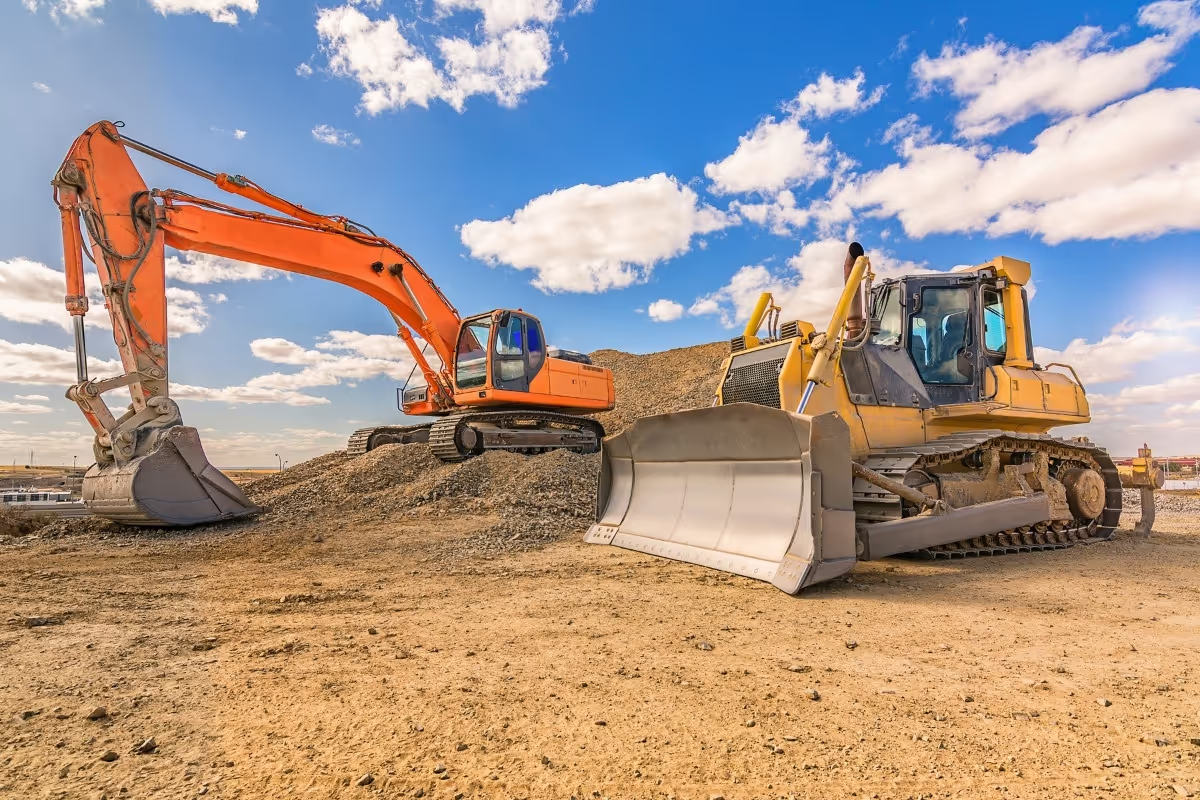
Heavy equipment financing — Excavators, concrete pumps, compactors, and construction assets for Kitchener's ongoing commercial and residential development pipeline.

Refinancing and sale-leaseback — Converts equity in owned equipment into working capital without requiring a sale. Supported on qualifying hard assets up to a reasonable percentage of current market value. Useful for established tech companies, manufacturers, and commercial operations with substantial equipment portfolios.

Asset-based lending — For larger capital requirements backed by a portfolio of equipment or receivables. Relevant for established technology companies, scale-ups, manufacturers, and larger construction contractors with recurring equipment financing needs.

Equipment line of credit — A revolving draw facility for businesses financing equipment on a recurring basis — useful for tech companies acquiring servers and infrastructure across multiple projects, startups managing scaling equipment needs, or manufacturers managing equipment replacement cycles.

Invoice and freight factoring — Converts outstanding invoices into immediate working capital. Factoring approval is based primarily on your customers' creditworthiness — not yours. Useful for Kitchener technology service providers and manufacturers managing 30–45 day receivables from corporate and industrial customers.

Working capital loans — Short-term capital to bridge between project payments, cover equipment costs ahead of a product launch, or manage timing between equipment installation and revenue ramp-up.

Review the eligible equipment guide to confirm what asset types qualify before applying.

The Kitchener-Specific Gotcha: Technology Startup Equipment Financing Requires Understanding Venture-Backed Business Models Where Revenue Timing and Customer Acquisition Cycles Differ from Traditional Operating Patterns

This is a market reality specific to Kitchener's technology startup economy that creates a financing pattern distinct from traditional commercial enterprises.

Technology startups operate on venture capital investment cycles and customer acquisition timelines that differ fundamentally from traditional business operations. A startup may have secured Series A funding from venture capital investors, demonstrating traction and market fit, but revenue may still be limited. Equipment financing is justified by the venture funding and the customer contracts the startup has signed, not by current operating cash flow.

The financing challenge: startup equipment is justified by customer contracts and venture funding visibility — not by historical profitability or steady-state operating cash flow. A software startup with a $5 million Series A funding round and a signed enterprise customer contract may need to finance servers and development infrastructure despite limited current revenue. But the venture funding and customer contract provide clear capacity evidence.

Technology company underwriting requires understanding whether the company has customer contracts, venture funding commitments, or milestone achievements (product launch, customer acquisition targets) that justify equipment investment.

The practical advice: Technology startups seeking equipment financing should include venture funding documentation, customer contracts or letters of intent, product development timelines, and equipment requirements aligned with customer contract milestones or product launches. For startups with limited operating history but strong venture backing, the venture funding and customer pipeline become the primary capacity documentation. The conversation with underwriters should explain the startup's funding and business model: "We're Series A funded, here's our customer pipeline, and here's the equipment we need to deliver on customer contracts starting [date]."

Mehmi's Take: Kitchener Technology Companies Should Finance Equipment Before Scaling Into Production or Customer Delivery Phases

Kitchener's tech startup ecosystem is competitive. Technology companies compete for customer contracts and market share by demonstrating product readiness and delivery capability. Startups that have secured customer contracts or funding are in a position to scale quickly if they have infrastructure in place.

For Kitchener technology companies, this creates a predictable dynamic: companies who have established financing relationships and acquired research, development, and production equipment before customer contracts are finalized are better positioned to scale and deliver quickly than companies who try to acquire equipment after contract signature.

The technology company that can say "We have infrastructure and capacity to begin customer delivery in [timeframe]" has a competitive advantage over the company that says "We'll need 60 days to acquire and configure equipment."

Pre-qualifying now, understanding your equipment financing range, and having a clear conversation with Mehmi about what server, development, or production equipment would position you for upcoming customer contracts is the exercise. Customer contract pipelines and venture funding provide forward visibility into equipment needs.

Use the amortization calculator to model different technology equipment scenarios before the next wave of customer contracts arrives.

Case Study: SaaS Company Finances Server Infrastructure and Development Systems for Enterprise Customer Launch

A software-as-a-service (SaaS) company in Kitchener — founded in 2022 by University of Waterloo alumni, developing enterprise data analytics software — had secured $3.2 million in Series A venture funding from a Toronto-based venture capital firm. The company's product was in beta with three early customer pilots.

An opportunity arrived: a major enterprise Fortune 500 company signed a definitive customer contract to deploy the SaaS platform across its organization, with a three-year contract value of $2.4 million. The contract required the company to have production infrastructure, security certifications, and customer support operations in place within three months.

The equipment investment: enterprise-grade server infrastructure, redundant systems, security monitoring equipment, and development workstations for the customer support and infrastructure team — total quoted at $380,000 from a technology equipment supplier.

The challenge: The SaaS company's bank statements showed limited operating revenue (still in customer acquisition phase). The Series A funding had been deployed toward product development and initial hiring. The enterprise customer contract was definitive, but equipment financing at $380,000 would typically require substantial financial statement documentation that a two-year-old startup lacked.

How Mehmi structured it: The file was submitted with the $380,000 server and development equipment package supported by Series A funding documentation (showing $3.2 million in committed venture capital), the enterprise customer contract (three-year, $2.4 million value, delivery timeline confirmed), the startup's product development roadmap and beta customer feedback, customer support and infrastructure staffing plan, and equipment supplier quotes with delivery timelines.

What made it work: The combination of a Series A funded technology startup with a signed enterprise customer contract worth $2.4 million, clear timeline showing equipment requirements tied to customer delivery, and explicit venture funding documentation created a straightforward venture-backed credit case. The enterprise customer contract provided definitive capacity evidence. The venture capital funding provided evidence of investor confidence and financial backing. The three-month customer delivery timeline created urgency that aligned with standard venture scaling patterns.

The outcome: Approval in three business days (approval required venture funding verification and enterprise customer contract confirmation). Equipment delivery from the supplier coordinated with customer support hiring and infrastructure buildout. All systems operational and certified within 10 weeks, meeting the enterprise customer's launch timeline. The SaaS company achieved successful enterprise customer deployment on schedule. The company raised an additional $8 million Series B round within 12 months based on the enterprise customer success. The company scaled from 12 to 35 employees. The equipment line of credit was implemented for ongoing infrastructure expansion and technology refresh as the customer base grew.

Commonly Financed Equipment in Kitchener

Kitchener's technology, manufacturing, professional services, research, and construction economy generates a distinctive equipment financing profile. These are the asset types we see most frequently, each linked to its specific financing page:

Technology & Software Development

Manufacturing & Precision Engineering

Office & Professional Services

Research & Education

Construction & Development

Industries We Finance in Kitchener

Technology and software development — SaaS companies, software developers, fintech startups, and artificial intelligence companies. Server infrastructure, development systems, and research equipment finance on customer contracts and venture funding. Kitchener is Canada's second-largest tech hub.

Hardware startups and advanced manufacturing — Product development companies and hardware innovators. Research, prototyping, and production equipment finance on product development contracts and customer orders.

Manufacturing and precision engineering — Automotive suppliers, precision machinery manufacturers, and specialty industrial operations. CNC and specialty tooling equipment finances on supply agreements and production schedules. See the comprehensive guide to manufacturing equipment financing.

Professional services and financial services — Law firms, consulting, accounting, and fintech operations. Office equipment and telecommunications infrastructure finance on staffing expansion and technology refresh.

Research and education — University of Waterloo and affiliated research operations. Research equipment and computing infrastructure finance on grant funding and capital plans.

Construction and commercial development — Commercial and residential development. Heavy equipment and construction assets serve Kitchener's sustained development. See the comprehensive guide to construction equipment financing.

How Approval Works in Kitchener

Most equipment financing applications require:

  • Recent bank statements (typically 3–6 months)
  • Government-issued identification
  • Business registration details
  • Equipment quote, invoice, or bill of sale

For technology companies: include customer contracts or letters of intent, product development roadmaps, equipment requirements tied to customer milestones or product launches, venture funding documentation (if applicable), and equipment supplier quotes alongside bank statements. Customer contracts and product roadmaps are as critical as financial statements for tech company files.

For hardware startups: include product development contracts, customer interest or pre-orders, equipment requirements tied to production timelines, venture funding documentation, and equipment supplier quotes.

For manufacturers: include supply contracts, production volume documentation, equipment requirements tied to supply agreement timelines, and bank statements.

For professional services: include client roster documentation, staffing expansion plans, equipment requirements, and bank statements.

For research institutions: include grant funding documentation, capital plan approval, equipment specifications tied to research programs, and bank statements.

For construction contractors: include development permits, project pipelines, and equipment requirements alongside bank statements.

Dealer purchases process fastest — application-only files under $250,000 with a clean bureau often return same-day decisions.

Larger files over $250,000 may require financial statements. Files over $500,000 typically need three years of accountant-prepared statements plus interim financials. Technology startups with strong customer contracts or venture backing may have alternative underwriting based on contract pipelines and funding.

Questions before applying? Review the FAQ or explore all financing services to understand every option available.

Ready to get your equipment funded in Kitchener?Call us directly at 437-777-5901 or apply online today to get an approval in 24–48 hours.

Contact Us!
Read about our privacy policy.
Thank you! Your submission has been received!
Oops! Something went wrong while submitting the form.

3 Steps. No Surprises.

The Mehmi Financial Group experience is simple, quick, and customized to your financial needs.

Find the Equipment you need

Whether it be an individual's private sale or equipment listed by a dealer, there are numerous options available.

Get In Touch

An all-in-one customer service platform that helps you balance everything your customers need to be happy.

Get Approved

Secure approval and funding in as little as 24–48 hours with flexible terms.

Frequently Asked Questions: Equipment Financing in Kitchener

Q. How fast are equipment financing approvals in Kitchener?A. Most complete files are approved within 24–48 hours. Application-only files under $250,000 with a clean bureau often return same-day decisions. Technology company files with complete customer contracts and product roadmaps typically return same-day or next-day decisions. Manufacturing files with documented supply contracts often return same-day approvals.

Q. I'm a technology startup with Series A funding and customer contracts. What documents do I need for equipment financing?A. Include venture funding documentation showing Series A commitment, customer contracts with delivery timelines and values, product development roadmap or milestone timeline, equipment requirements tied to customer delivery or product launch dates, and equipment supplier quotes. Venture funding and customer contracts are as critical as bank statements for technology startup files.

Q. What if my technology company is early-stage with limited revenue but strong customer traction?A. Include venture funding documentation, customer contracts or letters of intent, customer success metrics or pilot results, equipment requirements tied to scaling for customer delivery, and bank statements (even if limited). Strong customer validation and venture funding can support approval despite limited operating history.

Q. How do customer contracts and product development timelines affect my equipment financing?A. Customer contracts and product timelines determine when you need equipment operational. Include specific customer delivery dates and equipment deployment schedules tied to customer milestones. Clear alignment of equipment deployment with customer requirements accelerates approvals.

Q. What is HST treatment for leased technology equipment in Ontario?A. Ontario applies 13% HST. It is fully recoverable as ITCs for HST-registered businesses. Consult with your accountant about how your lease structure affects HST liability for your specific equipment type.

Q. Can I finance equipment if I'm a hardware startup developing a physical product?A. Yes. Include venture funding documentation, product development timeline with milestones, customer contracts or pre-orders, manufacturing or prototyping equipment requirements, and bank statements. Venture funding and product development documentation provide capacity evidence for hardware startups.

Q. Can I finance equipment if I'm a manufacturing or precision engineering supplier?A. Yes. Include supply contracts with OEMs or industrial customers, production volume documentation, equipment requirements tied to supply agreement timelines, and bank statements. Supply contracts provide capacity evidence for manufacturing files.

Q. Can I refinance equipment I already own?A. Yes. A refinancing or sale-leaseback converts equity in owned equipment into working capital without requiring a sale. Supported on qualifying hard assets up to a reasonable percentage of current market value.

Q. What equipment types qualify in Kitchener?A. Technology infrastructure, manufacturing and precision equipment, office systems, research equipment, and construction assets all qualify. See the eligible equipment guide for the complete list.

Example of gym equipment we could finance for a gym

Proudly Serving

We serve all major cities and locations across Canada for equipment financing.

Let Us Help Your Business Achieve Global Success