
This page covers equipment financing in Trois-Rivières, Quebec — qui est admissible, quelles structures sont disponibles, comment les approbations fonctionnent, et ce que les entreprises locales doivent savoir avant de soumettre une demande. Trois-Rivières est un centre industriel et de transport stratégiquement situé entre Montréal et Québec, avec une économie ancrée dans la foresterie, la fabrication, le transport et la construction. Les délais d’approbation et de financement varient selon le prêteur, l’exhaustivité du dossier et les conditions requises. This page is written in English and serves businesses operating in and around Trois-Rivières and the Mauricie region.
Trois-Rivières occupies one of the most strategically positioned locations in Quebec — sitting at the midpoint of the Highway 40 and 55 corridor connecting Montréal and Québec City, with the Saint-Maurice River feeding into the St. Lawrence and a deep industrial history rooted in pulp and paper, aluminum, manufacturing, and freight transport. For businesses here, equipment isn't optional infrastructure — it's the core of how work gets done.
Approval and funding timelines vary by lender, application completeness, and required conditions. Whether you're a forestry equipment operator running out of the Mauricie, a construction contractor building residential or commercial projects in Cap-de-la-Madeleine or Shawinigan, a manufacturer in the industrial zones along Boulevard des Forges, or a carrier running freight on the 40 corridor between Montréal and Québec, Mehmi structures financing around how your business actually operates.
Quebec has specific documentation and program requirements that differ meaningfully from the rest of Canada — including restrictions on private sales through certain programs and additional requirements for refinancing transactions. Understanding these before you apply saves time and avoids surprises.
Use the equipment payment calculator to model monthly payments before you apply.
When buying or refinancing business assets in Trois-Rivières, compare the structure and total ownership cost—not just the monthly payment. Availability and terms depend on equipment, business credit, cash flow and individual lenders.
| Equipment funding need | Option to compare | What to verify |
|---|---|---|
| Purchasing eligible construction machinery | Equipment loan or conditional sale | Equipment value, term, interest calculation, down payment, collateral, title and early-payout terms. |
| Using equipment while managing initial cash outlay | Equipment lease | Payment schedule, deposits, insurance, end-of-term purchase options, return conditions and total cost. |
| Purchasing from a used-equipment dealer or private seller | Used-equipment financing | Asset age, hours or mileage, inspection, seller verification, lien search and any lender limits. |
| Unlocking equity in owned machinery or vehicles | Equipment refinancing or sale-leaseback | Appraised value, current liens, payout amounts, advance against value, fees and continuing use of the asset. |
| Buying multiple assets or upgrading in stages | Equipment financing facility or separate leases | Each asset's eligibility, draw timing, security, documentation, amortization and combined payment burden. |
Next step: Compare equipment loans, leases and refinancing before requesting indicative terms. Examples above are educational, not offers or approvals.
Trois-Rivières has one of the most capital-intensive business environments in Quebec outside of Montréal. Forestry equipment, heavy transport assets, industrial machinery, and construction iron are all large-ticket items that, purchased outright, pull working capital from payroll, materials, and the day-to-day costs that keep operations moving.
There are a few patterns specific to the Mauricie region worth understanding before you structure a deal:
Forestry and wood processing operators across the Mauricie — running harvesting equipment, chippers, processors, and transport assets through the Laurentian and Appalachian forests — are among the most active equipment financing clients in the region. Seasonal revenue cycles, high asset values, and the remote operating environment all favour financing over outright purchase. Seasonal skip-payment programs are particularly relevant here, allowing payments to align with revenue peaks rather than running flat against an uneven income cycle.
Industrial manufacturers in Trois-Rivières' established industrial zones — along Boulevard des Récollets, the port-adjacent industrial corridor, and the Parc industriel de Trois-Rivières — supply automotive, aluminum, paper, and chemical processing sectors. Approval and funding timelines vary by lender, application completeness, and required conditions.
Construction contractors across the Mauricie are active on residential infill projects in Trois-Rivières proper, commercial development in Cap-de-la-Madeleine, and infrastructure work tied to the region's ongoing road and bridge maintenance programs. Equipment leasing options work well for contractors whose equipment needs shift by project type and duration.
Carriers running the Montréal–Québec corridor on Highway 40 and 55 use Trois-Rivières as a natural midpoint hub for staging, maintenance, and fleet management. Truck and trailer financing for highway tractors, flatbeds, and refrigerated trailers is one of the most common financing requests we see from the region.
For operators who want full ownership from day one, equipment loans provide a clear path — fixed payments, equity build, and the ability to refinance against the asset later if working capital is needed.
Lenders assess five core factors — character, capacity, capital, collateral, and conditions — and the strength of your file across all five determines what gets approved, on what terms, and at what rate.
Character is your business track record. Years in operation, commercial bureau history (Equifax/PayNet), and whether bank statements reflect consistent, well-managed cash flow. Documentation requirements vary by lender, transaction size, business history, and credit profile. Newer businesses can still qualify — a strong deposit, personal guarantee, or verified contract revenue helps support the file.
Capacity is whether your revenue comfortably supports the proposed payment. A Mauricie carrier with verified freight contracts, a forestry operator with a standing timber supply agreement, or a manufacturer with signed supply orders all present clear capacity pictures. Irregular deposits without explanation are the most common reason files slow down at this stage.
Capital is your equity position. Down payments vary by risk profile and asset type — stronger, established files often require little to nothing upfront, while higher-risk profiles may require 10–20%. A reasonable deposit improves rate and approval terms and is sometimes the difference between an approval and a conditional decline on a marginal file.
Collateral is the asset itself. Lenders assess age, condition, and secondary market value. For construction and yellow iron equipment, well-maintained assets commonly qualify up to 15 model years on stronger profiles. For transport assets, age and kilometre thresholds apply — and in Quebec, some programs offer slightly more flexibility on used Class 8 trucks compared to Western Canadian standards. Forestry equipment requires condition documentation and sometimes appraisal due to the specialized nature of the assets and thinner resale markets.
Conditions cover the deal structure — term length, payment structure, advance amount, and documentation requirements. Larger transactions may require additional financial statements, interim reporting, projections, or other underwriting documents depending on the lender and file.
Thresholds above reflect typical patterns across Mehmi's financing programs. Requirements vary by program and file.
Equipment loans — Full ownership from day one. Fixed payments, equity build, and the asset on your balance sheet. Best for long-lived assets Trois-Rivières businesses plan to keep — industrial machinery, forestry equipment, transport assets.
Equipment leasing — Lower upfront cost with end-of-term flexibility — return, renew, or purchase. Works well for construction and manufacturing operators where equipment type changes between projects or contracts. Confirm CCA and Quebec tax treatment with your accountant before signing.
Conditional sales contracts — Fixed payments with a nominal buyout at the end. A common ownership path for yellow iron, commercial vehicles, and industrial assets throughout the Mauricie.
Truck and trailer financing — For Trois-Rivières carriers running the Highway 40 and 55 freight corridor, regional distribution across Mauricie and Centre-du-Québec, and long-haul lanes to Montréal and Québec City.
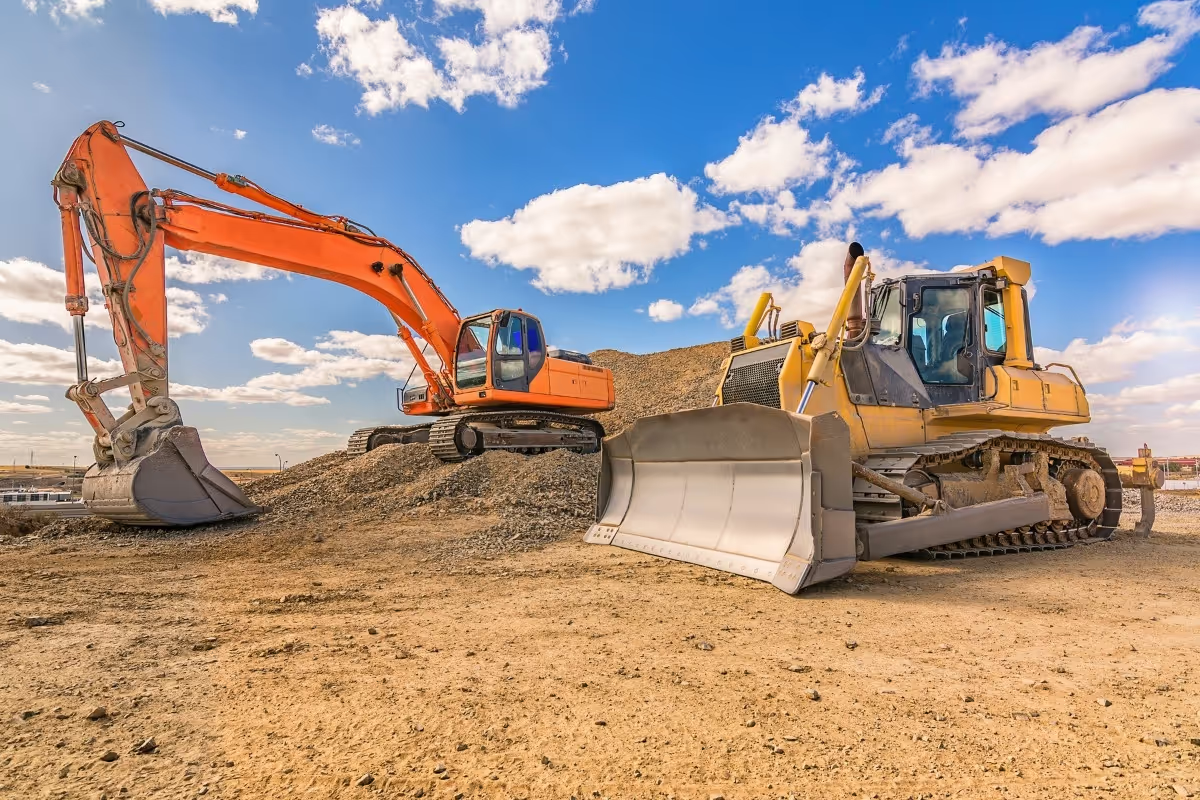
Heavy equipment financing — Excavators, cranes, logging equipment, chippers, loaders, and large industrial machinery for construction, forestry, and industrial operations across the Mauricie region.
Refinancing and sale-leaseback — If you own equipment outright or have equity in it, a sale-leaseback converts that equity into working capital without selling the asset. In Quebec, refinancing transactions through certain programs require a vendor of convenience — an important procedural detail covered below.
Asset-based lending — For larger capital requirements backed by a portfolio of equipment or receivables. Common for mid-size manufacturers and forestry operators with significant asset bases.
Equipment line of credit — A revolving draw facility for businesses that finance equipment on a recurring basis — useful for contractors cycling assets between seasons or operators adding to a fleet regularly.
Invoice and freight factoring — Converts outstanding invoices into immediate working capital. Factoring approval is based primarily on your customers' creditworthiness — not yours — so Credit-review practices vary by factoring provider. Useful for Trois-Rivières carriers and forestry operators managing 30–60 day receivables from large commercial or government customers.
Working capital loans — Short-term capital to bridge seasonal gaps, cover operational costs, or manage cash flow between equipment payments and incoming revenue.
Review the eligible equipment guide to confirm what asset types qualify before applying.
This is one of the most important financing nuances for Trois-Rivières businesses — and one that catches operators off guard regularly if they've financed equipment in other provinces before.
Private sales in Quebec are restricted under certain programs. Some financing programs that allow private-sale purchases freely in Ontario, BC, or Alberta do not permit them in Quebec, or require additional documentation steps that change the process. If you're planning to purchase equipment directly from another business or individual in Quebec — rather than from a licensed dealer — confirm program eligibility before committing to the purchase. Not every program available nationally is available for Quebec private-sale transactions.
Refinancing in Quebec requires a vendor of convenience for certain programs. If you own equipment outright and want to refinance it or do a sale-leaseback, some programs require a vendor of convenience (VOC) — a licensed dealer who acts as an intermediary in the transaction to satisfy Quebec's financing registration requirements. This is a Quebec-specific procedural requirement that adds a step to the refinancing process but does not prevent the transaction from completing.
QST (Quebec Sales Tax) applies separately from GST. Unlike Ontario where HST combines federal and provincial tax into a single recoverable amount, Quebec charges GST and QST separately. For most businesses registered for both, both taxes are generally recoverable as input tax credits — but the filing and recovery process is separate for each. Confirm the tax treatment of your specific financing structure with your accountant before signing.
These are genuine Quebec-specific differences that don't appear in any generic Canadian equipment financing guide — and they matter practically for Trois-Rivières operators structuring deals.
One of the most consistent structuring errors we see with forestry equipment operators in Quebec — and across eastern Canada — is financing highly specialized, high-value assets on terms that outlast their productive usefulness in a specific operation. A harvesting head or processor financed on a 72-month term may be mechanically functional at month 60 but operationally obsolete for the type of stand the operator is cutting. Being locked into payments on a unit you've already side-lined is a real cash flow problem.
Our advice for Mauricie forestry operators: match the term to the asset's productive life in your specific operating context — not just its mechanical maximum. A 48-month term that aligns with your timber supply agreement or equipment upgrade cycle is almost always better than a 72-month term chosen to lower the monthly payment. The difference in total interest cost over 24 extra months on a $200,000 harvester is meaningful, and the flexibility to upgrade at month 48 is worth more than the lower monthly number.
If cash flow is genuinely tight, explore seasonal skip-payment structures or pair the equipment financing with an invoice and freight factoring facility to manage receivable gaps — rather than extending the term to compensate.
Illustrative example only; not a statement of a specific funded client transaction.
A Mauricie-based forestry contractor operating harvesting and forwarding equipment in the Laurentian hills had paid off two units over the previous five years. The business was in strong financial health — clean bureau, consistent revenue from a standing timber supply agreement with a regional mill — but needed capital to add a third harvesting unit to take on a new cutting block. Their bank quoted a timeline of six to eight weeks and required a full financial package including audited statements.
The challenge: The new cutting block was available for only a limited season window. Waiting six to eight weeks for bank approval meant losing the block to another contractor. The business needed working capital quickly — and had significant equity sitting in owned equipment.
How Mehmi structured it: We structured a sale-leaseback on one of the two owned units, unlocking the equity as working capital. In Quebec, this required a vendor of convenience to satisfy program registration requirements — a step Mehmi coordinated directly, which was completed as part of the financing process. The proceeds from the sale-leaseback funded the deposit on the new harvesting unit, which was financed separately as a new equipment transaction.
What would have killed it: A business with derogatory bureau history or inconsistent revenue patterns would have required additional documentation that stretched timelines. A refinancing transaction without understanding the vendor of convenience requirement in Quebec would have stalled at the funding stage with a different broker unfamiliar with the province's requirements.
Approval and funding timelines vary by lender, application completeness, and required conditions. New unit financed simultaneously. The contractor mobilized on the new cutting block within the season window, met the mill's delivery schedule, and maintained the supply agreement. The working capital loan option was noted for future use during the spring thaw period when equipment movement is restricted and revenue dips.
Natural resources and energy — Forestry operators, wood processors, and resource sector businesses across the Mauricie and Haute-Mauricie are among the most active equipment financing clients in the region. High-value assets, seasonal revenue, and ongoing capital needs make financing an operational necessity rather than a preference.
Manufacturing and wholesale — Industrial manufacturers in Trois-Rivières' established zones — aluminum processing, chemical products, paper and packaging, and mechanical fabrication — access equipment financing for production upgrades and capacity expansion. See our overview of equipment finance rates in Canada.
Transportation and trucking — Highway 40 and 55 corridor carriers, regional freight operators, and flatbed and reefer fleets using Trois-Rivières as a staging hub between Montréal and Québec City.
Construction and contractors — Residential, commercial, and infrastructure contractors across Trois-Rivières, Cap-de-la-Madeleine, Shawinigan, Drummondville, and the broader Centre-du-Québec region. Read the comprehensive guide to construction equipment financing.
Farming and agriculture — Agricultural producers in the Nicolet and Bécancour plains south of Trois-Rivières access agricultural equipment financing including seasonal payment structures suited to Quebec's crop cycles.
Hospitality and food service — Restaurants, hotels, and food service operators across Trois-Rivières and the Mauricie access kitchen, refrigeration, and service equipment financing.
Medical, dental and wellness — Clinics, dental practices, and wellness operators across Trois-Rivières finance diagnostic and treatment equipment.
Technology and business services — IT infrastructure and production hardware for Trois-Rivières' growing professional and technology services sector, including businesses linked to the Université du Québec à Trois-Rivières ecosystem.
Aviation and aerospace — The Trois-Rivières Airport and regional aviation services access ground support and maintenance equipment financing.
Most equipment financing applications require:
Dealer purchases process fastest — application-only files under $250,000 for businesses with two to three or more years in business and a clean bureau are reviewed according to lender requirements.
Private-sale purchases in Quebec require confirming program eligibility first — not all programs permit Quebec private sales. For eligible programs, the process includes lien search, seller verification, serial number confirmation, and condition photos. Confirm before committing to the purchase.
Refinancing transactions in Quebec require a vendor of convenience through certain programs — a procedural step Mehmi handles directly. Confirm this requirement before initiating a refinancing or sale-leaseback.
Larger files over $250,000 may require financial statements depending on the program. Files over $500,000 typically need three years of accountant-prepared statements plus interim financials. Over $1 million, expect a full structured credit submission.
Factoring files are assessed on your customers' credit — Credit-review practices vary by factoring provider.
Questions before applying Review the FAQ or explore all financing services to understand every option available.
Ready to get your equipment funded in Trois-Rivières? Call us directly at 1-833-863-4644 or apply online to request financing options, subject to lender review.
Related resource: Browse our equipment financing by city directory for more local financing guides.
Q. How fast are equipment financing approvals in Trois-Rivières?A. Approval and funding timelines vary by lender, application completeness, and required conditions. Application-only dealer purchase files under $250,000 with two to three or more years in business and a clean bureau are reviewed according to lender requirements. Quebec-specific requirements — including vendor of convenience for refinancing — are managed by Mehmi and are assessed as part of lender review.
Q. Can I finance private-sale equipment in QuebecA. It depends on the program. Some financing programs that permit private sales freely in other provinces restrict or limit them in Quebec. Confirming program eligibility before committing to a private-sale purchase is important — contact Mehmi with the asset details before you finalize the deal with the seller.
Q. What is a vendor of convenience and when do I need one in QuebecA. A vendor of convenience (VOC) is a licensed dealer who acts as an intermediary in certain Quebec financing transactions — most commonly refinancing and sale-leaseback deals. It's a provincial procedural requirement for some programs, not a cost or complication for the business owner. Mehmi coordinates the VOC step directly when required.
Q. How does QST affect equipment financing in QuebecA. Quebec charges GST and QST separately on equipment purchases and lease payments. Both are generally recoverable as input tax credits for registered businesses, but the filing process is separate for each. The timing of QST recovery on a lease versus a purchase also differs. Confirm the full tax treatment of your specific structure with your accountant before signing.
Q. Are seasonal payment structures available for forestry and agricultural operators in MauricieA. Yes. Qualified operators can access seasonal skip-payment programs that pause or reduce payments during designated off-peak months without penalty or negative credit reporting. These programs are well suited to Mauricie's forestry and agricultural cycles and are worth asking about specifically when applying.
Q. Can older or high-hour forestry and construction equipment qualify for financingA. Yes. Age and condition limits vary by asset class and program. Well-maintained construction equipment commonly qualifies up to 15 model years on stronger profiles. Forestry equipment requires condition documentation and sometimes appraisal — maintenance records and operating history improve approval outcomes significantly for older or high-hour specialized units.
Q. Can I refinance equipment I already own in Trois-RivièresA. Yes. A refinancing or sale-leaseback converts equity in owned equipment into working capital without requiring a sale. In Quebec, certain programs require a vendor of convenience for this transaction — Mehmi manages this step directly. Supported on qualifying hard assets up to a reasonable percentage of current market value.
Q. What documents do I need to applyA. For most files: bank statements, government ID, business registration including Quebec enterprise number, and an equipment quote or bill of sale. Quebec private-sale files require program eligibility confirmation before submission. Refinancing files may require a vendor of convenience. Files over $250,000 may require financial statements depending on the program and your credit profile.

.svg)