
This page covers equipment financing in Vancouver, British Columbia — who qualifies, what structures are available, how approvals work, and what local businesses need to know before applying. Vancouver is Canada's third-largest city and its most active Pacific gateway, with a dense concentration of construction, transportation, marine, technology, and natural resource businesses that require fast, practical financing decisions. Approval and funding timelines vary by lender, application completeness, and required conditions.
Vancouver moves more freight, breaks more ground, and finances more equipment than any other city in western Canada. The Port of Vancouver is the largest in Canada by tonnage — a gateway for Pacific trade that feeds a deep supply chain of carriers, logistics operators, warehousing businesses, and industrial contractors across the Lower Mainland. Construction cranes are a permanent feature of the skyline. The technology sector anchors entire districts in Mount Pleasant and Gastown. And resource-sector operators — forestry, marine, energy — are headquartered here even when their work happens across BC and beyond.
Approval and funding timelines vary by lender, application completeness, and required conditions. Whether you're a carrier managing freight lanes out of the port, a contractor on a Burnaby high-rise, a tech operator scaling production infrastructure in East Van, or a hospitality business upgrading for the next wave of tourism growth, Mehmi structures financing around how your business operates — not just what your balance sheet looked like last year.
Equipment can be sourced from Lower Mainland dealerships, private sellers, auctions, out-of-province, or internationally through port-entry. High-hour and older units commonly qualify when they continue generating stable revenue.
Use the equipment payment calculator to model monthly payments before you apply.
When buying or refinancing business assets in Vancouver, compare the structure and total ownership cost—not just the monthly payment. Availability and terms depend on equipment, business credit, cash flow and individual lenders.
| Equipment funding need | Option to compare | What to verify |
|---|---|---|
| Purchasing eligible construction machinery | Equipment loan or conditional sale | Equipment value, term, interest calculation, down payment, collateral, title and early-payout terms. |
| Using equipment while managing initial cash outlay | Equipment lease | Payment schedule, deposits, insurance, end-of-term purchase options, return conditions and total cost. |
| Purchasing from a used-equipment dealer or private seller | Used-equipment financing | Asset age, hours or mileage, inspection, seller verification, lien search and any lender limits. |
| Unlocking equity in owned machinery or vehicles | Equipment refinancing or sale-leaseback | Appraised value, current liens, payout amounts, advance against value, fees and continuing use of the asset. |
| Buying multiple assets or upgrading in stages | Equipment financing facility or separate leases | Each asset's eligibility, draw timing, security, documentation, amortization and combined payment burden. |
Next step: Compare equipment loans, leases and refinancing before requesting indicative terms. Examples above are educational, not offers or approvals.
Vancouver's cost environment is one of the most expensive in Canada for business operations — real estate, labour, and overhead all run significantly higher than the national average. In this context, preserving working capital is not just good financial practice, it's often a survival strategy. Tying up $250,000 in an outright equipment purchase while paying Vancouver commercial lease rates and labour costs can create cash flow fragility that financing avoids entirely.
There are a few patterns specific to Vancouver worth understanding before you structure a deal:
Port-related carriers and logistics operators running freight through the Port of Vancouver face some of the highest utilization rates in the country. Trucks pulling container freight from Deltaport and Centerm often accumulate kilometres faster than inland haul operators — which affects age and kilometre assessments at the underwriting stage. Lenders assess this actively, and documentation around utilization and maintenance history matters more for high-volume port-haul assets.
Construction contractors in Metro Vancouver — working on everything from North Shore residential to Surrey mixed-use to Burnaby transit-oriented development along the SkyTrain corridors — need equipment decisions that match project award timelines. A contractor who wins a tender on a Monday and needs equipment mobilized by the following week can't wait three weeks for a bank credit committee.
Technology and creative economy businesses in Vancouver's dense innovation districts — Mount Pleasant, False Creek Flats, Yaletown — often require production hardware, studio equipment, and specialized tooling on shorter cycles than traditional equipment. Equipment leasing options are well suited here, giving businesses the flexibility to upgrade rather than hold depreciating assets.
Natural resource and forestry operators headquartered in Vancouver but operating across BC rely on specialized, high-value equipment — logging, road-building, marine harvest gear — that requires lenders comfortable with both the asset class and the operating environment. Not all programs serve this space; Mehmi works specifically with programs that do.
For operators who want ownership from day one, equipment loans provide a straightforward path — fixed payments, equity build, and the option to refinance later.
Lenders assess five core factors — character, capacity, capital, collateral, and conditions — and the strength of your file across all five determines what gets approved, on what terms, and at what rate.
Character is your track record. Years in business, commercial bureau history, and whether bank statements show consistent, well-managed deposits. Documentation requirements vary by lender, transaction size, business history, and credit profile. Vancouver's competitive business environment produces many newer businesses — a strong deposit, personal guarantee, verified contract revenue, or a co-signer can support files that fall below standard thresholds.
Capacity is whether your revenue comfortably supports the proposed payment. For Vancouver carriers, cash flow coverage of at least 1.05x existing obligations is a common benchmark. A business with verified freight contracts, signed construction project agreements, or demonstrable recurring revenue presents a much cleaner capacity picture than a file with irregular deposits and no supporting documentation.
Capital is your equity position. Down payments vary by risk profile and asset type. Stronger, established files often require little to nothing upfront. Higher-risk profiles — younger businesses, challenged credit, or specialized assets with thin secondary markets — may require 10–25%. In Vancouver's high-cost environment, a meaningful deposit also signals to lenders that the business has genuine operating reserves.
Collateral is the asset itself. Lenders assess age, condition, and secondary market value in the current BC market. For transport assets, kilometre thresholds are applied carefully — port-haul trucks accumulate mileage faster than most, and some programs cap eligibility at 800,000 km for standard units. Construction equipment commonly qualifies up to 15 model years on stronger profiles. Forestry and marine assets require more documentation due to thinner resale markets.
Conditions cover the deal structure — term (typically 24–84 months, with up to 96 months available on some new vocational and construction assets), advance amount, and documentation thresholds. Larger transactions may require additional financial statements, interim reporting, projections, or other underwriting documents depending on the lender and file.
Thresholds above reflect typical patterns across Mehmi's financing programs. Requirements vary by program and file.
Equipment loans — Full ownership from day one. Fixed payments, equity build, and the asset on your balance sheet. Best for long-lived assets Vancouver businesses plan to keep — heavy equipment, commercial kitchen builds, industrial machinery.
Equipment leasing — Lower upfront cost with end-of-term flexibility — return, renew, or purchase. Works well for technology, hospitality, and production assets where equipment cycles faster than useful life. CCA classification should be confirmed with your accountant.
Conditional sales contracts — Fixed payments with a nominal buyout at the end. A clean ownership path commonly used for yellow iron, commercial vehicles, and industrial assets across Metro Vancouver.
Truck and trailer financing — Purpose-structured for Vancouver-area carriers running port-haul routes from Deltaport and Centerm, regional distribution across the Lower Mainland, and long-haul lanes up the Trans-Canada and Highway 1 corridor.
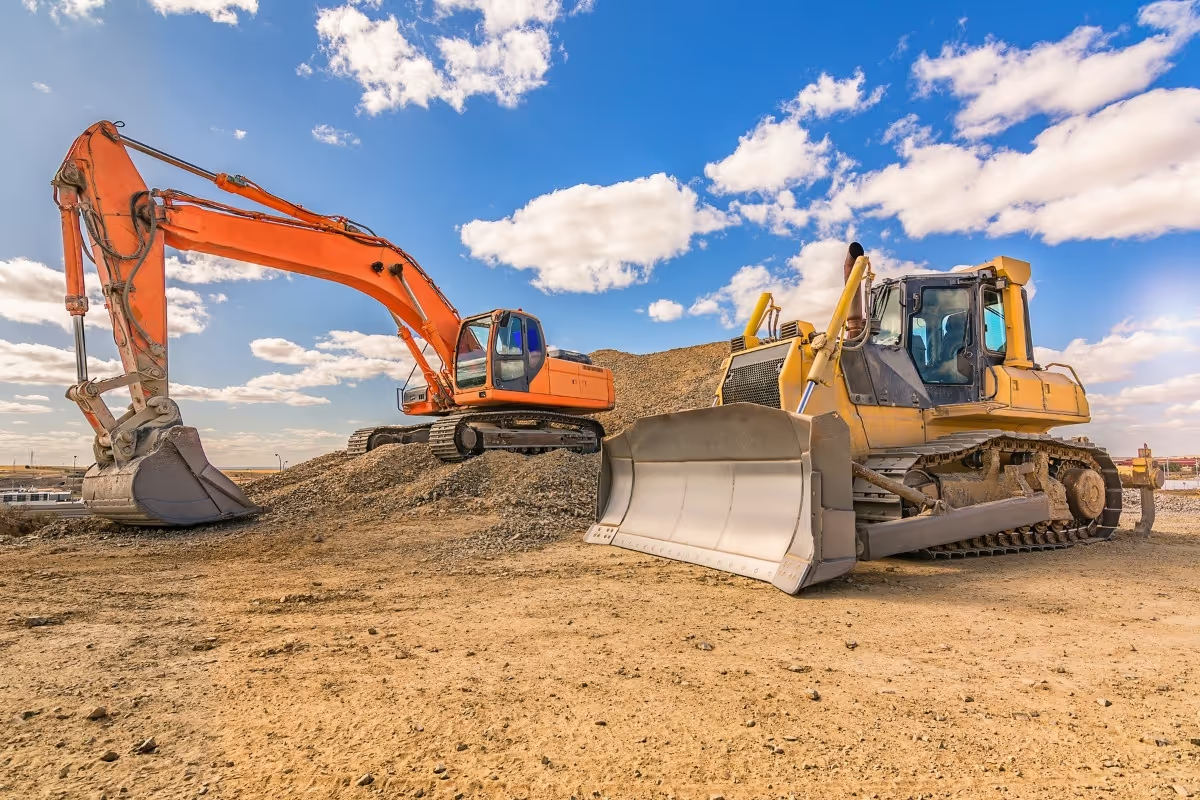
Heavy equipment financing — Excavators, cranes, compactors, pavers, and large industrial machinery for Metro Vancouver's active construction and infrastructure sector.
Refinancing and sale-leaseback — If you own equipment outright or have equity in it, a sale-leaseback converts that equity into working capital without requiring a sale. Supported on qualifying hard assets up to a reasonable percentage of current market value. Particularly relevant for Vancouver businesses that made large equipment purchases and now need operating capital in a high-cost environment.
Asset-based lending — For larger capital requirements backed by a portfolio of equipment or receivables. Common for mid-size and larger operators with significant asset bases across the Lower Mainland.
Equipment line of credit — A revolving draw facility for businesses that finance equipment on a recurring basis — useful for fleet operators, contractors cycling assets across multiple projects, and businesses with ongoing capital equipment needs.
Invoice and freight factoring — Converts outstanding invoices into immediate working capital. Factoring approval is based primarily on your customers' creditworthiness — not yours — so Credit-review practices vary by factoring provider. Particularly useful for Vancouver carriers and contractors waiting 30–60 days on port authority, government, or large commercial receivables.
Working capital loans — Short-term capital to cover operational gaps, bridge periods, or manage cash flow between equipment payments and incoming revenue in a market where overhead runs high.
Review the eligible equipment guide to confirm what asset types qualify before applying.
This is a financing nuance that applies specifically to carriers operating out of Port of Vancouver container terminals — Deltaport in Delta and Centerm and Vanterm on Burrard Inlet. Port-haul drayage routes are short by highway standards but extremely high-frequency. A truck pulling containers between terminals and rail yards or distribution centres in Burnaby, Surrey, and Coquitlam can accumulate 150,000–200,000 km annually — roughly double the rate of a standard highway carrier running longer, less frequent runs.
This matters at the underwriting stage because lenders set kilometre thresholds as part of their collateral assessment. A port-haul truck that's three years old may already have 450,000–600,000 km on it — which can affect eligibility and terms under certain programs. Some programs cap standard transport assets at 800,000 km; others are more flexible with documented maintenance history.
The practical approach for Vancouver port-haul operators: keep detailed maintenance records, have engine rebuild documentation current where applicable, and discuss utilization history upfront when applying. A well-documented high-mileage unit is a fundamentally different file from an undocumented one — and the difference can mean the difference between approval and a decline.
British Columbia charges Provincial Sales Tax (PST) at 7% on equipment purchases and on certain lease structures — and BC's PST framework differs significantly from Ontario's HST model. For most businesses in BC, PST paid on equipment is not recoverable as an input tax credit the way Ontario HST is for HST registrants.
For a Vancouver business purchasing $200,000 worth of equipment, the PST component is $14,000 — a real, unrecoverable cost for most commercial buyers that affects how a deal should be structured. Some exemptions exist for specific industries and asset types, but they are narrower than many operators assume.
This is a material consideration when comparing a lease versus a purchase structure. Under some lease programs, PST is applied to each periodic payment rather than the full capital cost upfront — which affects both cash timing and total tax cost. Confirm the PST treatment on your specific asset class and business structure with your accountant before committing to either structure.
We'll say it directly: in Vancouver, the case for leasing equipment over buying outright is stronger than almost anywhere else in Canada — and it comes down to the cost of capital in this market.
When commercial real estate runs $40–$60 per square foot, labour costs are among the highest in the country, and operational overhead is structurally elevated, the opportunity cost of tying up $300,000 in an owned asset is genuinely higher than it is in Regina or Sault Ste. Marie. That same $300,000 deployed as working capital in a Vancouver operation covers more months of payroll, more raw materials, more buffer against a slow quarter.
Leasing preserves that capital. It also keeps your balance sheet cleaner for other borrowing — a consideration for Vancouver businesses that frequently need working capital lines alongside equipment financing.
The counter-argument is tax efficiency: CCA deductions on owned equipment can be meaningful, particularly with accelerated investment incentive provisions still available in Canada. But for most small to mid-size Vancouver operators, the working capital benefit of a lease outweighs the incremental tax benefit of ownership — especially when the alternative is a cash purchase that depletes reserves in a market with little margin for error.
Use the amortization calculator to model both scenarios side by side before you decide.
Illustrative example only; not a statement of a specific funded client transaction.
A Lower Mainland drayage carrier with seven years in business was awarded a new container-movement contract from a freight forwarder at Centerm. The contract required two additional day-cab tractors to be operational within three weeks of signing — a timeline that ruled out their primary bank, which had an eight-to-ten week commercial credit process.
The challenge: Both units the carrier had identified were four-year-old tractors with approximately 500,000 km each — well within their operational prime for port-haul use, but at a kilometre level that requires careful program placement. The carrier's financials were strong, but one of the principals had a historical personal credit blemish from a business closure five years prior.
How Mehmi structured it: We identified programs that assessed port-haul utilization in context — recognizing that 500,000 km on a well-maintained drayage tractor in four years reflects normal operation, not abuse. The historical credit blemish was addressed through a detailed write-up explaining the circumstances and demonstrating the intervening five years of clean commercial history. Three months of bank statements confirmed strong, consistent freight revenue. The new Centerm contract was included as supporting documentation for capacity.
What would have killed it: Submitting the file without context on the kilometre accumulation rate would have triggered a standard age-and-mileage decline. A file without clean bank statements or without explanation of the prior credit event would have required either a larger deposit or a co-signer to proceed.
Approval and funding timelines vary by lender, application completeness, and required conditions. The carrier had both tractors operational before the contract start date. The invoice and freight factoring facility was activated simultaneously to manage the 45-day receivable cycle on the new contract, ensuring the carrier could cover fuel and driver costs without waiting on the freight forwarder to pay.
Transportation and trucking — Port-haul carriers, regional distributors, long-haul operators, and logistics businesses across Metro Vancouver and the Lower Mainland. See our overview of trends in commercial truck financing in Ontario for broader context on how the market is moving.
Construction and contractors — Metro Vancouver's construction activity is among the most sustained in Canada. Residential, commercial, mixed-use, and infrastructure projects across Burnaby, Surrey, North Vancouver, Coquitlam, and the City of Vancouver all rely on reliable equipment access. Read the comprehensive guide to construction equipment financing.
Natural resources and energy — Forestry operators, marine resource businesses, and energy sector companies headquartered in Vancouver access specialized equipment financing for high-value, operationally critical assets across BC.
Technology and business services — Production hardware, server infrastructure, studio and creative equipment, and specialized tooling for Vancouver's dense technology and creative economy sector.
Manufacturing and wholesale — Food processing, fabrication, and industrial operations across East Vancouver, Burnaby, and the Surrey industrial corridor.
Hospitality and food service — Restaurants, hotels, and catering businesses across Metro Vancouver access kitchen, refrigeration, and service equipment financing. Vancouver's hospitality sector is one of the most active in Canada.
Medical, dental and wellness — Clinics, dental practices, imaging centres, and wellness operators across Greater Vancouver finance diagnostic and treatment equipment.
Farming and agriculture — Agricultural operations in the Fraser Valley — Surrey, Langley, Abbotsford, Chilliwack — access agricultural equipment financing including seasonal payment structures.
Aviation and aerospace — Vancouver International Airport, helicopter operators, float plane services, and aerospace MRO businesses access ground support and maintenance equipment financing.
Most equipment financing applications require:
Dealer purchases process fastest — application-only files under $250,000 for businesses with two to three or more years in business and a clean bureau are reviewed according to lender requirements.
Private-sale purchases require an additional verification step — lien search, seller ID, serial number confirmation, and condition photos — but are fully supported. For high-mileage transport assets, maintenance records and any engine rebuild documentation should be prepared in advance.
Larger files over $250,000 may require financial statements depending on your profile. Files over $500,000 typically need three years of accountant-prepared statements plus interim financials. Over $1 million, expect a full structured credit submission including receivables, payables, and financial projections.
Factoring files are assessed on your customers' credit — Credit-review practices vary by factoring provider.
Questions before applying Review the FAQ or browse all financing services to understand every option available.
Ready to get your equipment funded in Vancouver? Call us directly at 1-833-863-4644 or apply online to request financing options, subject to lender review.
Related resource: Browse our equipment financing by city directory for more local financing guides.
Q. How fast are equipment financing approvals in Vancouver?A. Approval and funding timelines vary by lender, application completeness, and required conditions. Application-only files under $250,000 with two to three or more years in business and a clean bureau are reviewed according to lender requirements — even for complex files involving high-mileage port-haul assets or private-sale purchases.
Q. Do high-mileage port-haul trucks qualify for financing in VancouverA. Yes, with the right documentation. Port-haul drayage trucks accumulate kilometres faster than highway units — this is normal operating context, not a red flag. Detailed maintenance records, engine rebuild documentation where applicable, and a clear explanation of utilization history are the key to getting these files placed correctly.
Q. Does BC PST apply to equipment purchases and leases in VancouverA. Yes. BC charges PST at 7% on equipment purchases and on some lease structures. Unlike Ontario's HST, BC PST is generally not recoverable as an input tax credit for most commercial buyers. This is a real cost that affects deal structuring — confirm the treatment on your specific asset class with your accountant before signing.
Q. Is leasing better than buying for Vancouver businessesA. In many cases, yes — particularly in Vancouver's high-cost operating environment where preserving working capital has a higher opportunity value than most other Canadian cities. Leasing also keeps the balance sheet cleaner for other borrowing. That said, owned equipment provides CCA deductions that can be meaningful depending on your tax position. Use the amortization calculator to model both options before deciding.
Q. Can I finance forestry or marine equipment through Mehmi in VancouverA. Yes. Forestry and marine assets are financeable through programs that understand these asset classes — but they require more documentation than standard yellow iron or transport assets due to thinner secondary markets. Condition reports, appraisals where applicable, and detailed equipment history improve outcomes significantly.
Q. Do I need strong personal credit to qualifyA. Not necessarily. Cash flow and business revenue carry significant weight alongside credit history. Prior credit blemishes that are well-explained and distant in time are regularly overcome with strong current financials. Factoring files are assessed entirely on your customers' creditworthiness — Credit-review practices vary by factoring provider.
Q. Can I refinance equipment I already own in VancouverA. Yes. A refinancing or sale-leaseback converts equity in owned equipment into working capital without requiring a sale. Supported on qualifying hard assets up to a reasonable percentage of current market value — particularly useful in Vancouver where operational overhead is high and working capital is valuable.
Q. What documents do I need to applyA. For most files: bank statements, government ID, business registration, and an equipment quote or bill of sale. Private-sale files add condition photos and seller verification. High-mileage transport files benefit from maintenance records. Files over $250,000 may require financial statements depending on the program and your credit profile.

.svg)