This page covers equipment financing in Pickering, Ontario — who qualifies, what structures are available, how approvals work, and what local businesses need to know before applying. Pickering is Durham Region's western gateway — a city of over 100,000 anchored by the Pickering Nuclear Generating Station on Lake Ontario's north shore, one of the GTA's most active residential development corridors in the Seaton community, the Highway 401/407 ETR commercial and industrial spine, and a growing Durham Region manufacturing and logistics base. Most approvals take 24–48 hours once documents are complete.

Pickering is the city where Toronto ends and Durham begins — the first municipality east of Scarborough on Highway 401, where the GTA's urban density gives way to the mixed residential-industrial character that defines Durham Region's western edge. It is also the home of the Pickering Nuclear Generating Station, Ontario's second-largest nuclear facility after Darlington, which has provided baseload power to Ontario's grid since 1971 and which anchors an industrial maintenance, nuclear services, and specialized trades sector that gives Pickering an economic character entirely different from the residential-suburban cities to its west.
Equipment financing in Pickering typically returns an approval within 24–48 hours once your documents are complete. Whether you're an industrial maintenance contractor working on the Pickering NGS refurbishment and maintenance schedule, a construction contractor building in the Seaton community — Pickering's 70,000-resident greenfield development north of Taunton Road — a manufacturer or logistics operator in the Highway 401/407 industrial corridor, a carrier running Highway 401 east toward Whitby and Oshawa or connecting to the 407 ETR, or a healthcare or dental practice serving Pickering's growing population, Mehmi structures financing around how Durham Region's industrial economy actually operates.
Equipment can be sourced from Durham Region and GTA dealers, private sellers, or auctions. High-hour and older units qualify regularly when they continue generating stable revenue and are properly documented.
Use the equipment payment calculator to model monthly payments before you apply.
Pickering's economy creates distinct financing patterns across three sectors with very different revenue profiles.
Nuclear and industrial maintenance contractors serving the Pickering NGS — OPG (Ontario Power Generation) and its subcontractor network, including specialized trades, scaffolding and insulation companies, industrial cleaning operators, hydrovac and vacuum service businesses, welding and pipe fitting contractors, and crane operators — have revenue tied directly to OPG's planned outage schedule and maintenance windows. Like Sarnia's Chemical Valley and Saint John's Irving complex, Pickering NGS maintenance contracts involve large, scheduled work programs with defined scopes and creditworthy obligors. OPG contract documentation — a scope letter, purchase order, or MSA — transforms how files with lumpy bank deposits are read by underwriters unfamiliar with the nuclear services sector.
Construction contractors working on the Seaton community build-out — Canada's largest approved greenfield development, with an eventual built-out population of approximately 70,000 residents north of Taunton Road across Pickering's rural lands — represent a sustained construction pipeline unlike almost anything else in the GTA. Seaton is not a single project; it is a phased 25-year development program spanning multiple landowners, builders, and municipal servicing contracts. Contractors who are active in Seaton have reliable forward workloads that are documented through developer contracts, municipal servicing agreements, and phase approval records.
Highway 401/407 corridor manufacturers and logistics operators — running warehouses, distribution centres, light manufacturing, and fleet operations in Pickering's industrial areas along Squires Beach Road, Brock Road, and the 407 ETR commercial nodes — serve the eastern GTA's supply chain from a location that is increasingly competitive as land values in Scarborough and Ajax have escalated.
For operators who want full ownership from day one, equipment loans provide a clear path — fixed payments, equity build, and refinancing options when working capital is needed.
Lenders assess five core factors — character, capacity, capital, collateral, and conditions — and the strength of your file across all five determines what gets approved, on what terms, and at what rate.
Character is your business track record. Years in operation, commercial bureau history, and whether bank statements reflect consistent, well-managed cash flow. For application-only approvals up to $250,000, most programs require a minimum of two to three years in business with a clean bureau.
Capacity is whether your revenue supports the proposed payment. For nuclear maintenance contractors, OPG contract documentation is capacity evidence from one of Canada's largest Crown corporations — Ontario Power Generation is 100% owned by the Province of Ontario, making it one of the most creditworthy counterparties in Canadian industrial contracting. A scope letter or purchase order from OPG immediately elevates how any file is assessed. For Seaton construction contractors, developer letters of intent and municipal servicing agreements anchor capacity. For 401/407 logistics operators, long-term warehouse or distribution contracts with named clients strengthen larger files.
Capital is your equity position. Down payments vary by risk profile and asset type. Pickering's real estate market — both residential and commercial — has appreciated substantially over the past decade, and homeownership is a meaningful capital indicator for owner-operated businesses.
Collateral is the asset itself. Construction iron has the highly liquid GTA secondary market. Industrial service vehicles — hydrovac trucks, vacuum tankers, welding rigs, cranes — are established assets in Ontario's industrial service sector with active secondary markets.
Conditions cover the deal structure — term (typically 24–84 months), advance amount, and documentation thresholds. Files over $250,000 may require financial statements. Files over $500,000 typically need three years of accountant-prepared statements plus interim financials.
Thresholds above reflect typical patterns across Mehmi's financing programs. Requirements vary by program and file.
Equipment loans — Full ownership from day one. Fixed payments, equity build, and the asset on your balance sheet. Best for long-lived industrial service, construction, and manufacturing assets Pickering businesses plan to keep.
Equipment leasing — Lower upfront cost with end-of-term flexibility — return, renew, or purchase. Ontario's 13% HST applies to lease payments — ITCs are fully recoverable for HST-registered businesses.
Conditional sales contracts — Fixed payments with a nominal buyout at the end. A common ownership path for commercial vehicles, construction iron, and industrial service assets throughout Ontario.
Truck and trailer financing — For Pickering carriers running Highway 401 east and west across Durham Region, the 407 ETR east-west connection, and distribution routes serving Durham Region's growing residential and industrial base.
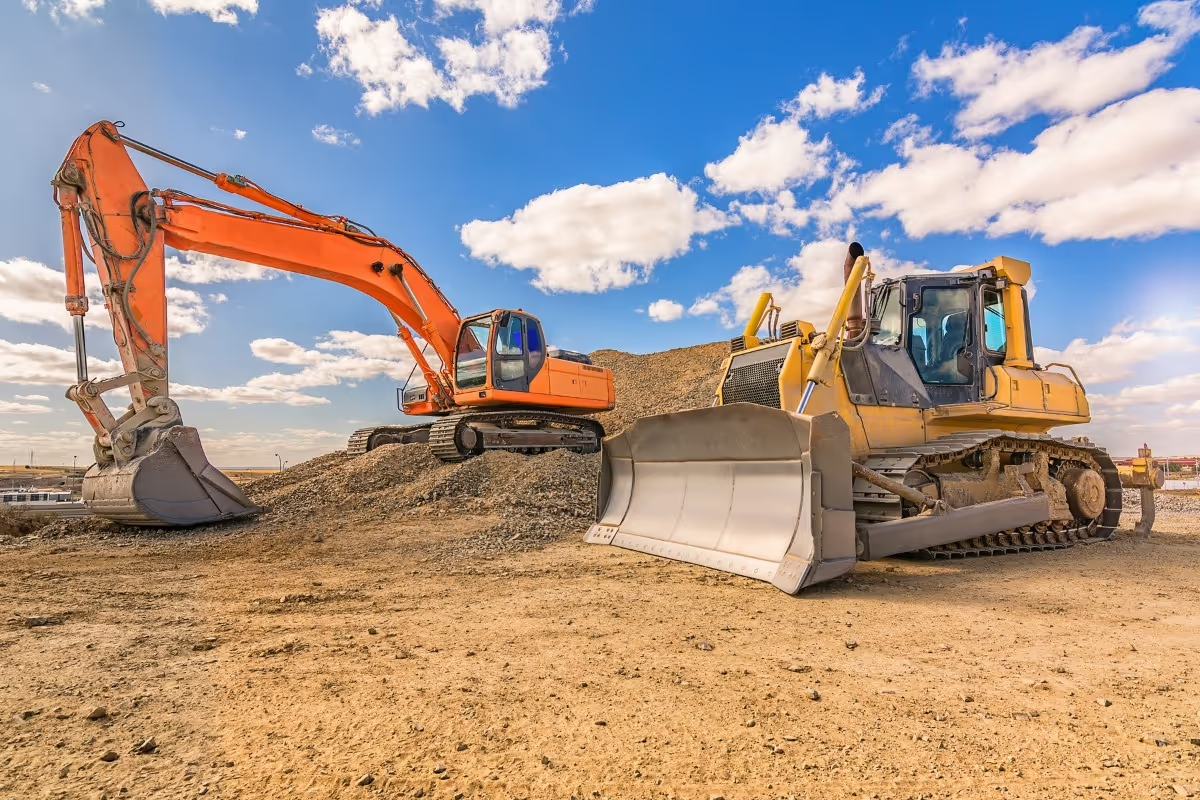
Heavy equipment financing — Excavators, concrete pumps, tower cranes, compactors, and construction assets for Pickering's Seaton development, commercial construction, and civil infrastructure projects.
Refinancing and sale-leaseback — Converts equity in owned equipment into working capital without requiring a sale. Useful for Pickering nuclear contractors and construction companies who have built equity across multiple operational cycles.
Asset-based lending — For larger capital requirements backed by a portfolio of equipment or receivables. Relevant for established Pickering industrial maintenance and construction operations.
Equipment line of credit — A revolving draw facility for businesses financing equipment on a recurring basis — useful for nuclear contractors cycling assets across OPG outage windows or Seaton builders adding fleet by development phase.
Invoice and freight factoring — Converts outstanding invoices into immediate working capital. Factoring approval is based primarily on your customers' creditworthiness — not yours. Particularly valuable for Pickering nuclear subcontractors managing 30–60 day payment cycles from OPG prime contractors.
Working capital loans — Short-term capital to bridge between OPG contract milestone payments, cover Seaton project mobilization costs, or manage timing between equipment delivery and first invoice.
Review the eligible equipment guide to confirm what asset types qualify before applying.
This is the operational reality specific to Pickering's nuclear services sector that contractors new to the OPG subcontractor ecosystem consistently underestimate — and it affects equipment financing timelines in a specific way.
Working at the Pickering NGS requires nuclear security clearances through OPG's contractor management program and the Canadian Nuclear Safety Commission (CNSC) regulatory framework. Personnel clearances are distinct from corporate registration — individual workers require site security cards, radiation worker training, and in many cases fitness-for-duty assessments before they can set foot on the protected area.
The equipment financing side of this is straightforward: Mehmi can approve a hydrovac truck, a vacuum tanker, or a crane truck in 24–48 hours. OPG's contractor onboarding process for new suppliers, however, operates on its own timeline — typically four to twelve weeks for a new contractor to complete corporate qualification, insurance verification, and initial personnel clearances. A contractor who wins an OPG subcontract in March, secures equipment financing in April, and then discovers that personnel clearances won't be completed until June has financed equipment that is sitting idle for two months generating payment obligations without revenue.
The practical advice: if you are a Pickering industrial contractor pursuing OPG work for the first time — or expanding to a new scope category that requires additional clearances — initiate the OPG supplier qualification process well in advance of bidding, not after winning. The financing will be ready in 48 hours. The clearances will take weeks regardless of how urgently the equipment is needed on-site.
The parallel is exact. OPG is to Pickering what Irving is to Saint John: the dominant industrial employer, the counterparty on the largest contracts in the local economy, and the entity whose payment certainty changes how any file is assessed.
An OPG scope letter or purchase order represents contracted revenue from a Crown corporation that is 100% owned by the Province of Ontario — an obligor whose creditworthiness is essentially sovereign. A hydrovac or vacuum service contractor with an OPG maintenance contract, or a crane operator with an OPG lift assignment, holds forward revenue that is as solid as any commercial contract in Ontario.
The mistake — made consistently across Pickering's nuclear contractor community — is not including the OPG documentation in the financing application. Bank statements that show large, irregular deposits around OPG outage windows followed by quiet periods look, to an unfamiliar underwriter, like an unstable business. With the OPG contract in the file, those deposits are immediately recognizable as scheduled outage income from a creditworthy Crown corporation.
Include OPG contract documentation — a scope letter, purchase order, or MSA — with every initial financing submission. If the documentation is from an OPG prime contractor rather than directly from OPG, include that as well. The capacity story is in the contract, not the bank statement.
The application-only equipment financing guide up to $500K provides useful reference on documentation preparation at different transaction sizes.
A Pickering-based industrial hydrovac and vacuum service contractor had been providing safe excavation and industrial cleaning services at the Pickering NGS for five years, operating two units under an OPG maintenance MSA. An expanded scope was awarded for the upcoming Unit 4 outage, requiring three hydrovac units simultaneously on-site for a six-week maintenance window.
A third hydrovac unit was available from a Durham Region dealer at $410,000.
The challenge: The file exceeded application-only thresholds and required financial statement review. The OPG outage start date was fixed — nuclear outage schedules are not negotiable. The contractor's bank statements showed the characteristic nuclear contractor pattern: large deposits concentrated around outage windows followed by quieter inter-outage periods.
How Mehmi structured it: The file was submitted with the OPG expanded scope letter confirming the three-unit requirement, the outage window, and the estimated contract value; three years of accountant-prepared financial statements; and three months of bank statements. The OPG scope letter led the submission, establishing capacity from a Crown corporation counterparty before the underwriter reached the financial statements.
What made it work: The scope letter transformed the bank statement pattern from apparent irregularity to recognizable scheduled outage income. The financial statements corroborated five years of consistent contracting history with OPG. The equipment was a standard hydrovac from an approved dealer, requiring no third-party inspection.
The outcome: Approval in three business days. Equipment delivered before the outage start date. The contractor fulfilled the six-week scope on schedule, was retained for the Unit 5 outage the following year, and expanded to a fourth unit twelve months later. The invoice and freight factoring facility was noted as a complementary tool for managing the 45-day payment cycle typical of OPG prime contractor invoicing.
Pickering's nuclear services, construction, manufacturing, transportation, and health services economy generates a distinctive equipment financing profile. These are the asset types we see most frequently, each linked to its specific financing page:
Nuclear & Industrial Services
Construction (Seaton & General)
Manufacturing & Precision
Transportation
Medical & Dental
Natural resources and energy — Nuclear services contractors, industrial maintenance firms, and energy sector service businesses working under OPG contracts at the Pickering NGS and across Ontario's nuclear supply chain.
Construction and contractors — Seaton community residential and civil construction; commercial and industrial development along the Highway 401/407 corridor; and municipal infrastructure projects throughout Pickering and Durham Region. See the comprehensive guide to construction equipment financing.
Transportation and trucking — Highway 401 long-haul carriers, industrial service transport, Seaton construction supply logistics, and distribution operators serving Durham Region's growing residential and commercial base.
Manufacturing and wholesale — Light industrial manufacturers, precision fabricators, and distribution businesses in Pickering's Highway 401/407 industrial corridor.
Medical, dental and wellness — Rouge Valley Health System (now Lakeridge Health Ajax Pickering) anchors the regional health services sector. Dental practices, clinics, and wellness businesses across Pickering access diagnostic and treatment equipment financing.
Technology and business services — Professional services and technology businesses in Pickering's commercial corridors, including firms supporting OPG's operations and Durham Region's growing institutional economy.
Hospitality and food service — Restaurants and food service operators along Kingston Road and Pickering's commercial corridors access kitchen, refrigeration, and service equipment financing.
Aviation and aerospace — Nuclear and advanced manufacturing businesses in Pickering's industrial zones that supply precision components to Ontario's aerospace and defence supply chain.
Most equipment financing applications require:
For OPG nuclear contractor files: OPG scope letters, purchase orders, or Master Service Agreements should be included as the lead document in every initial submission. This is the single most important documentation step for Pickering nuclear services operators.
For Seaton construction files: developer letters of intent or municipal servicing agreements alongside bank statements confirm forward workload on phased development project files.
Note on nuclear clearance timelines: OPG contractor onboarding and personnel clearances typically take four to twelve weeks for new suppliers. Initiate this process before bidding on OPG work — the financing will be ready in 48 hours; the clearances take longer regardless of urgency.
Dealer purchases process fastest — application-only files under $250,000 with two to three or more years in business and a clean bureau often return same-day decisions.
Private-sale purchases require lien search, seller verification, serial number confirmation, and condition photos — fully supported and typically adds no more than 24 hours when documentation is complete.
Larger files over $250,000 may require financial statements depending on your profile. Files over $500,000 typically need three years of accountant-prepared statements plus interim financials.
Questions before applying? Review the FAQ or explore all financing services to understand every option available.
Ready to get your equipment funded in Pickering?Call us directly at 437-777-5901 or apply online today to get an approval in 24–48 hours.
Q. How fast are equipment financing approvals in Pickering?A. Most complete files are approved within 24–48 hours. Application-only files under $250,000 with two to three or more years in business and a clean bureau often return same-day decisions. Nuclear contractor files with OPG contract documentation typically return decisions within 48–72 hours even for larger files, as OPG's creditworthiness significantly simplifies capacity assessment.
Q. Does having an OPG contract help my equipment financing application?A. Significantly. Ontario Power Generation is 100% owned by the Province of Ontario — its contracts represent committed revenue from a Crown corporation with essentially sovereign creditworthiness. An OPG scope letter or purchase order is the strongest capacity document in Durham Region's industrial financing market. Always include it with your initial submission.
Q. My bank deposits are irregular because they concentrate around OPG outage windows. Will lenders flag this?A. Not if you include the OPG contract documentation. Nuclear outage revenue concentration is a well-documented pattern for OPG contractors — but bank statements alone don't explain it. The OPG contract does. Without it, large irregular deposits look unstable. With it, they are immediately recognizable as scheduled outage income. See the Mehmi's Take section above.
Q. What is the OPG contractor clearance timeline and how does it affect my equipment financing?A. New OPG contractors typically require four to twelve weeks for corporate qualification and initial personnel clearances before personnel can access the protected area at Pickering NGS. The financing can be completed in 48 hours — but the clearances cannot be accelerated. If you are pursuing OPG work for the first time, initiate the supplier qualification process before you bid, not after you win.
Q. I'm building in the Seaton community — what documents strengthen my application?A. Developer letters of intent, phase approval records, or municipal servicing agreements alongside bank statements provide the forward workload evidence that accelerates approvals on phased development projects. Seaton's multi-phase structure means active participants typically have documented forward workloads — include that documentation.
Q. Can I refinance industrial service equipment I already own?A. Yes. A refinancing or sale-leaseback converts equity in owned equipment into working capital without requiring a sale. Supported on qualifying hard assets up to a reasonable percentage of current market value.
Q. What documents do I need to apply?A. For nuclear contractor files: OPG scope letter, purchase order, or MSA as the lead document, plus bank statements, government ID, business registration, and equipment quote. For Seaton construction files: developer letter of intent plus bank statements. Files over $250,000 may require financial statements. All files need an equipment quote or dealer invoice.